 |
| Zond 5 Reaches Moon Zond 5 rounds the Moon and heads for Earth after the first Lunar Circumnavigation Credit: © Mark Wade. 11,168 bytes. 489 x 145 pixels. |
| astronautix.com | Soviet Manned Lunar Projects Part 2 |
|
| Zond 5 Reaches Moon Zond 5 rounds the Moon and heads for Earth after the first Lunar Circumnavigation Credit: © Mark Wade. 11,168 bytes. 489 x 145 pixels. |
The N1-L3 - by N1 to the Moon - 1964 to 1970
Returning to 3 August 1964, Command number 655-268 issued by Central Committee of Communist Party gave Korolev the objective of putting one man on the moon and returning him safely to earth - ahead of the Americans (who had begun over three years earlier, in April 1961). To achieve this aim a large part of the industry had to be mobilised. It would require design of what was designated the L3 complex, with the combined launch vehicle/spacecraft termed the N1-L3. The L3 would utilise the same lunar orbit rendezvous method to achieve moon landing as was selected for the Apollo program. By upgrading the N1 from a 75 tonne to a 95 tonne payload capacity it was felt possible that a single N1 launch could accomplish the mission. The L3 complex itself, with a total mass of 95 tonnes, would consist of a fourth stage (Block G) for the N1 to take the L3 from low earth orbit to trans-lunar trajectory; a lunar orbiter with a Soyuz re-entry capsule for return to earth (LOK); a lunar lander (LK) for the landing of a single cosmonaut on the surface of the moon; and a deceleration stage (Block D) which would brake the L3 complex into low earth orbit and then take the LK lander to near zero velocity above the surface of the moon.
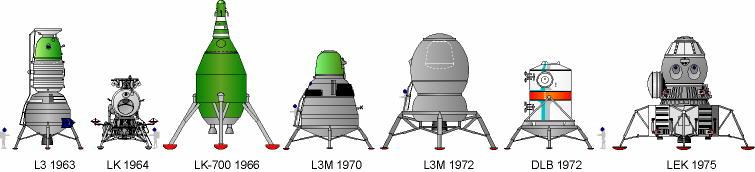 | Soviet Lunar Landers - Comparison of Soviet lunar lander designs. Only the LK reached the hardware stage. 23,098 bytes. 755 x 172 pixels. |
In what was only to be the first stage of a sustained campaign, single cosmonauts would land on the lunar surface. However this would be just part of a larger mission with the following objectives:
 | LOK Lunar Orbiter - The Soyuz 7K-LOK lunar orbiter spacecraft to be used in the L3 lunar landing project complex. Credit: © Mark Wade. 19,358 bytes. 497 x 178 pixels. |
 | LK Lunar Lander - LK lunar lander. 19,698 bytes. 306 x 338 pixels. |
 | Early LK Test Model - Dynamic Test Model of Early LK Concept. Credit: © Mark Wade. 58,518 bytes. 354 x 458 pixels. |
 | DLB Stow/Unstowed - View of DLB Soviet lunar base modules as they would appear in short transport configuration and in inflated, telescoped deployed configuration. 14,830 bytes. 597 x 157 pixels. |
The work for the L3 project was split as follows:
 | Zvezda / DLB base - Zvezda / DLB long-tern lunar base Credit: Spetsmash. 14,792 bytes. 320 x 218 pixels. |
 | Zvezda / DLB module - Basic module for Zvezda / DLB long-tern lunar base 10,212 bytes. 279 x 140 pixels. |
By September 1964 construction began of the first N1 launch pad (LC110R). On October 13, while Voskhod 1 was in orbit, Khrushchev was removed from power and Brezhnev's faction assumed control of Politburo. The advance design project for the N1-L3 was completed in collaboration with Kuznetsov's OKB-586 on 30 December 1964. The decree for production of 16 shipsets of spacecraft and boosters was issued on 26 January 1965. The N1-L3 was to manufactured to the following schedule: 4 in 1966; 6 in 1967; and 6 in 1968. The plan was for the first launch of the N1 to be in the first quarter of 1966, with the first lunar landings in 1967 to 1968, ahead of the American goal of 1969.
 | DLB Lunar Base - Models of Elements of Zvezda Lunar Base Credit: © Mark Wade. 24,363 bytes. 605 x 191 pixels. |
The project continued. In February 1966 construction started of the second N1 launch pad (LC 110L). By November the first N1 hardware arrived at Baikonur and construction of the 1M1 full-size mock-up of the launch vehicle began. On 16 November 1966 another Keldysh-headed expert commission considered the state of the programme. With Korolev dead, once again Glushko, Chelomei, and Yangel advocated development of the UR-700 or R-56 in lieu of the N1. Chelomei, smarting from cancellation of his LK-1 project, offered an LK-700 direct flight manned lander in lieu of the L3. While it was agreed that engine development and studies of these alternate approaches could continue, the February 1967 government decree approved Mishin's draft plan for the first lunar landing.
 | DLB Module Deployed - View of the DLB Soviet lunar base modules as they would appear deployed on the lunar surface. 11,895 bytes. 619 x 135 pixels. |
In February assembly of the first N1 began at the Progress plant in Samara. By the end of summer the first N1 launch pad (LC110R) was completed. Assembly of the first 1M1 mock-up was nearing completion at the MIK assembly building at Baikonur. In September 1967 the EU-28and EU-29 test models of the second and third stages began hot firing tests on their test stands at Samara. On 25 November 1967 the 1M1 mock-up was first erected on LC-110R.
 | DLB Lunar Base - Models of Elements of Zvezda Lunar Base Credit: © Mark Wade. 59,585 bytes. 640 x 262 pixels. |
 | L3M - Cutaway View - Cutaway views of early and later L3M manned lunar lander designs. 26,904 bytes. 629 x 336 pixels. |
Against this failure, the Apollo program was achieving success after success in bimonthly missions. While beating the Americans to a moon landing was now clearly impossible, a dual unmanned mission was devised, which, if successful, would have stolen a little of the American's thunder. The plan was for the next N1 to launch an unmanned 7K-L1S spacecraft on a loop around the moon. It would take multi-spectral photographs of the lunar surface and far side. Meanwhile, a Proton rocket would launch an unmanned Ye-8 soil return spacecraft. This would soft land on the moon, deploy a core drill which would take a small sample of lunar regolith. Deposited in a small spherical re-entry capsule, this then would automatically be returned to earth.
 | L3M - External views of early and later L3M manned lunar lander designs. 22,843 bytes. 630 x 340 pixels. |
 | Vulkan LV - Vulkan Launch Vehicle Credit: © Mark Wade. 1,893 bytes. 94 x 462 pixels. |
 | LEK Model - Model of LEK in Energiya museum - unusual reentry capsule or subsidiary module at its top. Credit: Andy Salmon. 13,184 bytes. 196 x 281 pixels. |
 | LEK Lunar Lander - Lunar lander of the Lunar Expeditionary Complex (LEK). 11,842 bytes. 286 x 232 pixels. |
 | LEK Lunar Lander - LEK LK moon lander Vulkan-launched Credit: © Mark Wade. 1,436 bytes. 159 x 129 pixels. |
 | LZhM lunar habitat - LZhM Laboratory-Residence Module Credit: © Mark Wade. 1,538 bytes. 156 x 155 pixels. |
The Zvezda DLB - 1964 to 1974
It may be recalled that the N1 draft project of 1962 spoke as well of 'establishment of a lunar base and regular traffic between the earth and the moon'. Korolev raised the matter informally at tea with Chief Designer of rocket complexes Vladimir Pavlovich Barmin, head of GSKB SpetsMash (State Union Design Bureau of Special Machine-Building). Barmin was interested in pursuing the subject, but how could such a base be placed on the moon. 'You juste design the base', Korolev assured him, 'and I'll figure out how to get it there'. The project was known to SpetsMash as the 'Long-term Lunar Base' (DLB) and to OKB-1 as 'Zvezda'. Consideration was given to using the same elements in expeditions to other planets. Under the DLB studies SpetsMash defined purposes of the base, the principles of its construction, phases of its deployment and composition of its scientific and support equipment. The enthusiasts that worked on the project at Zvezda were naturally known as 'lunatics'.
 | Lunokhod LEK Credit: © Mark Wade. 2,009 bytes. 248 x 155 pixels. |
Ambitious articulated mobile nuclear-powered Lunokhod laboratories would take the cosmonauts from the landing sites on long-duration traverses of the lunar surface. The Lunokhods were equipped with core samplers and manipulators so that the crew could conduct collection of surface samples from within the pressurised cab without the need to always exit the ship and conduct surface operations in space suits. One of the main objectives of the base would be the location and mining of Helium-3 for use in nuclear fusion reactors on earth. Rare on the earth, Helium-3 was abundant on the moon, having collected in the regolith from the solar wind.
 | N1 6L liftoff Credit: RKK Energia. 12,810 bytes. 310 x 240 pixels. |
The nine modules would be pre-equipped in the factory for specialised functions: command module, laboratory/warehouse module, workshop module, midpoint module, medical/gymnasium module, galley module with dining room, and three living modules. A prototype of one of these modules was used in 1967 for a one-year closed-cycle living experiment at the IBMP (Institute for Bio-Medical Problems). Based on the results of this experiment it was planned that the units on the moon would have a false window, showing scenes of the Earth countryside that would change to correspond with the season back in Moscow. The exercise bicycle was equipped with a synchronised film projector, that allowed the cosmonaut to take a 'ride' out of Moscow with return. These psychological measures were felt important to maintain the crew's mental health.
 | Cutaway of N1 Credit: RKK Energia. 5,227 bytes. 67 x 240 pixels. |
By 1971 the lunar city project was practically complete and Chief Designer Barmin arranged a meeting with Secretary Ustinov, head of all military and space rocketry. He brought along two of this 'lunatics', Aleksandr Yegorov and Vladimir Yeliseyev. The project was defended in a marathon meeting - nine presentations over six hours. At the conclusion, Ustinov agreed that the project should go ahead - but he couldn't decide, at the pace of a walk or the speed of a freight train. In the event, the point was moot. The N1 never successfully flew, and the rocket, and its associated projects, were cancelled in May 1974. In any case, the Soviet economy very likely could never have sustained the cost of the project - 80 billion dollars in 1997 prices.
 | LZM lunar factory Credit: © Mark Wade. 1,998 bytes. 214 x 155 pixels. |
 | 2 N1s Mounted on Pad Credit: RKK Energia. 22,643 bytes. 337 x 239 pixels. |
Concurrent with DLB studies, OKB-1 was already developing more powerful versions of the N1 to launch heavier payloads to the moon. The N1 growth study S. P. Korolev had signed shortly before his death had foreseen the wide use of oxygen-hydrogen propellants in modified versions of the N1 launch vehicle.
It will be recalled that the 1965 study foresaw development of a Block V-II Lox/LH2 replacement for the Block B second stage of the N1. At OKB-276 N. D. Kuznetsov led a project to develop a liquid oxygen/liquid hydrogen version of the NK-15V engine with a flight thrust of 200 tonnes for use in this modernised version of the second stage of the N1. However Kuznetsov was having enough difficulty in completing satisfactory development of the conventional version of this engine for use in the basic N1 and his 200 tonne engine did not reach the hot firing test stage.
 | N1 5L Explosion - Final explosion of N1 5L, destroying pad. Credit: RKK Energia. 15,200 bytes. 310 x 238 pixels. |
Isayev set about adapting the 11D56 engine, with a vacuum thrust of 7.5 tonnes, for the Block R. This engine had originally been designed in the early 1960's for use in the third stage of an uprated Molniya-L launch vehicle. The new Block R for the N1 was to have an empty mass of 4.3 tonnes, a maximum fuel load of 18.7 tonnes, and would have been 8.7 m long and 4.1 m in diameter.
 | N1 5L Falls Back - Having just cleared the towr, N1 5L falls back onto the pad at a 45 degree agnle. Credit: RKK Energia. 9,379 bytes. 311 x 240 pixels. |
First hot firings of the 11D56 on the test stand began in June 1967. Both the 11D56 and 11D57 engines successfully completed their state development test series.
At the Tsniimash museum in Korolev a photograph is displayed of a dynamic test model of an N1 configuration that has been called N1M. This model shows an N1 first stage, with a Block V-III second stage, and Blocks S and R third and fourth stages. Calculations indicate that a two stage Block A / Block V-III N1 would have a low earth orbit payload comparable to that of the basic N1 (around 95 tonnes). Evidently this configuration was considered as an alternative to a conventional three stage N1 for launching the L3M complex into low earth orbit.
 | N1 5L clears tower - N1 5L Clears the tower but falters as the KORD system incorrectly shuts down engines. Credit: RKK Energia. 10,577 bytes. 306 x 238 pixels. |
 | N1 5L liftoff - Engine ignition of N1 5L. Credit: RKK Energia. 13,195 bytes. 311 x 239 pixels. |
 | N1 7L liftoff - N1 7L rises over the apartment blocks of the workers that built it Credit: RKK Energia. 18,831 bytes. 306 x 240 pixels. |
Full go-ahead to develop a liquid hydrogen/liquid oxygen high energy upper stage for the N1F finally came in June 1970. The decision was made to develop a multi-engine Block Sr with a propellant mass of 66.4 tonnes. This single stage would be used in place of the previously-planned Blocks S and R to insert spacecraft of what was now termed the Lunar Expeditionary Complex (LEK) into low lunar orbit. It was also to be used to insert heavy spacecraft into geosynchronous orbit and on interplanetary trajectories.
 | N1 subassemblies - N1 tank sections were built in Samara, then shipped to Baikonur for assembly of the launch vehicle. Credit: RKK Energia. 15,820 bytes. 307 x 240 pixels. |
 | N1 stages - N1 stages in teh assembly hall Credit: RKK Energia. 24,949 bytes. 332 x 240 pixels. |
The Vulkan LEK - 1974 to 1976
Although the N1, L3, and Zvezda projects were cancelled, Glushko still considered the establishment of a moon base to be a primary goal for his country. While the Americans had achieved the first moon landing, it was known that all moon flights after Apollo 17 had been cancelled. There existed an opportunity, through establishment of a permanent moon base, to steal the lead in the space race once again. Furthermore, analysis of the results of the previous unmanned and manned indicated that the moon was suited for a variety of 'special investigations', and that a permanent lunar expeditionary complex (LEK) would be required to accomplish this.
 | N1 tank assembly - Subassmeblies from Samara were built up into stage bulkheads on assembly jigs at Baikonur. Credit: RKK Energia. 16,696 bytes. 310 x 240 pixels. |
The Vulkan was designed to deliver 230 tonnes into a 200 km low earth orbit; 60 tonnes to lunar orbit; and 22 tonnes to the lunar surface.
 | N1 boattail assembly - Base of N1 first stage in assembly jig Credit: RKK Energia. 23,032 bytes. 310 x 240 pixels. |
The expeditionary and transport craft consisted of:
 | Energia-launched LOK - LOK Lunar Orbiter (Energia-launched) Credit: © Mark Wade. 2,214 bytes. 163 x 137 pixels. |
The equipment of the permanent base station consisted of:
 | LEK LK moon lander - LEK LK moon lander Energia-launched Credit: © Mark Wade. 1,875 bytes. 159 x 164 pixels. |
Delivery of the components of the LEK would be in three stages:
The LEK study and initial Vulkan design were completed by the end of 1975. However the Academy of Sciences Expert Commission decided that the LEK Project should be deferred into the next century. Soon thereafter all of NPO Energia's efforts were directed to support development of the reusable launch vehicle Energia/Buran.
The Energia LEK - 1976 to 1978
A modified version of the LEK was proposed in the 1980's using the Energia launch vehicle. Because of the much lower payload capability of the Energia (88 tonnes to low earth orbit versus the 230 tonnes of the Vulkan) this would use a new LOK lunar orbital spacecraft (unrelated to the earlier Soyuz-based LOK) and an LK lander based on the Vulkan LEK lander. The LOK and LK lander would be inserted into lunar orbit by separate Energia launches. As in the earlier projects, prior to the Energia launches an unmanned Lunokhod would scout the region, allowing selection of a suitable landing site, and serve as a landing beacon for the precision LK landing. After rendezvous and docking in lunar orbit, three of the five crew aboard the LOK would transfer to the LK and descend to the lunar surface. After 5 to 10 days on the surface, the ascent stage of the LK would return to lunar orbit, and the crew would transfer back to the LOK. The LOK would remain in lunar orbit for a full lunar day (29 days) until returning to earth. This proposal did not attract support and further development of the concept was not continued.
Thus, with a whimper, ended manned lunar base studies in Russia.