
Credit: © Mark Wade. 6,988 bytes. 60 x 430 pixels.
| astronautix.com | Proton 8K82K / DM3 |
|
| Proton 8K82K / 11S86 - Proton 8K82K / 11S86 Block DM launch vehicle - cutaway drawing showing arrangement of N2O4 oxidiser tanks (green) and UDMH fuel tanks (orange) in Proton, and Liquid oxygen (blue) and kerosene (pink) tanks in the Block DM stage. Block DM guidance package is housed in the light brown compartment above the LOX tank. Credit: © Mark Wade. 6,988 bytes. 60 x 430 pixels. |
This four stage version has a guidance unit in the fourth stage, which reduces payload but does not require the spacecraft's guidance system to provide steering commands to booster. Fourth stage is a 'Block DM-2M' / 11S861-01 modified for insertion of Hughes HS-601 bus spacecraft into geosynchronous orbit.
Launches: 15. Failures: 1. Success Rate: 93.33% pct. First Launch Date: 08 April 1996. Last Launch Date: 01 October 2000. Payload: 1,880 kg. to a: geosynchronous orbital trajectory. Liftoff Thrust: 902,100 kgf. Total Mass: 712,460 kg. Core Diameter: 4.2 m. Total Length: 59.0 m. Launch Price $: 70.00 million. in 1994 price dollars.
Geostationary at 19.3E.
Geosynchronous. Stationed over 58.0W. Used HS-601 XIPS ion engine for station keeping.
Geosynchronous. Stationed over 23.9E
The spacecraft was left in a high inclination useless orbit by a failure of the DM-3 stage and became an insurance writeoff. Two trips around the Moon to remove the inclination under its new owner (Hughes) saw it back into very limited service (as HGS-1) by August 1998 over the Indian Ocean and available for sale at bargain rates.
 | Proton with Granat - Proton with Granat payload Credit: Lockheed Martin. 18,616 bytes. 356 x 446 pixels. |
The first burn of the Proton's Block DM3 put the spacecraft into a 220 x 36,007 km x 51.6 deg transfer orbit. Astra 2A satellite was a Hughes HS-601, owned by Societe Europeene de Satellites, based in Luxembourg. Luxembourg has not registered any of the Astra satellites with the United Nations, in violation of treaty requirements. Geostationary at 28.3 degrees E. Used HS-601 XIPS ion engine for station keeping.
The Proton launch vehicles Block DM3 fourth stage put the Panamsat PAS 8 into a 6784 km x 35941 km x 17.3 degree transfer orbit. PAS 8 had 24 C-band and 24 Ku-band transponders and was to be located over the Pacific after its R-4D apogee engine manoeuvred the orbit to geostationary altitude and inclination. Geostationary at 166.1 degrees E.
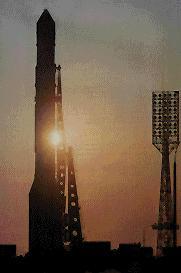 | Proton sunrise Credit: Lockheed Martin. 6,963 bytes. 181 x 273 pixels. |
A replacement for Asiasat 3, placed in the wrong orbit by a Proton launch in 1997, Asiasat 3S carried C and Ku band transponders. The Blok DM3 upper stage placed it a 9,677 km x 35,967 km x 13.1 deg geosynchronous transfer orbit. Asiasat's on-board R4D apogee engine was to be used to raise perigee to geostationary altitude. Mass in transfer orbit was 3,463 kg, down to 2,500 kg after insertion in geostationary orbit. Stationed at 105 deg E.
Telesat Canada's Nimiq television broadcasting satellite was placed into a 7050 km x 35790 km x 15.9 degree transfer orbit. The Nimiq was to use its liquid apogee engine (Royal Ordnance Leros 1) to reach geosynchronous orbit. Telesat Canada also operated the Anik Canadian domestic communications satellites, the first of which was launched in 1972.
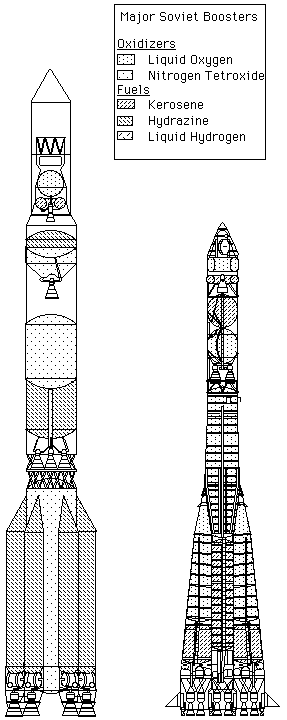 | R-7 vs Proton - R-7 / Proton LVs Cutaway Credit: © Mark Wade. 10,191 bytes. 287 x 720 pixels. |
Geosynchronous communications satellite. Stationed at 19 deg E.
Geosynchronous communications satellite. Stationed at 75 deg E.
Geosynchronous communications satellite for the ACES consortium (PSN of Indonesia, PLDT of the Phillipines, Lockheed Martin, and Jasmine of Thailand). The satellite had two large 12-m diameter L-band antennae for cellular telephone relay. Stationed at 123 deg E.
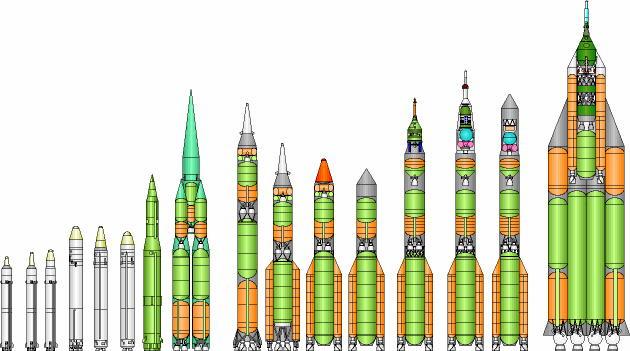 | Universal Rockets - Chelomei's Universal Rocket Family. From left to right: UR-200. Original UR-500 configuration, composed of clustered UR-200's. Conventional UR-500 monoblock configuration. Selected UR-500 polyblock configuration. UR-500 two-stage configuration as flown. UR-500K configuration with Block D upper stage. Credit: © Mark Wade. 36,031 bytes. 630 x 351 pixels. |
Sirius Radio's Sirius 2 was launched into a 144 x 168 km x 64.8 deg parking orbit. The Blok DM3 stage then made two burns to deliver Sirius 2 to an elliptical 6192 x 47057 km x 63.4 deg orbit. The was to provide digital radio broadcasts to mobile users in North America. Stationed at 64 deg W.
Ku-band communications satellite to provide broadcast services for eastern Asia. Stationed at 108 deg E.