This page no longer updated from 31 October 2001. Latest version can be found at www.astronautix.com
 |
| Proton 8K82K / 11S86 - Proton 8K82K / 11S86 Block DM launch vehicle - cutaway drawing showing arrangement of N2O4 oxidiser tanks (green) and UDMH fuel tanks (orange) in Proton, and Liquid oxygen (blue) and kerosene (pink) tanks in the Block DM stage. Block DM guidance package is housed in the light brown compartment above the LOX tank. Credit: © Mark Wade. 6,988 bytes. 60 x 430 pixels. |
|
Family: UR. Country: Russia. Status: Hardware. Other Designations: Proton / Block DM2. Library of Congress Designation: D-1e. Department of Defence Designation: SL-12. Article Number: 8K82K. Manufacturer's Designation: UR-500K.
This four stage version has a guidance unit in the fourth stage, which reduces payload but does not require the spacecraft's guidance system to provide steering commands to booster. Fourth stage is a 'Block DM-5' / 17S40 modified for insertion of multiple LM 700 (Iridium) spacecraft into medium earth orbit.
SpecificationsLaunches: 3. Failures: 0. Success Rate: 100.00% pct. First Launch Date: 18 June 1997. Last Launch Date: 07 April 1998. LEO Payload: 5,000 kg. to: 777 km Orbit. at: 86.0 degrees. Liftoff Thrust: 902,100 kgf. Total Mass: 708,410 kg. Core Diameter: 4.2 m. Total Length: 59.0 m. Launch Price $: 70.00 million. in 1994 price dollars.
- Stage Number: 1. 1 x Proton K-1 Gross Mass: 450,510 kg. Empty Mass: 31,100 kg. Thrust (vac): 1,067,659 kgf. Isp: 316 sec. Burn time: 124 sec. Isp(sl): 267 sec. Diameter: 4.2 m. Span: 7.4 m. Length: 21.2 m. Propellants: N2O4/UDMH No Engines: 6. RD-253-11D48
- Stage Number: 2. 1 x Proton K-2 Gross Mass: 167,828 kg. Empty Mass: 11,715 kg. Thrust (vac): 244,652 kgf. Isp: 327 sec. Burn time: 206 sec. Isp(sl): 230 sec. Diameter: 4.2 m. Span: 4.2 m. Length: 14.0 m. Propellants: N2O4/UDMH No Engines: 4. RD-0210
- Stage Number: 3. 1 x Proton K-3 Gross Mass: 50,747 kg. Empty Mass: 4,185 kg. Thrust (vac): 64,260 kgf. Isp: 325 sec. Burn time: 238 sec. Isp(sl): 230 sec. Diameter: 4.2 m. Span: 4.2 m. Length: 6.5 m. Propellants: N2O4/UDMH No Engines: 1. RD-0212
- Stage Number: 4. 1 x Proton 17S40 Gross Mass: 14,600 kg. Empty Mass: 3,300 kg. Thrust (vac): 8,670 kgf. Isp: 352 sec. Burn time: 450 sec. Diameter: 3.7 m. Span: 3.7 m. Length: 7.1 m. Propellants: Lox/Kerosene No Engines: 1. RD-58M
Proton 8K82K / DM2 Chronology
1997 Jun 18 - - 14:02 GMT. LV Configuration: Proton 8K82K s/n 390-02 / DM2 s/n 1L. Launch Site: Baikonur . Launch Complex: LC81L.
- Iridium 14 Spacecraft: LM 700. Payload: Iridium s/n SV014. Mass: 689 kg.
Plane 5. Ascending node 294.2 degrees. Not in service.
- Iridium 12 Spacecraft: LM 700. Payload: Iridium s/n SV012. Mass: 689 kg.
Plane 5. Ascending node 294.2 degrees.
- Iridium 9 Spacecraft: LM 700. Payload: Iridium s/n SV009. Mass: 689 kg.
Plane 5. Ascending node 294.2 degrees.
- Iridium 10 Spacecraft: LM 700. Payload: Iridium s/n SV010. Mass: 689 kg.
Plane 5. Ascending node 294 degrees.
- Iridium 13 Spacecraft: LM 700. Payload: Iridium s/n SV013. Mass: 689 kg.
Plane 5. Ascending node 294.2 degrees.
- Iridium 16 Spacecraft: LM 700. Payload: Iridium s/n SV016. Mass: 689 kg.
Plane 5. Ascending node 294.2 degrees.
- Iridium 11 Spacecraft: LM 700. Payload: Iridium s/n SV011. Mass: 689 kg.
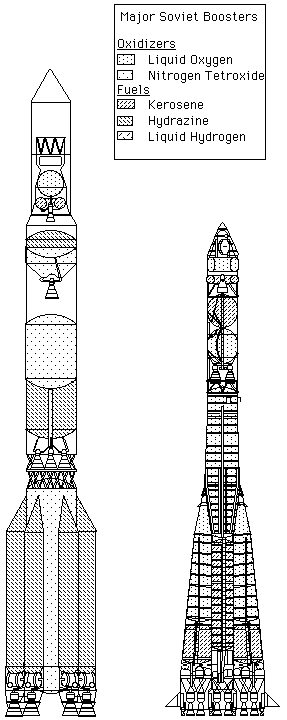
 | R-7 vs Proton - R-7 / Proton LVs Cutaway Credit: © Mark Wade. 10,191 bytes. 287 x 720 pixels. |
Plane 5. Ascending node 294.6 degrees. Not in service.
1997 Sep 14 - - 01:36 GMT. LV Configuration: Proton 8K82K s/n 391-01 / DM2 s/n 2L. Launch Site: Baikonur . Launch Complex: LC81L.
- Iridium 33 Spacecraft: LM 700. Payload: Iridium s/n SV033. Mass: 689 kg.
Plane 3. Ascending node 230.9 degrees.
- Iridium 27 Spacecraft: LM 700. Payload: Iridium s/n SV027. Mass: 689 kg.
Plane 3. Ascending node 223.2 degrees. Failed in low orbit.
- Iridium 28 Spacecraft: LM 700. Payload: Iridium s/n SV028. Mass: 689 kg.
Plane 3. Ascending node 230.9 degrees.
- Iridium 31 Spacecraft: LM 700. Payload: Iridium s/n SV031. Mass: 689 kg.
Plane 3. Ascending node 230.9 degrees.
- Iridium 29 Spacecraft: LM 700. Payload: Iridium s/n SV029. Mass: 689 kg.
Plane 3. Ascending node 230.9 degrees.
- Iridium 30 Spacecraft: LM 700. Payload: Iridium s/n SV030. Mass: 689 kg.
Plane 3. Ascending node 230.8 degrees.
- Iridium 32 Spacecraft: LM 700. Payload: Iridium s/n SV032. Mass: 689 kg.
Plane 3. Ascending node 230.9 degrees.
1998 Apr 7 - - 02:13 GMT. LV Configuration: Proton 8K82K s/n 391-02 / DM2. Launch Site: Baikonur . Launch Complex: LC81L.
- Iridium 65 Spacecraft: LM 700. Payload: Iridium s/n SV065. Mass: 689 kg.
Plane 1. Ascending node 167.9 degrees.
- Iridium 63 Spacecraft: LM 700. Payload: Iridium s/n SV063. Mass: 689 kg.
Plane 1. Ascending node 167.8 degrees.
- Iridium 64 Spacecraft: LM 700. Payload: Iridium s/n SV064. Mass: 689 kg.
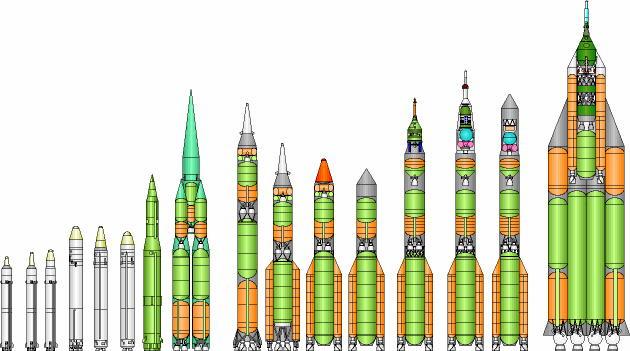
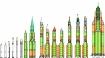 | Universal Rockets - Chelomei's Universal Rocket Family. From left to right: UR-200. Original UR-500 configuration, composed of clustered UR-200's. Conventional UR-500 monoblock configuration. Selected UR-500 polyblock configuration. UR-500 two-stage configuration as flown. UR-500K configuration with Block D upper stage. Credit: © Mark Wade. 36,031 bytes. 630 x 351 pixels. |
Plane 1. Ascending node 167.6 degrees.
- Iridium 68 Spacecraft: LM 700. Payload: Iridium s/n SV068. Mass: 689 kg.
The Proton launch vehicle placed the Iridium cluster and the Block DM2 stage into low parking orbit. The DM2 fired twice to enter the deployment orbit and dispensed the seven satellites, which used their own propulsion units to reach operational altitude. The DM2 stage then fired again to deorbit itself, to avoid creating space debris. SV068 placed in Plane 1. Ascending node 167.8 degrees.
- Iridium 67 Spacecraft: LM 700. Payload: Iridium s/n SV067. Mass: 689 kg.
Plane 1. Ascending node 167.8 degrees.
- Iridium 66 Spacecraft: LM 700. Payload: Iridium s/n SV066. Mass: 689 kg.
Plane 1. Ascending node 167.8 degrees.
- Iridium 62 Spacecraft: LM 700. Payload: Iridium s/n SV062. Mass: 689 kg.
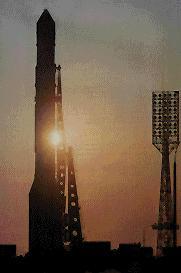
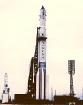 | Proton with Granat - Proton with Granat payload Credit: Lockheed Martin. 18,616 bytes. 356 x 446 pixels. |
Plane 1. Ascending node 167.9 degrees.
Bibliography:- 67 - Kaesmann, Ferdinand, et. al., Journal of the British Interplanetary Society, "Proton - Development of A Russian Launch Vehicle", 1998, Volume 51, page 3.
- 42 - Isakowitz, Steven J,, International Reference to Space Launch Systems Second Edition, AIAA, Washington DC, 1991.
- 151 - Clark, P S, Journal of the British Interplanetary Society, "Soviet Spacecraft Masses for Deep Space Missions", 1985, Volume 38, page 25.
- 219 - Mission Planner's Manual - Proton Commercial Launch Vehicle, Space Commerce Corporation, Houston, TX 1989.
- 274 - Vladimirov, A, Novosti kosmonavtiki, "Tablitsa zapuskov RN 'Proton' i 'Proton K'", 1998, Issue 10, page 25.
Back to Index
Last update 12 March 2001.
Definitions of Technical Terms.
Contact Mark Wade with any corrections or comments.
Conditions for use of drawings, pictures, or other materials from this site..
© Mark Wade, 2001 .