
Credit: © Mark Wade. 1,369 bytes. 76 x 438 pixels.
| astronautix.com | Nova 4L |
|
| Nova NASA 4 F-1 - Credit: © Mark Wade. 1,369 bytes. 76 x 438 pixels. |
Earliest Nova design, using only 4 F-1's, capability less than later Saturn designs.
LEO Payload: 68,000 kg. to: 160 km Orbit. at: 0.0 degrees. Payload: 24,000 kg. to a: translunar trajectory. Liftoff Thrust: 3,437,700 kgf. Total Mass: 3,084,600 kg. Core Diameter: 15.5 m. Total Length: 78.0 m.
NASA signed a definitive contract with Rocketdyne Division, NAA, for $102 million covering the design and development of a single-chamber, liquid-propellant rocket engine in the 1- to l.5-million-pound-thrust class (the F-1, to be used in the Nova superbooster concept). NASA had announced the selection of Rocketdyne on December 12.
After consultation and discussion with DOD, NASA formulated a national space vehicle program. The central idea of the program was that a single launch vehicle should be developed for use in each series of future space missions. The launch vehicle would thus achieve a high degree of reliability, while the guidance and payload could be varied according to purpose of the mission. Four general-purpose launch vehicles were described: Vega, Centaur, Saturn, and Nova. The Nova booster stage would be powered by a cluster of four F-1 engines, the second stage by a single F-1, and the third stage would be the size of an intercontinental ballistic missile but would use liquid hydrogen as a fuel. This launch vehicle would be the first in a series that could transport a man to the lunar surface and return him safely to earth in a direct ascent mission. Four additional stages would be required in such a mission.
NASA issues plan for development in next decade of Vega (later cancelled as too similar to Agena), Centaur, Saturn, and Nova launch vehicles. Juno V renamed Saturn I.
The national booster program, Dyna-Soar, and Project Mercury were discussed by the Research Steering Committee. Members also presented reviews of Center programs related to manned space flight. Maxime A. Faget of STG endorsed lunar exploration as the present goal of the Committee although recognizing the end objective as manned interplanetary travel. George M. Low of NASA Headquarters recommended that the Committee:
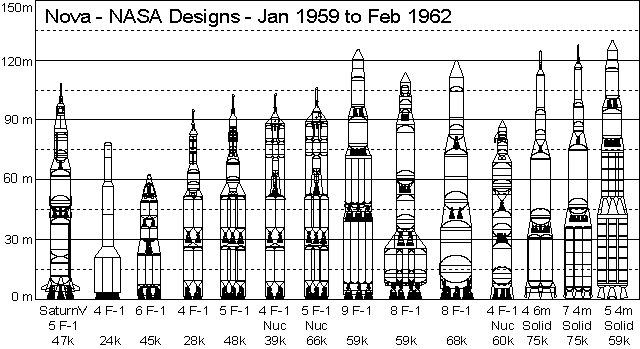 | Nova Concepts - NASA Credit: © Mark Wade. 13,422 bytes. 640 x 349 pixels. |
Committee formed to recommend post-Mercury space program. After four meetings, and studying earth-orbit assembly using Saturn II or direct ascent using Nova, tended to back development of Nova.
The House Committee on Science and Astronautics declared: "A high priority program should be undertaken to place a manned expedition on the moon in this decade. A firm plan with this goal in view should be drawn up and submitted to the Congress by NASA. Such a plan, however, should be completely integrated with other goals, to minimize total costs. The modular concept deserves close study. Particular attention should be paid immediately to long lead-time phases of such a program." The Committee also recommended that development of the F-1 engine be expedited in expectation of the Nova launch vehicle, that there be more research on nuclear engines and less conventional engines before freezing the Nova concept, and that the Orion project be turned over to NASA. It was the view of the Committee that "NASA's 10-year program is a good program, as far as it goes, but it does not go far enough. Furthermore the space program is not being pushed with sufficient energy."
At the first meeting of the Manned Lunar Landing Task Group, Associate Administrator Robert C. Seamans, Jr., Director of the Office of Space Flight Programs Abe Silverstein, and Director of the Office of Advanced Research Programs Ira H. Abbott outlined the purpose of the Group to the members. After a discussion of the instructions, the Group considered first the objectives of the total NASA program:
 | Nova NASA 4 F-1 - Nova NASA 4 F-1 / Nerva Credit: © Mark Wade. 1,786 bytes. 58 x 441 pixels. |
The Manned Lunar Landing Task Group (Low Committee) transmitted its final report to NASA Associate Administrator Robert C. Seamans, Jr. The Group found that the manned lunar landing mission could be accomplished during the decade, using either the earth orbit rendezvous or direct ascent technique. Multiple launchings of Saturn C-2 launch vehicles would be necessary in the earth orbital mode, while the direct ascent technique would require the development of a Nova-class vehicle. Information to be obtained through supporting unmanned lunar exploration programs, such as Ranger and Surveyor, was felt to be essential in carrying out the manned lunar mission. Total funding for the program was estimated at just under $7 billion through Fiscal Year 1968.