This page no longer updated from 31 October 2001. Latest version can be found at www.astronautix.com
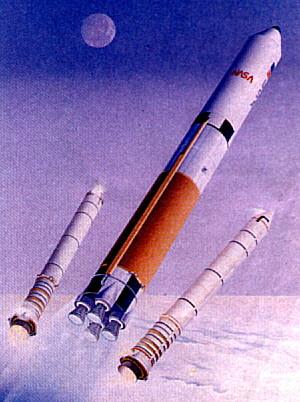 |
| NLS - Martin - NLS - Martin Marietta version utilizing Shuttle Solid Rocket Boosters Credit: Lockheed Martin. 26,153 bytes. 300 x 402 pixels. |
|
Family: ALS/NLS. Country: USA. Status: Study 1991. Other Designations: National Launch System. Manufacturer's Designation: New Launch System.
The New (or National) Launch System (NLS) followed the demise of the ALS and was yet another 1980�s proposal to develop a family of launch vehicles to replace existing �high cost� boosters derived from 1950�s missile designs. This joint NASA/USAF effort was aimed at first launch of an NLS in 2002.
NLS required development of these major new systems:
- STME (Space Transportation Main Engine, a simplified, low-cost LOX/LH2 engine with 295,000 kgf
- Family of three new launch vehicles to covering the payload weight classes expected in the 21st century
- High-energy upper stage to reach geosynchronous orbits and interplanetary trajectories
- Cargo transfer vehicle for transporting payloads to the (then) Space Station Freedom
- New booster processing facilities and launch pads at Cape Canaveral Air Force Station
- Modified and new facilities at the Kennedy Space Center.
Three versions of the NLS were planned:
- NLS-1 heavy-lift vehicle consisting of core vehicle with four liquid-fuelled engines and
two strap-on Solid Rocket Boosters. Payload of 45,000 kg to 400 km/28 degree orbit planned for
Space Station Freedom
- NLS-2 medium-lift vehicle, using only the core vehicle of the NLS-1. Payload capability
of 23,000 kg to low Earth orbit (matching USAF�s heaviest payloads).
- NLS-3 would use a single STME on a lower-diameter core stage, and could deliver 9,000 kg to low earth orbit. This would launch DOD and NASA medium class payloads and was expected to be a competitor in the international communications satellite launcher market
As in the case of the ALS, the NLS was estimated to cost $12 billion range to develop, including $2 billion for the STME engine. Again the development cost could not be recouped in recurring launch costs, and the NLS was terminated in 1991. Boeing attempted to stimulate government interest in development of the �Spacelifter� version of its NLS design but failed. Since development costs were similar to development of a new airliner, Boeing obviously did not feel the actual operating cost of an NLS would be low enough to justify the development cost on a purely commercial basis
SpecificationsLiftoff Thrust: 1,813,510 kgf. Total Mass: 851,732 kg. Core Diameter: 8.7 m. Total Length: 62.0 m. Flyaway Unit Cost $: 89.00 million. in 1985 unit dollars.
- Stage Number: 0. 1 x NLS Semistage Gross Mass: 36,000 kg. Empty Mass: 36,000 kg. Thrust (vac): 1,460,000 kgf. Isp: 425 sec. Burn time: 100 sec. Isp(sl): 350 sec. Diameter: 8.7 m. Span: 9.0 m. Length: 9.0 m. Propellants: Lox/LH2 No Engines: 4. STME
- Stage Number: 1. 1 x NLS Core Gross Mass: 815,732 kg. Empty Mass: 44,757 kg. Thrust (vac): 730,000 kgf. Isp: 430 sec. Burn time: 350 sec. Isp(sl): 360 sec. Diameter: 8.7 m. Span: 8.7 m. Length: 52.0 m. Propellants: Lox/LH2 No Engines: 2. STME
Bibliography:- 238 - Kolcum, Edward H, Aviation Week and Space Technology, "Martin Marietta Poised to Adapt External Tank for NLS Core", 1991-08-26, page 58.
Back to Index
Last update 12 March 2001.
Definitions of Technical Terms.
Contact Mark Wade with any corrections or comments.
Conditions for use of drawings, pictures, or other materials from this site..
© Mark Wade, 2001 .