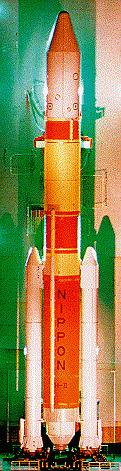
21,293 bytes. 121 x 471 pixels.
| astronautix.com | H-2 |
|
| H-2 - H-2 - COSPAR 1994-007 21,293 bytes. 121 x 471 pixels. |
Launches: 7. Failures: 2. Success Rate: 71.43% pct. First Launch Date: 03 February 1994. Last Launch Date: 15 November 1999. LEO Payload: 10,060 kg. to: 200 km Orbit. at: 30.4 degrees. Payload: 3,930 kg. to a: Geosynchronous transfer trajectory. Liftoff Thrust: 405,000 kgf. Total Mass: 260,000 kg. Core Diameter: 4.0 m. Total Length: 49.0 m. Development Cost $: 2,300.00 million. in 1998 average dollars. Launch Price $: 190.00 million. in 1994 price dollars. Cost comments: Development cost includes $ 800 million spent on LE-7 engine development.
Orbital Reentry Experiment. Orbital Re-entry Experiment Vehicle (OREX) Ryusei. Acquisition of data related to atmospheric reentry. Launch vehicle H-II rocket test flight H-II 1F. Launching organization NASDA. Launch time 2220:00 UT.
Vehicle Evaluation Payload; monitored H-2 performance. Vehicle Evaluation Payload (VEP) MYOJO. Provides a ranging function as well as functions to measure the acceleration and deformation, in order to confirm the accuracy of the H-II rocket orbit injection and understand the environment of the payload equipme nt. Launch vehicle H-II rocket test flight H-II 1F. Launching organization NASDA. Launch time 2220:00 UT.
Failed to reach geostationary orbit; Engineering Test Satellite; partial mission success. Also tested ion engines for NSSK.
Geostationary Meteorological Satellite; carried search and rescue package. Stationed at 140.2 deg E.
Space Flyer Unit; carried materials, astronomy, biological experiments; retrieved by STS-72 1/20/96.
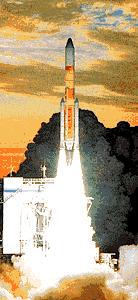 | H-2 Liftoff Credit: NASDA. 11,299 bytes. 138 x 300 pixels. |
The Orihime and Hikoboshi satellites undocked and redocked on July 7 1998 in the FP-1 test of automated docking systems. Despite claims of the NASDA space agency that this is a first, automated Russian craft have docked on many occasions since the Kosmos-186/188 docking in 1968.
Attached to Hikoboshi. It would later separate and serve as a passive docking target for the Hikobishi active automatic docking technology spacecraft.
Kakehashi, meaning 'Bridge', was called Communuications and Broadcasting Experimental Test Satellite (COMETS) before launch. It contained Ka-band communications and inter-satellite data relay payloads. Premature shutdown 44 seconds into the H-II second stage second burn put the satellite into a much lower than planned orbit. The on-board Unified Propulsion System was used to raise it to a more useful orbit.
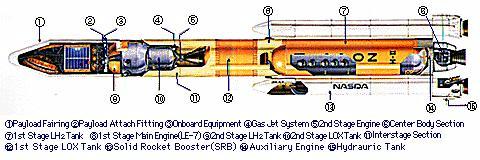 | H-2 Cutaway view Credit: NASDA. 25,477 bytes. 480 x 160 pixels. |
Multi-functional Transportation Satellite intended to provide communications and air traffic control for the Japanese transportation ministry and a meteorological data for the Japanese Meteorological Agency. The spacecraft had a mass of 1223 kg dry and was a follow-on to the GMS (Himawari) weather satellite series.