18,493 bytes. 184 x 402 pixels.
| astronautix.com | H-1 |
|
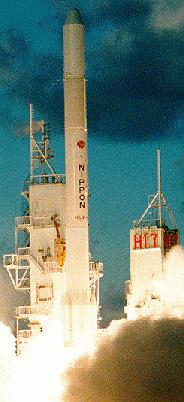
| Nasda H-1 - Nasda H-1 - COSPAR 1987-070 18,493 bytes. 184 x 402 pixels. |
Launches: 9. Failures: 0. Success Rate: 100.00% pct. First Launch Date: 12 August 1986. Last Launch Date: 11 February 1992. LEO Payload: 3,200 kg. to: 185 km Orbit. Payload: 1,100 kg. to a: Geosynchronous transfer trajectory. Liftoff Thrust: 217,380 kgf. Total Mass: 142,260 kg. Core Diameter: 2.5 m. Total Length: 42.0 m. Launch Price $: 90.00 million. in 1990 price dollars.
MABES (Jindai). Experiment on the levitation of the magnetic bearing flywheel under zero-g condition.
Japanese Amateur Satellite. JAS-1 (Fuji). Amateur satellite communications. Development of amateur satellite technology. Launch vehicle H-I (two-stage) test flight no. 1. Launch time 2045 GMT. Launching organization NASDA. Fuji-OSCAR 12 was launched piggyback with a Japanese experimental geodetic satellite Ajisai (EGS). Weight 50 kg. 26-sided polyhedron, 40 x 40 x 47 cm. FO-12 was the first Japanese amateur satellite developed by the Japan Amateur Radio League (English version) with system design and integration performed at NEC. FO-12 was taken out of service November 5, 1989 because of battery failure.
Experimental Geophysical Payload; new launch vehicle test flight. EGS (Ajisai). Improvement of the accuracy of domestic geodetic triangulation network. Determination of accurate location of remote islands. Clarification of the relationship between Japanese geodetic system network and those of other areas of the world. L aunch vehicle H-I (two-stage) test flight no. 1. Launch time 2045 GMT. Launching organization NASDA.
Stationed at 150 deg E. ETS-V (Kiku-5). Establishment of basic technology for bus systems needed for 3-axis stabilized geostationary satellites. Accumulation of key technologies required for high performance in the next generation of applications satellites; Experiment of mobile satellite communications for the control of aircrafts over the Pacific Ocean, and for the communication, navigational aid, search and rescue of ships. H-I (3-stage) launch vehicle. Launching organization NASDA. Launch time 0920 GMT.
Stationed at 132 deg E. CS-3A (Sakura 3-A). To continue communications services provided by the communications satellite 2 (CS-2). To meet increasing and diversifying demands for communications. To develop technologies for communications satellites. Launch vehicle H18F. Launchin g organization NASDA. Launch time 1005 GMT.
Telephone communications; 136 deg E. CS-3B (Sakura 3-B). To continue communications services provided by the communications satellite 2 (CS-2). To meet increasing and diversifying demands for communications; to develop technologies for communications satellites. Launch vehicle H-I (H19F). La unching organization NASDA. Launch time 0959 GMT.
Stationed at 140 deg E. GMS-4 (Himawari-4). Improvement of meteorological observation. Development of meteorological satellite technology. Launch vehicle H-I (H20F). Launching organization NASDA. Launch time 1911 GMT.
Boom, umbrella test. DEBUT 'Orizuru'. Experiment of extending and contracting boom; experiment of expanding and contracting aerodynamic brake. Launching organization NASDA. Launch time 0133 UT.
JAS-1b 'Fuji-2'. Continuation of amateurradio services of JAS-1; extension of amateur radio communications area; advancement of amateur radio technology. Launching organization NASDA. Launch time 0133 UT.
Marine observation. Continuation of Earth observation functions of MOS-1; establishment of common technology necessary for Earth-observation satellites. Launching organization NASDA. Name MOS-1b 'Momo-1b'. Launch time 0133 UT.
Japanese DBS; 110 deg E. Continuation of broadcasting services by BS-2; accommodations to increasing and diversifying demands for broadcasting; establishment of common technology necessary for broadcasting satellite. Launching organization NASDA. Launch time 0905 GMT. BS-3a 'Yuri -3a'.
TV; 110 deg E.
Japanese Research Satellite-1. JERS-1 (FUYO-1). To verify functions and performance of optical sensors and a Synthetic Aperture Radar and to establish an integrated system for observing the Earth's resources; to perform observations and measurements for land survey, agriculture, forest ry, fishery, environmental preservation, disaster prevention and coastal surveillance. Launch time 0150 GMT. Launching organization NASDA. The Japanese Fuyo-1 (ERS-1) satellite failed on Oct 12, 1998 after six years of operation.