17,265 bytes. 180 x 412 pixels.
| astronautix.com | Delta 6925 |
|
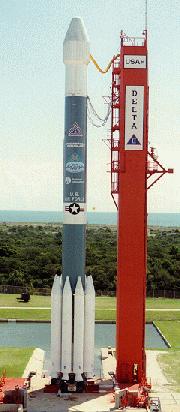
| Delta 6925 no. 199 - Delta 6925 no. 199 - COSPAR 1990-088 17,265 bytes. 180 x 412 pixels. |
Launches: 17. Failures: 0. Success Rate: 100.00% pct. First Launch Date: 14 February 1989. Last Launch Date: 24 July 1992. LEO Payload: 3,981 kg. to: 185 km Orbit. Payload: 1,446 kg. to a: Geosynchronous transfer trajectory. Liftoff Thrust: 354,920 kgf. Total Mass: 218,000 kg. Core Diameter: 2.4 m. Total Length: 38.1 m. Launch Price $: 36.70 million. in 1987 price dollars.
Second generation Global Positioning System. Spacecraft engaged in practical applications and uses of space technology such as weather or communication (US Cat C).
Global Positioning System. Spacecraft engaged in practical applications and uses of space technology such as weather or communication (US Cat C).
Global Positioning System. Spent boosters, spent maneuvering stages, shrouds and other non-functional objects (US Cat D).
Global Positioning System. Spacecraft engaged in practical applications and uses of space technology such as weather or communication (US Cat C).
Global Positioning System. Spacecraft engaged in research and exploration of the upper atmosphere or outer space (US Cat B).
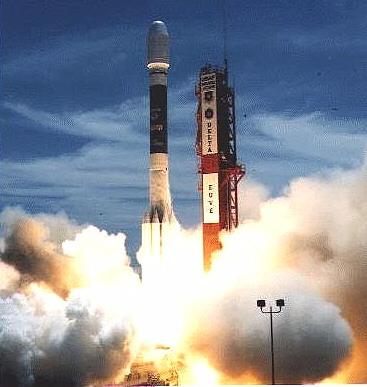 | Delta 7925 Credit: Boeing. 21,299 bytes. 367 x 387 pixels. |
Relay Mirror Experiment; also known as Losat-R. RME validated stabilization, tracking, and pointing technologies for Strategic Defense Initiative (SDI) missions through a credible demonstration of a space-based relay mirror system. The Wideband Angular Vibration Experiment (WAVE) measured low-level angular vibrations affecting performance of acquisition, tracking, and pointing systems. The experiment demonstrated that a laser beam can be accurately relayed from the earth to an orbiting satellite 450 kilometers away and then back to a 3-meter target on the ground. It achieved relay beam pointing accuracy which was 16 times better than the technical requirement. WAVE demonstrated the capability to discern platform disturbance amplitudes of a few nanoradians at discrete frequencies and is therefore a candidate to fulfill similar requirements for future ATP experiments.
Low-power Atmospheric Compensation Experiment for SDIO. Research and exploration of the upper atmosphere and outer space. The McDonnell Douglas Corporation has provided the following information for its launch of the Losat spacecraft on 14 Feb 1990: LACE spacecraft (Losat-L), launch time 1615:00.626 GMT, ETR L aunch Complex 17. Programmed orbital parameters 95.6 min, apogee 551 km, inc. 43.1 deg. Evaluate laser beam distortion in space.
Global Positioning System. Spacecraft engaged in research and exploration of the upper atmosphere or outer space (US Cat B).
 | Delta LV - Delta LV Solid Motor Separation Credit: Boeing. 13,069 bytes. 236 x 318 pixels. |
West German extreme UV, X-ray telescope; all-sky survey.
Global Positioning System. Spacecraft engaged in research and exploration of the upper atmosphere or outer space (US Cat B).
UK DBS; 31 deg W. Direct broadcasting system. Expected operational life 12.5 yr. Owner/operator: British Sky Broadcasting Ltd, 6 Centaurs Business Park, Grant Way, Isleworth, Middlesex TW7 5QD. Sold on-orbit in 1992 to Telenor Norway and redesignated Thor 1.
Global Positioning System. Spacecraft engaged in research and exploration of the upper atmosphere or outer space (US Cat B).
Mobile communications; 64.5 deg E.
Mobile and maritime communications; 15.5 deg W.
Extreme Ultra-Violet Explorer; mapped galactic EUV sources. Spacecraft engaged in research and exploration of the upper atmosphere or outer space (US Cat B).
Measured magnetosphere and Earth's geomagnetic tail. To investigate the structure and dynamics of the geomagnetic tail that extends on the nightside of the Earth. Launch time 1426 GMT. Launching states Japan and the United States of America. Launching organization NASA.
Diffuse Ultraviolet Explorer package bolted to Delta 2 2nd stage.