25,075 bytes. 166 x 434 pixels.
| astronautix.com | Atlas IIAS |
|
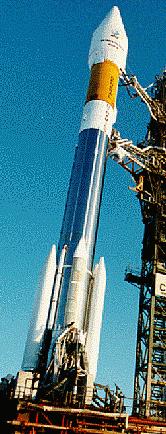
| Atlas 2AS - Atlas 2AS - AC-108 - COSPAR 1993-077 25,075 bytes. 166 x 434 pixels. |
The Atlas II booster was 2.7-meters longer than an Atlas I and included uprated Rocketdyne MA-5A engines. The Atlas I vernier engines were replaced with a hydrazine roll control system. The Centaur stage was stretched 0.9-meters compared to the Centaur I stage. Fixed foam insulation replaced Atlas I's jettisonable insulation panels. Higher performance RL10A-4 (or RL10A-4-1) engines replaced Atlas II's RL10A-3-3A engines. RL10A-4 and RL10A-4-1 engines were offered with or without extendable nozzles (Extendible nozzles increased the engines specific impulse, providing additional performance if required). The Atlas IIAS model added four Thiokol Castor IVA solid rocket boosters (SRBs) to the core Atlas stage to augment thrust for the first two minutes of flight. The first SRB pair was ignited at liftoff and burned for 54 seconds. The second pair was ignited in flight when vehicle loading constraints were satisfied. Both pairs were jettisoned shortly after their respective burnouts. The first Atlas IIAS successfully launched AC-108 / Telstar 401 on 15 December 1993.
Launches: 20. Failures: 0. Success Rate: 100.00% pct. First Launch Date: 16 December 1993. Last Launch Date: 14 July 2000. LEO Payload: 8,610 kg. to: 185 km Orbit. at: 28.5 degrees. Payload: 3,630 kg. to a: Geosynchronous transfer trajectory. Liftoff Thrust: 361,620 kgf. Total Mass: 234,000 kg. Core Diameter: 4.9 m. Total Length: 47.5 m. Launch Price $: 105.00 million. in 1994 price dollars.
Stationed at 97 deg W. Spacecraft engaged in practical applications and uses of space technology such as weather or communication (US Cat C). Launch vehicle put payload into geosynchronous transfer orbit with IFR trajectory option.
Stationed at 176.96 deg E. Launch vehicle put payload into supersynchronous earth orbit with MRS trajectory option.
Stationed at 66.0 deg E. Launch vehicle put payload into supersynchronous earth orbit with MRS trajectory option.
Stationed at 50.1 deg W. Launch vehicle put payload into supersynchronous earth orbit with MRS trajectory option.
8 transponders for digital TV. Stationed at 128.1 deg E. Launch vehicle put payload into supersynchronous earth orbit with IFR/MRS trajectory option.
Solar and Heliospheric Observatory; orbiting at L1 Lagrange point; solar physics. En route Earth-Sun L1 point Earth-Sun L1 libration point transfer trajectory. Inertial trajectory option.
30 C-band, 6 Ku-band transponders. Geostationary at 150.4E. Launch vehicle put payload into supersynchronous earth orbit with IFR/MRS trajectory option.
 | Atlas 2AS Credit: © Mark Wade. 2,685 bytes. 73 x 568 pixels. |
Geosynchronous. Stationed over 144.0E Launch vehicle put payload into supersynchronous earth orbit with IFR/MRS trajectory option.
Geosynchronous. Stationed over 87.1W Launch vehicle put payload into supersynchronous earth orbit with IFR/MRS trajectory option.
Geosynchronous. Stationed over 61.4W Launch vehicle put payload into supersynchronous earth orbit with IFR/MRS trajectory option.
Geosynchronous. Stationed over 79.2W Launch vehicle put payload into geosynchronous transfer orbit with MRS trajectory option. Used HS-601 XIPS ion engine for station keeping.
Geostationary at 40.5 degrees W.
Satellite had 28 C-band and 3 Ku-band transponders, and initially served the Atlantic Ocean region for INTELSAT. Launch vehicle put payload into geosynchronous transfer orbit with GCS trajectory option. Geostationary at 55.5 degrees W.
JCSAT-6 carried a Ku-band relay system. It was operated by Japan Satellite Systems, Inc., Tokyo, provided communications and data relay for Japan and the Pacific Rim. Two burns of the Centaur upper stage placed it into a supersynchronous transfer orbit of 258 km x 96736 km x 24.1 degrees. JCSAT-6's on-board R-4D engine would maneuver it into its final geostationary location. Dry mass of the spacecraft was 1230 kg. Stationed at 124 deg E
Communications satellite is for the European Telecommunications Satellite Organization. The vehicle entered a 153 km x 385 km x 27.4 deg parking orbit nine minutes after launch. The second Centaur stage burn delivered the satellite to a 166 km x 46,076 km x 19.7 deg super-synchronous transfer orbit. The satellite was stationed at 7 deg E and carried 24 Ku-band transponders with a wide beam covering Europe, North Africa and Asia, and a spot beam for digital TV to Turkey.
The Centaur second stage put Echostar 5 into a supersynchronous transfer orbit of 131 km x 45526 km x 26.6 degrees. The satellite's own engine put it into the final geosynchronous orbit. Echostar 5 was a Ku-band satellite, part of the Dish Network. Stationed at 110 deg W.
First launch in NASA's Earth Observing System program. Terra carried multispectral imagers, a radiation budget instrument, a detector to measure CO and methane pollution, and an instrument to study cloud top and vegetation properties.
Spanish domestic geosynchronous communications satellite. Stationed at 30 deg W.