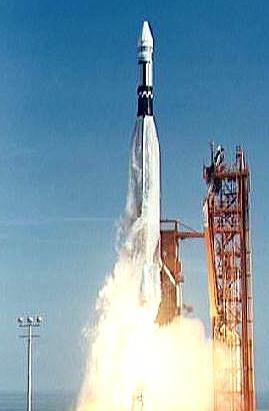
Credit: US Air Force. 14,206 bytes. 269 x 411 pixels.
| astronautix.com | Atlas LV-3A / Agena D |
|
| Atlas ATDA - Credit: US Air Force. 14,206 bytes. 269 x 411 pixels. |
Further improved and lightened Agena upper stage.
Payload: 1,000 kg. to a: Geosynchronous transfer trajectory. Liftoff Thrust: 197,753 kgf. Total Mass: 153,365 kg. Core Diameter: 3.1 m. Total Length: 35.0 m.
KH-7 type satellite. Space craft engaged in investigation of spaceflight techniques and technology (US Cat A).
KH-7 type satellite. Space craft engaged in investigation of spaceflight techniques and technology (US Cat A).
 | Atlas Agena D Credit: © Mark Wade. 1,762 bytes. 77 x 432 pixels. |
Decay date suspect Space craft engaged in investigation of spaceflight techniques and technology (US Cat A).
Space craft engaged in investigation of spaceflight techniques and technology (US Cat A).
KH-7 type satellite. Space craft engaged in investigation of spaceflight techniques and technology (US Cat A).
Space craft engaged in investigation of spaceflight techniques and technology (US Cat A).
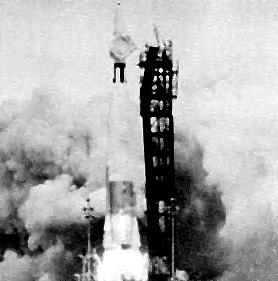 | Atlas Agena - First Atlas Agena - Agena s/n 1008 - Midas 1 14,310 bytes. 278 x 281 pixels. |
KH-7 type satellite. Space craft engaged in investigation of spaceflight techniques and technology (US Cat A).
KH-7 type satellite. Space craft engaged in investigation of spaceflight techniques and technology (US Cat A).
KH-7 type satellite. Space craft engaged in investigation of spaceflight techniques and technology (US Cat A).
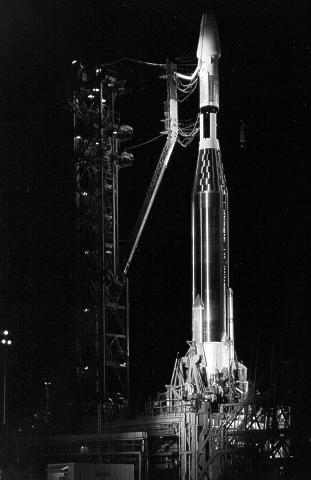 | Atlas Agena - Atlas Agena / Ranger C launch vehicle 19,961 bytes. 311 x 480 pixels. |
Radar monitoring.
KH-7 type satellite. Space craft engaged in investigation of spaceflight techniques and technology (US Cat A).
Space craft engaged in investigation of spaceflight techniques and technology (US Cat A).
Space craft engaged in investigation of spaceflight techniques and technology (US Cat A).
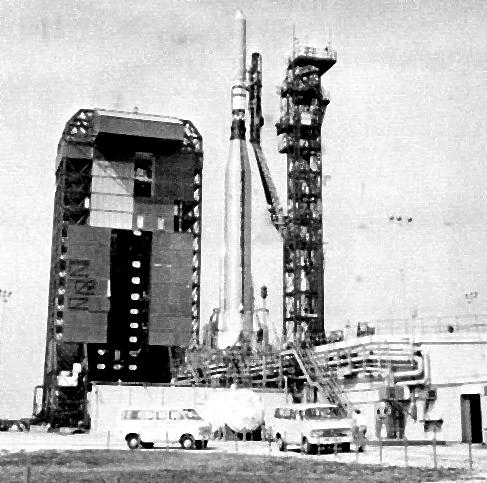 | Atlas Agena - Last Atlas Agena - Agena s/n P113 - 6 April 1978 49,813 bytes. 487 x 483 pixels. |
KH-7 type satellite. Space craft engaged in investigation of spaceflight techniques and technology (US Cat A).
Radar monitoring.
Mars probe; launch fairing failure prevented Mars flyby. Solar Orbit (Heliocentric). Spacecraft engaged in research and exploration of the upper atmosphere or outer space (US Cat B).
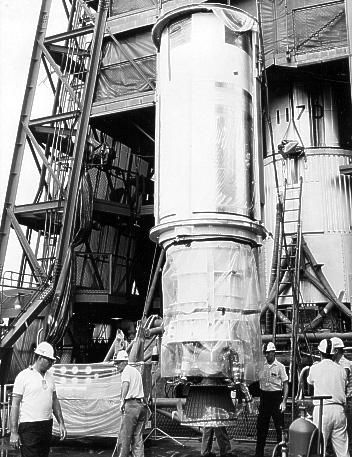 | Agena D - Agena D rocket stage being raised for mating with Atlas launch vehicle 47,872 bytes. 352 x 457 pixels. |
After a 228 day cruise, the spacecraft flew by Mars on July 14 and 15, 1965. Planetary science mode was turned on at 15:41:49 GMT on 14 July. The camera sequence started at 00:18:36 GMT on July 15 and 21 pictures plus 21 lines of a 22nd picture were taken. The images covered a discontinuous swath of Mars starting near 40 N, 170 E, down to about 35 S, 200 E, and then across to the terminator at 50 S, 255 E, representing about 1% of the planet's surface. The closest approach was 9,846 km from the Martian surface at 01:00:57 GMT 15 July 1965. The images taken during the flyby were stored in the onboard tape recorder. At 02:19:11 GMT Mariner 4 passed behind Mars as seen from Earth and the radio signal ceased. The signal was reacquired at 03:13:04 GMT when the spacecraft reappeared. Cruise mode was then re-established. Transmission of the taped images to Earth began about 8.5 hours after signal reacquisition and continued until 3 August. All images were transmitted twice to insure no data was missing or corrupt.
The spacecraft performed all programmed activities successfully and returned useful data from launch until 22:05:07 GMT on 1 October 1965, when the distance from Earth (309.2 million km) and the antenna orientation temporarily halted signal acquisition. In 1967 Mariner 4 returned to the vicinity of Earth again and engineers decided to use the ageing craft for a series of operational and telemetry tests to improve their knowledge of the technologies that would be needed for future interplanetary spacecraft. The cosmic dust detector registered 17 hits in a 15 minute span on 15 September, part of an apparent micrometeoroid shower which temporarily changed the spacecraft attitude and probably slightly damaged the thermal shield. On 7 December the gas supply in the attitude control system was exhausted, and on December 10 and 11 a total of 83 micrometeoroid hits were recorded which caused perturbation of the attitude and degradation of the signal strength. On 21 December 1967 communications with Mariner 4 were terminated.
Results
The total data returned by the mission was 5.2 million bits. All experiments operated successfully with the exception of the ionization chamber/Geiger counter which failed in February, 1965 and the plasma probe, which had its performance degraded by a resistor failure on 6 December 1964. The images returned showed a Moon-like cratered terrain (which later missions showed was not typical for Mars, but only for the more ancient region imaged by Mariner 4). A surface atmospheric pressure of 4.1 to 7.0 mb was estimated and no magnetic field was detected.
Radiation data. Space craft engaged in investigation of spaceflight techniques and technology (US Cat A).
Space craft engaged in investigation of spaceflight techniques and technology (US Cat A).
Space craft engaged in investigation of spaceflight techniques and technology (US Cat A).