Credit: USAF. 22,442 bytes. 255 x 356 pixels.
| astronautix.com | Vela |
|
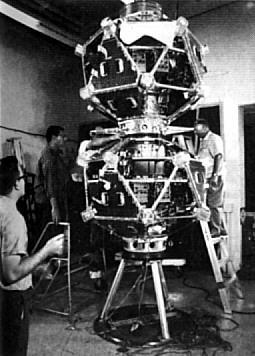
| Vela - Credit: USAF. 22,442 bytes. 255 x 356 pixels. |
The Vela (meaning "watchman" in Spanish) series of spacecraft were designed to monitor world-wide compliance with the 1963 nuclear test ban treaty. The Vela Nuclear Detection Satellites were launched in pairs into high altitude orbits to detect possible nuclear explosions in space and on earth. The project was directed by the Advanced Research Projects Agency of the Department of Defence; the USAF Space and Missile Systems organisation was responsible for the development of the-spacecraft. Prime Contractor was TRW Systems Group of TRW Inc. The first pair of satellites was launched in October 1963, the second in July 1964, and the third in July 1965. The satellites were so successful, each operating for at least 5 years, that a planned acquisition of a fourth and fifth set of pairs was cancelled. Instead, TRW was awarded a further contract in March 1965 for an Advanced Vela spacecraft series.The Vela series was the first spacecraft procurement to utilise a fixed price incentive contract. Spacecraft: Spin stabilised at 120 rpm.20-sided polyhedrons with body mounted solar cells generating 90 W. During launch, 2 satellites were connected by a central cylinder containing an apogee motor. Payload: Twelve external X-ray detectors and 18 internal neutron and gamma-ray detectors. The third pair (F5, 6) carried an improved detector package, including an optical nuclear flash instrument.
Design Life: 6 months. Total Length: 1.4 m. Maximum Diameter: 1.4 m. Total Mass: 225 kg.
Space craft engaged in investigation of spaceflight techniques and technology (US Cat A).
Space craft engaged in investigation of spaceflight techniques and technology (US Cat A).
Space craft engaged in investigation of spaceflight techniques and technology (US Cat A).
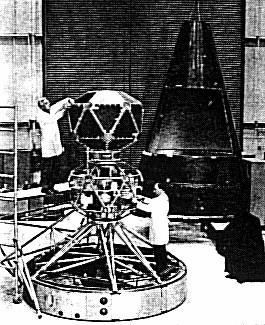 | Vela prepared - Vela prepared for launch Credit: USAF. 31,109 bytes. 265 x 325 pixels. |