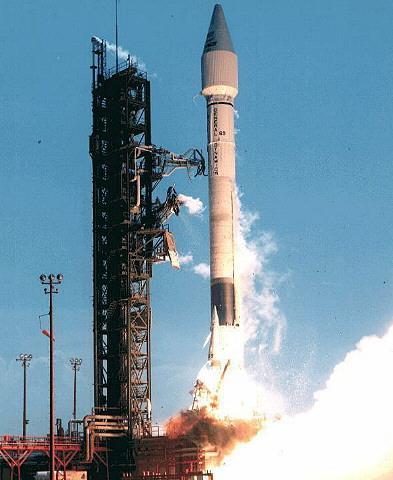
Credit: Lockheed Martin. 29,712 bytes. 393 x 480 pixels.
| astronautix.com | Atlas I |
|
| Atlas Centaur 69 - Credit: Lockheed Martin. 29,712 bytes. 393 x 480 pixels. |
The Atlas I launch vehicle was derived from the Atlas G, and included the same basic vehicle components (Atlas booster and Centaur upper stage). Significant improvements in the guidance and control system were made with an emphasis on replacing analog flight control components with digital units interconnected with a digital data bus. The first flight of an Atlas I was on July 25, 1990. Originally, 18 Atlas I vehicles were planned for manufacture. With the award by the USAF to General Dynamics of the MLV-II vehicle development contract for the Atlas II launch vehicle, the Atlas program rescoped Atlas I production commitments to 11 vehicles and converted the remaining commitments to the Atlas II/IIA/IIAS production effort.
Launches: 11. Failures: 3. Success Rate: 72.73% pct. First Launch Date: 25 July 1990. Last Launch Date: 25 April 1997. LEO Payload: 3,630 kg. to: 185 km Orbit. Payload: 2,255 kg. to a: Geosynchronous transfer trajectory. Liftoff Thrust: 197,750 kgf. Total Mass: 164,300 kg. Core Diameter: 3.1 m. Total Length: 43.9 m. Development Cost $: 400.00 million. in 1987 average dollars. Launch Price $: 75.00 million. in 1994 price dollars. Flyaway Unit Cost $: 70.30 million. in 1985 unit dollars. Cost comments: 1989, 61 sets of motors cost $ 650 mn.
Combined Release and Radiation Effects Satellite. Spacecraft engaged in research and exploration of the upper atmosphere or outer space (US Cat B). Elliptical orbit; MRS trajectory.
Geostationary at 125 deg W. Spent boosters, spent maneuvering stages, shrouds and other non-functional objects (US Cat D). Launch vehicle put payload into geosynchronous transfer orbit with GCS trajectory option.
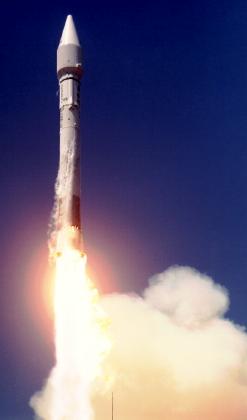 | Atlas Centaur No.69 Credit: Lockheed Martin. 7,396 bytes. 247 x 420 pixels. |
US Navy communications. Spacecraft engaged in practical applications and uses of space technology such as weather or communication (US Cat C). Launch vehicle put payload into subsynchronous earth orbit with MRS trajectory option.
Geostationary Environmental Satellite. Stationed at 75 deg W. Space craft engaged in investigation of spaceflight techniques and technology (US Cat A). Launch vehicle put payload into supersynchronous earth orbit with MRS trajectory option.
US Navy communications . Stationed at 14.38 deg W. Launch vehicle put payload into subsynchronous earth orbit with MRS trajectory option.
Stationed at 135 deg W. Launch vehicle put payload into supersynchronous earth orbit with MRS trajectory option.
LEO. Satellite per Astronomia a raggi X; X-ray celestial observatory Launch vehicle put payload into low earth orbit with IFR trajectory option.
Geosynchronous. Stationed over 105.7W Launch vehicle put payload into supersynchronous earth orbit with MRS trajectory option.