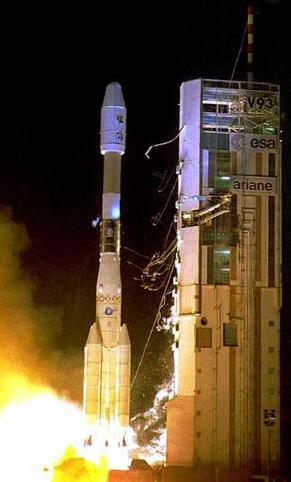
Credit: Arianespace. 22,028 bytes. 291 x 482 pixels.
| astronautix.com | Ariane 44L |
|
| Ariane 44L - Credit: Arianespace. 22,028 bytes. 291 x 482 pixels. |
Ariane 4 with 4 liquid rocket strap-ons.
Launches: 29. Failures: 1. Success Rate: 96.55% pct. First Launch Date: 05 June 1989. Last Launch Date: 22 December 1999. LEO Payload: 10,200 kg. to: 200 km Orbit. at: 5.2 degrees. Payload: 4,790 kg. to a: Geosynchronous transfer, 7 deg inclination trajectory. Liftoff Thrust: 549,640 kgf. Total Mass: 470,000 kg. Core Diameter: 3.8 m. Total Length: 58.4 m. Launch Price $: 125.00 million. in 2000 price dollars.
Multipurpose communications; 23.5 deg E. Communications satellite, position 23.5E, Ariane 4 flight no 20.
Japanese domestic business communications; 158 deg E.
Stationed at 24.5 deg E. At the time, the Intelsat 6 series were the largest commercial spacecraft ever built. The series were also the first commercial satellites to employ Satellite Switched/Time Division Multiple Access (SS/TDMA) techniques. Spacecraft: Based on Hughes 393 bus. Spin stabilised with despun antenna. Hydrazine propulsion system. Passive thermal control. Telescoping dual-cylinder structure with deployed antennas. Body mounted solar cells generate 2250 W (EOL). Solar drums are each about 6m tall. Payload: 38 (plus 12 backup) C-Band and 10 (plus 4 backup) Ku-Band transponders.120,000 telephone calls and 3 colour TV broadcasts simultaneously. SS/TDMA (Satellite-Switched Time Division Multiple Access) techniques used.
Launched with BS-2X. Targeted for Geosynch orbit.
West German DBS; 28.5 deg E. Communications satellite, position 28.5E Ariane 4 flight no 37.
French DBS; 19 deg W. Direct broadcasting satellite. Registration 1990-2-B.
Geostationary at 99 deg W. Spacecraft engaged in research and exploration of the upper atmosphere or outer space (US Cat B).
Stationed at 99 deg W. Spacecraft engaged in research and exploration of the upper atmosphere or outer space (US Cat B).
Experimental commsat; 13.2 deg E. ITALSAT is a body stabilized geostationary satellite and it is proposed to provide pre-operational domestic telecommunications services on the 20/30 GHz bands. Geographic longitude 13.2 deg E. Longitudinal tolerance +/- 0.1 deg.
Stationed at 10 deg E. Telecommunications satellite. Registered by France in ST/SG/SER.E/234 and 239 until EUTELSAT can register the satellite. EUTELSAT is the European Telecommunications Satellite Organization.
International communications; 14.5 deg W.
International communications; 27.5 deg W.
French communications; 3 deg E.
Global maritime and mobile communications; 178 deg E.
Stationed at 162 deg E. Domestic communications. Launching organization Arianespace. Launch time 2358 GMT.
Stationed at 31 deg E.
 | Ariane 44L Credit: © Mark Wade. 2,670 bytes. 78 x 609 pixels. |
Stationed at 3 deg E.
Stationed at 7 deg E.
Stationed at 74 deg E; also performed communications functions. INSAT-2A is a multi-purpose satellite, and it will provide the following services: Domestic long-distance telecommunications, meteorological earth observation and data collection services, direct satellite TV broadcasting to community TV receivers in rura l and remote areas, radio and TV progamme distribution, and Satellite Aided Search and Rescue services. Geostationary longitude 74 +/0 0.1 deg E.
Stationed at 30 deg W.
Stationed at 93.5 deg E; also acted as communications platform; carried search and rescue package. INSAT-2B is a multi-purpose satellite, and it will provide the following services: Domestic long range communications, meteorological Earth observation and data collection service, Direct satellite TV broadcasting to community TV recievers in rural and re mote areas, Radio and TV programme distribution, satellite aided search and rescue services. Inclination will be reduced to 0.1 deg and maintained. Geostationary longitude 93.5 +/- 0.1 deg E. Launch on Arianespace flight 58.
Stationed at 101.2 deg W. DirecTV, Inc. is a subsidiary of Hughes Communications and offers commercial satellite television service to the US. The orbital part of the system consists of 3 Hughes-built geosynchronous satellites. Broadcast services began in mid-1994. Competitors include the similar Primestar and USSB services, as well as older C-band satellite services and cable TV companies. Spacecraft: DirecTV uses the Hughes HS-601 spacecraft design.3-Axis stabilised, zero momentum biased control system. Two solar arrays (4 panels each side) span 31 meters and generate 4.3 kW power. Payload: The 2.5 m diameter graphite transmit reflector performs beam shaping.16 x 120 watt Ka-Band (12.2 - 12.7 GHz) transponders with 48-53 dBw EIRP and 24 MHz bandwidth. Power is higher in areas with heavy rain. The high power combined with Reed Solomon error correction coding allow the use of small 18 inch antennas by customers.
Financial/Operational:
FCC approved Direct Broadcast Satellites in 1986. By 1997 DirecTV had 2.6 million of 5.0 million US direct broadcast television subscribers. Direct Broadcast Satellites cost $ 175 million each and have 150 video channels.
Stationed at 109.67 deg E.
Stationed at 168.97 deg E.
18 C-Band transponders. Stationed at 113.06 deg W.
10 C-band, 2 Ku-band transponders. Stationed at 78.42 deg E.
Stationed at 1.1 deg E.
24 transponders. Stationed at 92.5 deg E.
Geostationary at 91.4E.
Geostationary at 43.0W.
34 transponders; Geostationary at 113.0E.
7 Ku-band transponders Geostationary at 4.1W.
Geostationary at 26.0E.
22 Ku band and 12 C band transponders.
Geostationary at 148.0E.
Geostationary at 21.9E.
Geosynchronous. Stationed over 84.9W
Geosynchronous. Stationed over 71.8W
Geosynchronous. Stationed over 74.1E
Geosynchronous. Stationed over 54.0W
Geosynchronous. Stationed over 4.8E
Geosynchronous. Stationed over 100.6E
Geostationary at 23.5 degrees E.
Geostationary at 16.0 degrees E.
Satellite was originally built as a backup for Argentina's Nahuelsat. This allowed Dornier and Alcatel to deliver the satellite in a record twelve months. Dry mass of GE 5 was 769 kg - it carried 950 kg of propellant at launch. Geostationary at 36.4 degrees W.
Afristar was the first WorldSpace satellite. Afristar was to broadcast digital radio over Africa and the Middle East. Small hand-held radios could pick up the 24 to 96 radio channels available on the three L-band beams. Dry mass of Afristar was 1205 kg; it carried 1534 kg of propellant at launch. Geostationary at 21.0 degrees E.
Skynet 4E was a SHF/UHF military communications satellite for the UK Ministry of Defense. Dry mass was 759 kg; it used a Thiokol Star 30 solid apogee motor. Stationed at 53 deg E.
The Arab League satellite had 20 Ku-band transponders and was to be stationed at 26 degrees East. Dry mass was 1200 kg.
First Hughes HS 702 bus satellite, for PanAmSat Corporation to expand video and telecommunications services to North America and Brazil. The 20-watt C-band transponders will be used primarily for cable television customers. The Ku-band payload offers two power levels: 140 watts for video distribution, and 75 watts for data networks and other general communications services. This gives Galaxy 11 a total payload of 64 active transponders.