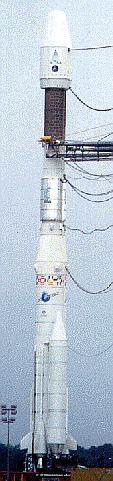
15,850 bytes. 113 x 481 pixels.
| astronautix.com | Ariane 42L |
|
| Ariane 42L V56 - Ariane 42L V56 - COSPAR 1993-031 15,850 bytes. 113 x 481 pixels. |
Ariane 4 with 2 liquid rocket strap-ons.
Launches: 12. Failures: 0. Success Rate: 100.00% pct. First Launch Date: 12 May 1993. Last Launch Date: 06 October 2000. LEO Payload: 7,900 kg. to: 200 km Orbit. at: 5.2 degrees. Payload: 3,590 kg. to a: Geosynchronous transfer, 7 deg inclination trajectory. Liftoff Thrust: 412,830 kgf. Total Mass: 400,000 kg. Core Diameter: 3.8 m. Total Length: 58.4 m. Launch Price $: 100.00 million. in 2000 price dollars.
Operated by Radio Amateur Club de LeSpace.
Stationed at 1.2 deg E. TV distribution services to Western Europe and the Canary Islands under franchise from the Grand Duchy of Luxembourg. Contracted and controlled by the private company formed in 1985 called Société Europíenne des Satellites (SES). This is the third in a series of 4 medium power satellites, and will act primarily as Astra 1A's backup. Spacecraft: HS-601 platform.3-axis unified ARC 22 N and one Marquardt 490 N bipropellant thrusters, Sun and Barnes Earth sensors and two 61 Nms 2-axis gimballed momentum bias wheels.1658 kg nitrogen tetroxide & MMH in four spheres. Spin-stabilised in transfer orbit. Twin solar wings of three 2.16 x 2.54 m panels carrying large area silicon cells on Kevlar substrate to satisfy 3.3 kW requirement. Eclipse protection provided by Nickel hydrogen batteries. Payload: 18 eclipse protected transponders, plus six spares with 63W TWTA 10.95-11.200 Ghz down Ku-band European beams in 250 Mhz band adjacent (below) to Astra 1A, 26 Mhz bandwidth, eirp 50 dBW min, orthogonal polarisation, operating in the FSS range
16 C-Band, 24 Ku-Band transponders; 320 radio + 120 DirecTV channels. Stationed at 68.5 deg E.
Direct TV for continental US. Stationed at 89.0 deg W.
Western Europe digital TV; 18 Ku-band transponders. Stationed at 19.2 deg E.
Geosynchronous. Stationed over 21.4W
Geosynchronous. Stationed over 47.0E
 | Ariane 42L Credit: © Mark Wade. 2,760 bytes. 78 x 609 pixels. |
The Ariane third stage placed the PAS 6B into a 228 km x 35717 km x 7.0 degree orbit. The satellite�s on board rocket system will move it into its final geostationary position over South America. PAS 6B will provide direct TV broadcasting service in replacement of PAS 6, a Loral satellite which had problems with its solar arrays. The new satellite had 32 Ku-band transponders.
Geosynchronous satellite launched to supplement Panamsat's Galaxy cable TV distribution constellation. It carried Ku and C band transponders and was to be stationed at 127 deg W. A replacement for Galaxy 10, lost on the first Delta 3 launch failure. Stationed at 123 deg W.
Galaxy 4R carried 28 Ku-band and 28 C-band transponders. After insertion in a standard 219 x 32007 km x 7.0 deg geostationary transfer orbit, Galaxy 4R's R-4D apogee engine raised orbit to 35765 x 35792 km x 0.1 deg by April 27 and was over 67 deg W by late April. Final destination was 99 deg W. The Galaxy satellites provide US domestic telecommunications services. 4R replaces the original Galaxy 4H which failed in May 1998, putting pagers out of action across the USA. Stationed at 99 deg W.
N-SAT-110, also known as Superbird 5, was jointly owned by SCC (Space Communications Corporation of Tokyo) and JSat (Japan Satellite Systems). SCC controlled the vehicle on orbit. The satellite carried 24 Ku-band transponders. By October 15 N-SAT-110 was in a 35610 x 35752 km x 0.1 deg orbit drifting past 109 deg E. Stationed at 110 deg E.