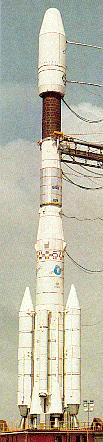
13,075 bytes. 103 x 442 pixels.
| astronautix.com | Ariane 44LP |
|
| Ariane 44LP V29 - Ariane 44LP V29 - COSPAR 1989-020 13,075 bytes. 103 x 442 pixels. |
Ariane 4 with 2 liquid rocket + 2 solid rocket strap-ons.
Launches: 24. Failures: 1. Success Rate: 95.83% pct. First Launch Date: 15 June 1988. Last Launch Date: 17 August 2000. LEO Payload: 9,100 kg. to: 200 km Orbit. at: 5.2 degrees. Payload: 4,290 kg. to a: Geosynchronous transfer, 7 deg inclination trajectory. Liftoff Thrust: 535,000 kgf. Total Mass: 420,000 kg. Core Diameter: 3.8 m. Total Length: 58.4 m. Launch Price $: 110.00 million. in 2000 price dollars.
Stationed at 45 deg W.
Stationed at 0 deg. Meteosat P2 is a geostationary meteorological satellite operating within the world wide network of the World Weather Watch of the World Meteorological Organization. Its main missions are: Imaging in the visible, IR and water vapour region of the spectrum; data reception from so-called Data Collection Platforms (DCPs); data distribution to meteorological services and other interested parties (research institutes, etc). Geostationary position 0 deg E. ESA designator ESA/88/02. Launch time 1119:33 UT.
AMSAT-OSCAR 13 was launched by the first test flight of the Ariane 4 launcher. Size 600 x 40 x 200 mm. AO-13 was the third in a series of Phase-3 type high-altitude, elliptical orbit amateur communications satellites. It was built by an international team of radio amateurs led by Dr. Karl Meinzer of AMSAT-Germany. It carried four beacon transmitters and four linear transponders. AO-13 also contained a digital communications transponder called RUDAK-1. However attempts to get the experiment operating failed. Operational life span was 8 years. Careful analysis of AO-13's orbit in early 1990 by Victor Kudelka, OE2VKW revealed that resonant perturbations exist which lead the satellite into a negative perigee altitude. The perigee was down to 150 km by August 1996 which drastically increased atmospheric drag on the satellite until it reentered the Earth's atmosphere December 5, 1996.
European TV broadcast; 19.2 deg W. Astra 1A provides TV coverage to Western Europe. The satellite is owned and operated by Société Europíenne des Satellites (SES), a private company formed in 1985. Astra 1A is based in the GE 4000 series platform, and was the first in a network of four satellites. Spacecraft: GE 4000 platform.3-axis stabilisation with momentum wheels, magnetic torquers, Earth sensors and 16 blowdown monopropellant hydrazine thrusters. Solar arrays provide 2800 W BOL, 3 50 Ahr NiH batteries. GEO insertion by Star 37XFP solid rocket motor. Payload: 16 Ku-band transponders (with six spares) .
British military communications; 1 deg W. Military communications.
Japanese domestic communications; 150 deg E. Domestic communication. Launching states: Japan, France, USA. Launch vehicle Ariane 29 (Ariane IV). Launching organization ARIANE SPACE. Launch time 1129 GMT.
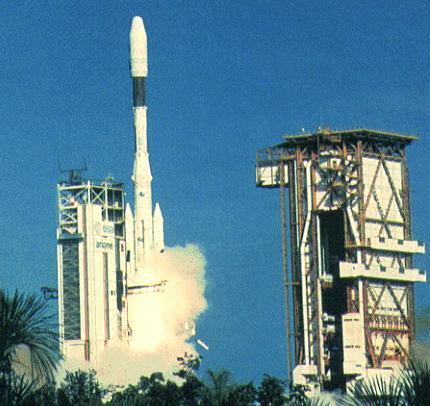 | Ariane Credit: Arianespace. 34,284 bytes. 430 x 406 pixels. |
Meteosat Operational Program; weather imaging, atmospheric data; 0 deg. Geostationary meteorological satellite, operating within the world-wide network of the World Weather Watch of the World Meteorological Organization (WMO). Its main missions are: imaging in the visible, infrared and water vapour region of the spectrum. Dat a reception from so called Data Collection Platforms (DCPs); data distribution to meteorological services and other interested parties (research institutes, etc).
Didn't reach GEO due to AKM failure; measured star positions. Scientific satellite for astrometry. Frequency plan 2054.25 /2241 MHz. Launch time 2325:53 UT. Designator ESA/89/03.
TV services to West Germany; 19 deg W. Direct broadcasting satellite. Position 19 deg W. Ariane 4, flight no 33.
Stationed at 13 deg E. Telecommunications satellite. Registered by France in ST/SG/SER.E/234 and 239 until EUTELSAT can register the satellite. EUTELSAT is the European Telecommunications Satellite Organization.
UK military communications; 1 deg W. United Kingdom military communications satellite. Owner/operator: UK Ministry of Defence. Expected operational life 10 years.
Stationed at 19.2 deg E; European coverage. Astra 1B provides TV coverage to Western Europe. The satellite is owned and operated by Société Europíenne des Satellites (SES), a private company formed in 1985. Astra 1B is the second in a network of four satellites. SES acquired Astra 1B from DBS Crimson Satellite Associates while still under construction by GE Astro Space (as Satcom K3). Astra 1B is colocated with Astra 1A, and doubled the number of channels provided by the Astra network. Spacecraft: GE 5000 platform.3-axis stabilisation with momentum wheels, magnetic torquers, Earth sensors and 20 blowdown monopropellant hydrazine thrusters. Solar arrays provide 4850 W BOL, 4 50 Ahr NiH batteries. GEO insertion provided by 2 500N bipropellant motors. Payload: 16 Ku-band transponders (with six spares)
 | Ariane 44LP+ V53 - Ariane 44LP+ V53 - COSPAR 1992-060 14,357 bytes. 145 x 488 pixels. |
Earth imaging for weather, climatology, atmospheric physics; 4 deg E. Geostationary meteorological satellite, operating within the world-wide network of the World Weather Watch of the World Meteorological Organization (WMO). Its main missions are: imaging in the visible, infrared and water vapour region of the spectrum. Dat a reception from so called Data Collection Platforms (DCPs); data distribution to meteorological services and other interested parties (research institutes, etc). Launch time 2336:00 UT.
Stationed at 30 deg W.
Stationed at 131 deg W.
International communications. The Intelsat 7 and 7A series were nearly identical except for an increase in the number of Ku-band transponders in the 7A series. Spacecraft: 3-axis stabilised. Hydrazine propulsion system. Two large solar panels with 1-axis articulation provide 3900W BOL. Payload: 7: 26 C-Band and 10 Ku-Band transponders.18,000 telephone calls and 3 colour TV broadcasts simultaneously. Or up to 90,000 telephone circuits using digital circuit multiplication equipment (DCME).7A: 26 C-Band and 14 Ku-Band transponders.22,500 telephone calls and 3 colour TV broadcasts simultaneously. Or up to 112,500 telephone circuits using DCME. Three independently steerable, high-powered, Ku-band spot beams. Independently steerable C-band spot beam coverage.
Stationed at 0 deg.
Stationed at 109.2 deg W.
 | Ariane 44LP Credit: © Mark Wade. 2,816 bytes. 78 x 608 pixels. |
50 cm cube; Space Technology and Research Vehicle; included solar cell tests.
Stationed at 1.03 deg W.
50 cm cube; Space Technology and Research Vehicle; included solar cell tests.
28 C-band transponders, 1 X-band transponder (military). Stationed at 70.05 deg W.
16 Ku-band transponders. Stationed at 41.92 deg E.
Stationed at 65.1 deg W.
Stationed at 13.0 deg E.
Stationed at 53.1 deg W.
GEO. 26 C-band, 14 K-band transponders. Geostationary at 0.9W.
Geosynchronous. Stationed over 110.0E
Geosynchronous. Stationed over 78.5E
Geosynchronous. Stationed over 10.2W
Geosynchronous. Stationed over 13.3E
Geostationary at 25.0 degrees E.
Geostationary at 84.0 degrees W.
Geostationary at 68.7 degrees E.
Telstar 7, owned by Loral Skynet, had 24 C-band and 24 Ku-band transponders. Dry mass was 1537 kg. After placement in final geosynchronous orbit it provided communications for North America from a position at 129 degrees East longitude. Stationed at 129 deg W.
Satellite used for international communications; complement the Telstar satellites operated by Loral Skynet. Stationed at 15 deg W.
Provided C and Ku-band communications services for GE Americom, replacing Spacenet 4. Stationed at 101 deg W.
Provided geosynchronous communications services for the Space Communications Corporation of Japan. Carried 23 Ku-band and 6 Ka-band transponders, and was equipped with a Marquardt R4D apogee engine and XIPS ion propulsion stationkeeping system. Stationed at 162 deg E.
Brasilsat B4 was a C-band geosynchronous communications satellite, replacing the 15-year-old Brasilsat A2 for the Brazilian communications company Embratel.
Geosynchronous communications satellite of the Egyptian company Nilesat SA. The satellite joined Nilesat 101 in providing Ku-band broadcast services. Stationed at 7 deg W.