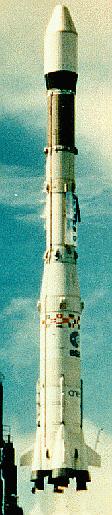
16,276 bytes. 112 x 515 pixels.
| astronautix.com | Ariane 1 |
|
| Ariane 1 L01 - Ariane 1 L01 - COSPAR 1979-104 16,276 bytes. 112 x 515 pixels. |
First successful European commercial launch vehicle, developed from L3S Europa launch vehicle replacement design. Development was authorised in July 1973, took eight years, and cost 2 billion 1986 Euros.
Launches: 11. Failures: 2. Success Rate: 81.82% pct. First Launch Date: 24 December 1979. Last Launch Date: 22 February 1986. Payload: 1,850 kg. to a: Geosynchronous transfer, 7 deg inclination trajectory. Liftoff Thrust: 249,470 kgf. Total Mass: 207,200 kg. Core Diameter: 3.8 m. Total Length: 50.0 m. Launch Price $: 32.00 million. in 1985 price dollars.
Development took eight years, and cost 2 billion 1986 ECU's.
Launch vehicle test. Technological Capsule (CAT). ESA registration number: ESA/79/2. Principal mission of the technological capsule (with ballast), which was equipped with batteries having a lifetime of approximately 8 orbits, was to transmit back to earth technological data on the first developmental flight L01 of the ARIANE launch vehicle. When the batteries were exhausted, the capsule ended its radio transmissions, and it is now inoperative but still in orbit.
The satellite never obtained orbit. Weight 92.2 kg. Mode B (435 MHz uplink and 145 MHz downlink) transponder and 145 MHz beacon. VHF and UHF helix wide beam antenna.
Experimental communications satellite. Geosynchronous altitude, longitude 10 deg East.
Launch vehicle test payload. Technological capsule. ESA registration ESA/81/02. Launch time 1233:03 UT. The technological capsule, equipped with batteries for a lifetime of about six orbital revolutions, transmits to earth technological data about test flight L-03 of ARIANE. After di scharge of the battery the capsule will stop its transmissions and remain in orbit on inactive status. Frequency 136-138 MHz (transmission until 65h after launch only). Projected time of reentry 1986.
Meteosat 2 is a geostationary meteorological satellite, operating within the world wide network of the World Weather Watch of WMO. Its main missions are: Imaging in the visible, IR and water vapour region of the spectrum; data reception from so-called dat a collection platforms (DCPs); data distribution to meteorological services and other interested parties (research institutes etc). Launch time 1233:03 UT. Geostationary position 0 deg E. Designator ESA/81/03.
MARECS-A was a geostationary maritime communications satellite, which formed part of INMARSAT's world-wide maritime communications satellite network. MARECS-A moved to a new position on the geostationary orbit. Old position: 334E. New position: 22.5 E. The Marecs satellites were members of Inmarsat's first generation global maritime communications network. Additional Details: MARECS 1.
Ariane L-04 technological capsule, ESA designator ESA/81/04. The technological capsule, equipped with batteries for a lifetime of about 6 orbital revolutions (65h), transmits to earth technological data about test flight L-04 of Ariane. After discharge of the battery the capsule will stop its transmissions and remain in orbit in an inactive status. Frequency 136-138 MHz, projected time of reentry before 1990.
Launch vehicle test payload.
Marecs B intended for maritime communications, planned for lease to Inmarsat; launched with Sirio 2. Geosynch orbit.
 | Ariane 1 Credit: © Mark Wade. 2,161 bytes. 82 x 493 pixels. |
AMSAT Oscar 10, registration no D-R 001. Scientific and communication satellite for the amateur radio service. Frequency plan: Transponder U: 435.1 MHz (uplink), 145.9 MHz (downlink), Bandwidth +/- 75 kHz. Transponder L: 1269.45 MHz (uplink), 436.55 MHz ( downlink), bandwidth +/- 400 kHz. Two beacons adjacent to passband. Launch vehicle Ariane L6. First amateur satellite with onboard propulsion (which did not function entirely correctly, due to collision with launch vehicle after separation - hence the not-quite-Molniya-orbit). Computer control failed December 1986 due to radiation damage to memory. As a result, ground control stations have no control over the spacecraft. However, when the orientation is favourable (with respect to the Earth and Sun), OSCAR 10 continues to provide good Mode B service. If users coorperate, OSCAR 10 may provide many more years of service. Project Management: AMSAT-NA (Jan King, W3GEY) and AMSAT-DL (Karl Meinzer, DJ4ZC). Spacecraft sub-systems: Contributed by groups in Canada, Hungary, Japan, United States and West Germany. Spacecraft: Spin Stabilised with Magnetorquers: Power: 50 W solar array, 2 NiCd batteries. Payload: Transponders/Beacons: Mode B: Type: Linear, inverting, 50W; General Beacon: 145.809 MHz (Carrier); Engineering Beacon: 145.987 MHz; Uplink: 435.030-435.180 MHz; Downlink: 145.975-145.825 MHz. Mode L (no longer operational): Type: Linear, inverting, 50W: Beacons: 436.020, 436.040 MHz; Uplink 1269.450 MHz (800 kHz); Downlink 436.550 MHz.
Ariane third stage. Launched by European Space Agency. Launch time 0045:36 GMT. Launched spacecraft Intelsat V F7.
Stationed at 120 deg W. C, Ku band communications satellite.
Encountered comet Halley March 13, 1986. The Giotto mission was designed to study Comet P/Halley, and also studied Comet P/Grigg-Skjellerup during its extended mission. The spacecraft encountered Halley on March 13, 1986, at a distance of 0.89 AU from the sun and 0.98 AU from the Earth and an angle of 107 degrees from the comet-sun line. The actual closest approach was measured at 596 km. All experiments performed well and returned a wealth of new scientific results, of which perhaps the most important was the clear identification of the cometary nucleus. Fourteen seconds before closest approach, Giotto was hit by a `large' dust particle. The impact caused the spacecraft angular momentum vector to shift 0.9 degrees. Scientific data were received intermittently for the next 32 minutes. Some experiment sensors suffered damage during this 32-minute interval. Other experiments (the camera baffle and deflecting mirror, the dust detector sensors on the front sheet of the bumper shield, and most experiment apertures) were exposed to dust particles regardless of the accident and also suffered damage. Many of the sensors survived the encounter with little or no damage. Questionable or partially damaged sensors included the camera (later proved to not be functional) and one of the plasma analyzers (RPA). Inoperable experiments included the neutral and ion mass spectrometers and one sensor each on the dust detector and the other plasma analyzer (JPA). During the Giotto extended mission, the spacecraft successfully encountered Comet P/Grigg-Skjellerup on July 10, 1992. The closest approach was approximately 200 km. The heliocentric distance of the spacecraft was 1.01 AU, and the geocentric distance, 1.43 AU at the time of the encounter. The payload was switched-on in the evening of July 9. Eight experiments were operated and provided a surprising wealth of data. The Johnstone Plasma Analyser detected the first presence of cometary ions 600,000 km from the nucleus at 12 hours before the closest approach. The Dust Impact Detectors reported the first impact of a fairly large particle at 15:30:56. Bow shocks/waves and acceleration regions were also detected. After the P/Grigg-Skjellerup encounter operation were terminated on 23 July 1992. The spacecraft will fly by the Earth on 1 July 1999.
Studied magnetic, electric, UV properties of auroral regions. Scientific satellite for the investigation of space plasma physics in the part of the magnetosphere close to the Earth, particularly in connection with the auroral phenomena. The nominal mission period is eight months but an extension can be envisaged. ST /SG/SER.E/167: The satellite Viking has ceased to function on 12 May 1987 due to a gradual degradation of its electrical power supply system. The satellite remains, however, in Earth orbit.
Remote sensing satellite. Registration 1986-1.B