Credit: Lockheed Martin. 22,715 bytes. 191 x 416 pixels.
| astronautix.com | ALS |
|
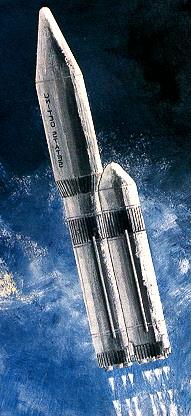
| ALS General Dynamics - Credit: Lockheed Martin. 22,715 bytes. 191 x 416 pixels. |
In the late 1980�s the deployment of the �Star Wars� ballistic missile defence system was expected to require launch of a small number of heavyweight chemical laser satellites, a moderate number of x-ray laser nuclear-pumped satellites, or a huge number of �brilliant pebble� kinetic interceptors. Existing launch vehicles did not have the lifting capacity to support such a program and cost too much per launch. With the ALS, the Air Force hoped to develop a flexible, modular, heavy-lift, high launch rate vehicle with a factor of ten reduction over existing cost per kilogram of payload.
Seven contractors were awarded five million dollar, one year study contracts in July 1987, with the studies to recommend a family of modular boosters with low earth orbit payloads from 2,400 kg to 90,000 kg. The new launch vehicle was expected to make its first flight in 1998, reach full operational capability of up to 30 flights per year in 2000, and replace all existing expendable launch vehicles by 2005. The studies covered not only the launch vehicle but the ground support equipment as an integrated system. Unfortunately there was no single breakthrough new technology that would lead to a common conclusion by the contractors. Proposed were expendable and partially reusable vehicles; fly-back boosters and recoverable propulsion/avionics modules; use of existing engines, solid rockets, or various new liquid engines.
By late 1989 the cold war was winding down and �Star Wars� was essentially dead. Even if the immense technical problems of developing an operational missile defence could be overcome, it had become possible to reduce or eliminate the ballistic missile threat using treaties rather than technology. Total development cost of ALS was estimated as $15 billion through its first flight in 1998, and the low launch rates expected could not pay back this investment, even with a substantial reduction in costs per launch. By 1990 the program was reduced to a $150 million per year propulsion development effort. However the technologies identified for use in ALS would be found in 1990�s upgrades to the space shuttle, the USAF Evolved Expendable Launch Vehicle program, and numerous commercial booster programs and proposals.
ALS was expected to exploit the following technologies to cut costs and improve reliability:
Liftoff Thrust: 3,591,835 kgf. Total Mass: 2,340,000 kg. Core Diameter: 8.7 m. Total Length: 72.0 m. Launch Price $: 141.00 million. in 1991 price dollars. Cost comments: Engine cost $ 3 mn ea, 10x reduction to SSME, based on 500 buy and 5-15 reuses.
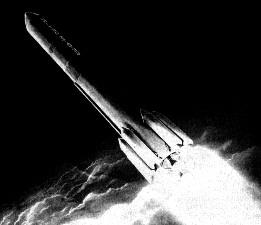 | ALS Martin Marrietta - ALS Martin Marrietta concept - liquid core with solid strap-on boosters Credit: Lockheed Martin. 7,576 bytes. 261 x 225 pixels. |
The studies to recommend a family of modular boosters with low earth orbit payloads from 2,400 kg to 90,000 kg. The new launch vehicle was expected to make its first flight in 1998, reach full operational capability of up to 30 flights per year in 2000, and replace all existing expendable launch vehicles by 2005.
 | ALS Martin Marrietta - ALS Martin Marrietta concept - asymmetric liquid first stage Credit: Lockheed Martin. 12,848 bytes. 243 x 202 pixels. |
Total development cost of ALS was estimated as $15 billion through its first flight in 1998, and in the absence of a massive 'Star Wars' space based defence, the lower launch rates could not pay back this investment. By 1990 the program was reduced to a $150 million per year propulsion development effort.
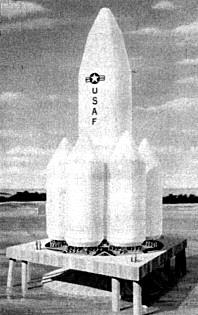 | ALS Hughes - ALS Hughes Aircraft concept. This had an immense number of RL-10 engines firing from identical rocket stages. Also known as 'Jarvis-2' Credit: Hughes. 14,366 bytes. 198 x 315 pixels. |