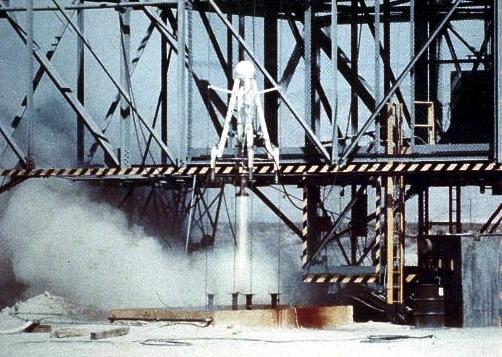
| Spacecraft: Lunex. The largest single development objective for the 1961 US Air Force Lunex program was to provide a spacecraft capable of transporting men and equipment to the lunar surface and returning them to a selected earth base. This payload would consist of a Lunar Landing Stage, Lunar Launch Stage and a 3-man Lunex Re-entry Vehicle. This payload was 16.1 m long, and the interface diameter with the Space Launching System was 7.62 m. The complete payload weighed 61,000 kg at escape velocity, and a 9,163 kg Manned Re-entry Vehicle was returned to the earth. The Lunex Re-entry Vehicle had to be capable of entering the earth's atmosphere with a velocity of approximately 11.3 km/sec. At that time, basic re-entry information for velocities of this magnitude did not exist. Therefore, engineering design effort for this re-entry vehicle would have to be accomplished concurrently with other major sub-systems developments and integrated with the High-Speed Re-entry test program and the Abort System test and development program. |