 |
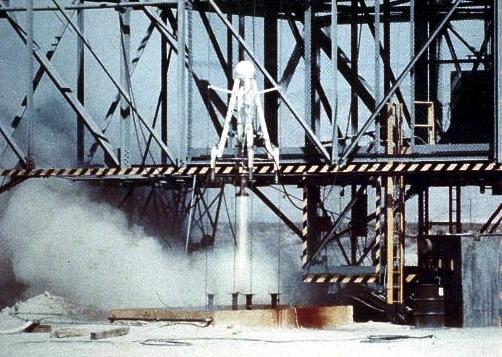
| Navy SLV US Navy Soft Landing Vehicle in test rig, 1961. This was the prototype of a lunar lander that was to have landed a dog on the moon by 1963 and returned lunar soil by 1964. Credit: US Navy. 56,829 bytes. 467 x 357 pixels. |
| astronautix.com | Navy SLV |
|
| Navy SLV US Navy Soft Landing Vehicle in test rig, 1961. This was the prototype of a lunar lander that was to have landed a dog on the moon by 1963 and returned lunar soil by 1964. Credit: US Navy. 56,829 bytes. 467 x 357 pixels. |
A US Navy lunar landing program was headed by the inimitable Dr. Nicolaides at China Lake. The team's Soft-Landing Vehicle (SLV) began control testing in a large rig in 1961. Termed in the official history 'an outgrowth of NOTS' unparalleled propulsion expertise', the SLV was an early prototype moon-lander that demonstrated advanced hypergolic-fuel, demand-thrust, and autonomous-control technologies. The history states cryptically 'this unit committed suicide following the final test of the program'....
The SLV would have sent a dog to the moon in 1963, and returned a soil sample in 1964. A scaled-up version of the lander was to have put a Navy man on the lunar surface by 1967.
Further Navy lunar efforts, like those of the Army and Air Force, were discontinued after NASA was given the Apollo moon landing project in April 1961.
Testifying before the Senate Committee on Aeronautical and Space Sciences, Maj. Gen. Bernard A. Schriever, Commander of the Air Force Ballistic Missile Division, stated that all three military services should be studying the possibility of a base on the moon. Up to that point, he felt, all such studies had been "in the blue thinking."
A US Navy lunar landing program was headed by the inimitable Dr. Nicolaides at China Lake. The team's Soft-Landing Vehicle (SLV) began control testing in a large rig in 1961. The SLV would have sent a dog to the moon in 1963, and returned a soil sample in 1964. A scaled-up version of the lander was to have put a Navy man on the lunar surface by 1967. Further Navy lunar efforts, like those of the Army and Air Force, were discontinued after NASA was given the Apollo moon landing project in April 1961.