 |
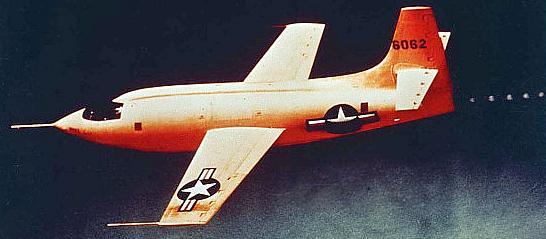
| XS-1 Credit: NASA. 21,892 bytes. 546 x 239 pixels. |
| astronautix.com | XS-1 |
|
| XS-1 Credit: NASA. 21,892 bytes. 546 x 239 pixels. |
Also known as the X-1. This rocket plane was the first aircraft to break the sound barrier, and the first in a line of X- aircraft leading to the space shuttle. Due to the press of war work, Bell Aircraft was the only company that would take on the project in 1944. German swept-wing research being unknown, the configuration developed was a thin, straight-winged aircraft with a bullet-shaped fuselage. The XS-1 began flight test in 1946 and Chuck Yeager flew it through the sound barrier on October 14, 1947.
The rocket aircraft research program conceived by NACA's John Stack, to investigage the flight characteristics of an airplane flying beyond the speed of sound or Mach 1.
Due to the press of war work, Bell Aircraft was the only company that would take on the XS-1 rocketplane project. This would produce the X-1, the first aircraft to break the sound barrier, and the first in a line of X- aircraft leading to the space shuttle. German swept-wing research being unknown, the configuration developed was a thin, straight-winged aircraft with a bullet-shaped fuselage.
At a National Advisory Committee for Aeronautics (NACA) seminar, in Washington, D.C., with Air Force and Navy personnel attending, NACA personnel proposed a jet-propelled transonic research airplane be developed. This proposal ultimately led to the 'X' series research airplane projects.
In an AAF-NACA conference, Air Force representatives indicated strong preference for use of rocket engines instead of jets in X-1 research airplane project.
Bell flight 1. First glide flight of AAF-NACA XS-1 rocket research airplane (No.1 of the original three X-1's built), by Jack Woolams, Bell Aircraft test pilot, at Pinecastle Army Air Base, Fla.
Bell flight 2. At Pinecastle AAF, Florida.
Bell flight 4. Gear retracted, left wing damaged. At Pinecastle AAF, Florida.
Bell flight 5. Nosewheel retracted on landing runout. Landing-gear door damaged. At Pinecastle AAF, Florida.
Bell flight 6. Static directional stability investigation. At Pinecastle AAF, Florida.
Bell flight 9. Rate of roll investigation. At Pinecastle AAF, Florida.
Bell flight 10. Static longitudinal stability investigation. At Pinecastle AAF, Florida.
First of three XS-1 (later X-1) rocket research airplanes moved from Bell Aircraft's Niagara Falls plant to Muroc, Calif.
Bell flight 1. Glide flight, pilot familiarization.
Bell flight 2. Glide flight.
Bell flight 3. Glide flight, small check.
Bell flight 4. Glide flight, check of fuel-jettison system.
First successful powered (RMI XLR-11 rocket engine) flight of an XS-1, flown by Chalmers Goodlin, Bell test pilot, reached a speed of 550 mph. This was first U.S. aircraft designed for supersonic speeds.
Bell flight 5. First XS-1 powered flight. Mach 0.79 at 10675 m. Minor engine fire. At Edwards AFB, California.
Bell flight 6. Familiarization powered flight.
Bell flight 7. Buffet boundary investigation. Mach 0.80 at 10675 m.
Bell flight 8. Buffet boundary investigation. Full-power climb. Plane reached mach 0.82.
Bell flight 9. Buffet boundary investigation. Full-power climb. Telemetry failure.
Bell flight 10. Buffet boundary investigation. Full-power climb.
Bell flight 11. Accelerated stalls. Partial power due to engine igniters. Mach 0.75.
Bell flight 12. Buffet boundary investigation. Mach 0.7.
Bell flight 13. Machmeter calibration.
Bell flight 14. Buffet boundary investigation.
Bell flight 15. Accelerated stalls.
Bell flight 16. Flight aborted after drop because of low engine-chamber pressure.
Bell flight 11. Glide flight and stall check. At Muroc Dry Lake, California.
Bell flight 12. Nosewheel damaged. First powered flight of XS-1 # 1 aircraft. At Muroc Dry Lake, California.
Bell flight 13. Handling qualities check. At Muroc Dry Lake, California.
Bell flight 14. Handling qualities check. At Muroc Dry Lake, California.
Bell flight 15. Handling qualities check. At Muroc Dry Lake, California.
Bell flight 16. Buffet-boundary investigation. Aileron-damper malfunction.
Bell flight 17. Buffet-boundary investigation. At Muroc Dry Lake, California.
Bell flight 18. Buffet-boundary investigation. At Muroc Dry Lake, California.
Bell flight 17. Pilot familiarization flight. Mach 0.72, 8 g pullout.
Bell flight 18. Airspeed calibration flight to mach 0.72. End of Bell contractor program.
Bell flight 19. Demonstration flight for Aviation Writers Association. At Muroc Dry Lake, California.
AF glide flight 1. Pilot familiarization.
AF glide flight 2.
AF glide flight 3.
AF powered flight 1. Mach 0.85.
AF flight 2. About mach 0.89. Telemeter failure required repeat of this flight.
AF flight 3.
AF flight 4. Mach 0.91. Stability and control investigation.
AF flight 5. Mach 0.92. Check of elevator and stabilizer effectiveness. Also buffet investigation.
NACA acceptance flight. Number 4 cylinder burned out.
AF flight 6. Check of elevator and stabilizer effectiveness. Also buffet investigation.
AF flight 7. Airspeed calibration flight. Plane attained mach 0.925.
AF flight 8. Stability and control investigation. Plane attained mach 0.997.
AF flight 9. World's first supersonic flight in level or climbing flight was made by Capt. Charles E. Yeager (USAF) at Muroc, Calif., in a rocket-powered NACA-USAF research plane, Bell XS-1XS-1 # 1 attained mach 1.06 at 13,115 m, approximately 1126 kph.
NACA glide-familiarization flight for NACA pilot. Stall check. Nosewheel collapsed on landing.
AF flight 10. Electric power failure. No rocket ignition.
AF flight 11. Telemetry failure.
AF flight 12. Telemetry failure.
AF flight 13.
AF flight 14.
AF flight 15.
AF flight 16. Mach 1.35 at 14823 m.
NACA powered flight 1. Familiarization. Mach 0.84. No telemetry record.
NACA flight 2. Familiarization. Mach 0.8.
NACA flight 3. Turns and pull-ups to buffet. Mach 0.74.
NACA flight 4. Turns and pull-ups to buffet. Mach 0.83.
NACA flight 5. Pilot familiarization.
NACA flight 6. Turns and pull-ups to buffet. Sideslips. Mach 0.76.
AF flight 17. Airspeed calibration. Mach 0.9.
NACA flight 7. Stabilizer effectiveness investigation. Mach 0.82 at 8845 m.
AF flight 18. Pressure distribution survey. Mach 1.2.
NACA flight 8. Attempted high-speed run aborted at mach 0.83, drop in chamber pressure.
NACA flight 9. High-speed run to mach 0.925 at 11590 m. Cylinders 2 and 3 failed to fire.
AF flight 19. Pressure distribution survey. Mach 1.1.
AF flight 20. Engine fire after launch forced jettisoning of propellants, completed as a glide flight.
NACA flight 10. High-speed run to mach 0.943 at 12200 m.
NACA flight 11. First NACA supersonic flight. First civilian supersonic flight. Mach 1.065. Nosewheel failed to extend for landing. Minor damage.
AF flight 21. Attained mach 1.25 in dive.
NACA flight 12. Stability and loads investigation. Mach 1.12.
AF flight 22. Attained mach 1.45 at 12239 m during dive. Fastest flight ever made in original XS-1 aircraft.
NACA flight 13. Stability and loads investigation. Mach 0.90.
NACA flight 14. Stability and loads investigation. Plane attained mach 1.1.
NACA flight 15. Engine failed to ignite. Propellants jettisoned, completed as glide flight.
AF flight 24. Pilot-check flight. Mach 1.1, during 4-cylinder run at 12505 m.
AF flight 25. Glide flight only.
AF flight 26. Familiarization flight.
AF flight 27. Powered pilot-check flight.
NACA flight 17. Stability and loads investigation. Plane's nosewheel collapsed on landing. Moderate damage.
AF flight 29. Aborted because of inconsistent rocket operation. Reached mach 0.9.
AF flight 30. Pressure distribution survey. Attained mach 1.18.
AF flight 31. Pressure distribution survey. Mach 1.15.
AF flight 32. Stability and control and buffeting investigation. Mach 0.92.
AF flight 33. Buffet investigation, wing and tail loads. Mach 1.08.
AF flight 34. Buffet investigation, wing and tail loads. Mach 1.05.
AF flight 35. Left main gear door opened in flight. Nosewheel collapsed on landing.
NACA flight 18. Stability and control. Mach 0.9. Number 4 cylinder failed to fire.
NACA flight 19. Stability and control. Also pressure-distribution survey. Mach 0.98.
NACA flight 20. Pilot familiarization. Check on handling qualities and pressure distribution.
NACA flight 21. Check on handling qualities and pressure distribution. Mach 0.88.
NACA flight 22. Check on handling qualities and pressure distribution.
AF flight 36. Handling qualities and wing and tail loads at mach 1.
NACA flight 23. Check on handling qualities and pressure distribution. Plane exceeded mach 1 briefly.
AF flight 37. Handling qualities and wing and tail loads at mach 1.
AF flight 38. Wing and tail loads during supersonic flight at high altitudes. Mach 1.09.
AF flight 39. Rocket takeoff from the ground.
AF flight 40. Familiarization flight. Mach 1.23 at 10675 m. Small engine fire due to loose igniter.
AF flight 41. Familiarization flight. Inflight engine fire and shutdown.
AF flight 42. Familiarization flight. Mach 1.22 at 12200 m.
AF flight 43. Check of pressure suit for altitude operation. Mach 1.24 at 14640 m. Rocket fire and automatic engine shutdown.
AF flight 44. Accelerated stall check at transonic speeds. Mach 1.1 at 12200 m.
AF flight 45. Altitude attempt. Only 2 cylinders fired.
AF flight 46. Partial engine malfunction, faulty engine ignition plug.
AF flight. Engine chamber exploded, jamming rudder. Everest landed safely.
NACA flight 24. Check on airplane instrumentation. Mach 0.88 at 12200 m.
NACA flight 25. Spanwise pressure distribution, stability and control. Mach 0.91.
NACA flight 26. Spanwise pressure distribution, stability and control. Mach 0.91. Stabilizer found more effective than the elevator during pull-ups at mach 0.91.
NACA flight 27. Spanwise pressure distribution, stability and control. Rolls and pull-ups around mach 0.91.
NACA flight 28. Spanwise pressure distribution, stability and control. Rolls, pull-ups, check of stabilizer effectiveness.
NACA flight 29. Spanwise pressure distribution, stability and control. Rolls, pull-ups, check of stabilizer effectiveness. Mach 0.91. Number 2 cylinder failed to fire.
NACA flight 30. Spanwise pressure distribution, stability and control. Rolls, pull-ups, check of stabilizer effectiveness. Mach 0.91. Number 2 cylinder failed to fire.
AF flight 48. Altitude attempt. Attained 20388 m altitude.
NACA flight 31. Spanwise pressure distribution, stability and control. Rolls, pull-ups, check of stabilizer effectiveness.
NACA flight 32. Spanwise pressure distribution, stability and control. Rolls, pull-ups, check of stabilizer effectiveness.
AF flight 49. Altitude attempt. Attained 21930 m altitude.
AF flight 50. First use of partial pressure suit to save life of pilot during flight at high altitude. X-1 # 1 lost cockpit pressurization about 21000 m. Everest made safe emergency descent.
NACA flight 33. Pilot familiarization. Mach 0.9.
AF flight 51. Pilot familiarization.
AF flight 52. Pilot familiarization.
AF flight 53. High-altitude wing-tail loads investigation.
NACA flight 33. Mach 0.91.
AF flight 54. High-altitude wing-tail loads investigation.
AF flight 55. Wing-and-tail-loads investigation.
AF flight 56. Lateral stability and control investigation.
AF flight 57. Buffeting, wing and tail loads.
AF flight 58. Buffeting, wing and tail loads.
NACA flight 34. Spanwise pressure distribution, stability and control. Pull-ups and rolls.
NACA flight 35. Spanwise pressure distribution, stability and control. Pull-ups and rolls. Mach 1.13 at 12810 m.
NACA flight 36. Spanwise pressure distribution, stability and control. Pull-ups and rolls. Mach 1.20. Nosewheel collapsed on landing.
NACA flight 38. For pressure distribution and stability and control data. Check of stabilizer effectiveness. Mach 0.98.
NACA flight 39. For pressure distribution and stability and control data. Check of stabilizer effectiveness.
NACA flight 40. For pressure distribution and stability and control data. Check of stabilizer effectiveness. Also drag investigation. Pull-ups. Mach 0.90.
NACA flight 41. For pressure distribution and stability and control data. Check of stabilizer effectiveness. Also drag investigation. Pull-ups.
NACA flight 42. Flight for RKO film Jet Pilot. Slight engine fire but no damage.
NACA flight 43. Pilot familiarization. Reached mach 1.07.
NACA flight 44. Plane and instrument check.
NACA flight 45. Wing loads and aileron effectiveness. Aileron rolls at mach 0.90.
NACA flight 46. Wing loads and aileron effectiveness. Aileron rolls at mach 1.07.
NACA flight 47. Wing loads and aileron effectiveness. Abrupt rudder fixed aileron rolls left and right, from mach 0.70 to mach 0.88.
NACA flight 48. Wing loads and aileron effectiveness.
NACA flight 49. Wing loads and aileron effectiveness.
NACA flight 50. Wing loads and aileron effectiveness. Elevator and stabilizer pull-ups.
NACA flight 51. Wing loads and aileron effectiveness. Elevator and stabilizer pull-ups, clean stalls.
NACA flight 52. Pilot familiarization. Reached mach 1.16 at 13420 m during four-cylinder run.
NACA flight 53. Fuselage pressure distribution survey. Number 1 cylinder failed to fire. Stabilizer pull-ups at mach 1.07.
NACA flight 54. Engine cut out after two ignition attempts; propellants jettisoned and flight completed as glide flight. Plane subsequently grounded because of possibility of fatigue failure of nitrogen spheres.
Planned captive flight with B-50 for propellant jettison test. XS-1 (No. 3) rocket research airplane and its B-29 "mother" airplane were destroyed on the ground by postflight explosion and fire. Pilot Cannon was injured.