
Credit: © Mark Wade. 41,449 bytes. 394 x 579 pixels.
| astronautix.com | TKS VA |
|
| TKS VA capsule - The landing capsule of the three crew military TKS transport/resupply spacecraft for the Almaz space station. Called �our Apollo� by cosmonaut Leonov. After separation of the capsule from the Almaz the retrorocket assembly at top deorbited the capsule. TKS capsules (VA is the Russian acronym) flew 13 times between 1976 and 1983, ten times in capsule tests, three times as part of complete TKS spacecraft which docked with Salyut space stations. They were never flown manned. Credit: © Mark Wade. 41,449 bytes. 394 x 579 pixels. |
TKS VA capsules were launched in pairs by Proton boosters in 1976 to 1979 in a seemingly exhaustive series of flight tests to prove the design. They also flew as part of the complete TKS ferry spacecraft Cosmos 929, 1267, and 1443 in 1977-1983. Despite this, they were never flown manned.
Craft.Crew Size: 3. Design Life: 1.3. Orbital Storage: 400.00 days. Total Length: 3.6 m. Maximum Diameter: 2.8 m. Total Habitable Volume: 4.56 m3. Total Mass: 3,800 kg. Total Payload: 2,235 kg. Electrical System: Batteries.
Double reentry test of TKS-VA capsule of TKS orbital shuttle. Spacecraft each weighed 9,090 kg. One was placed into a lower 189 X 213 km orbit, the other at the higher orbit indicated. After one orbit, both recovered at 44 deg N, 73 deg E, on December 15, 1976 3:00 GMT.
Dual reentry test of two TKS-VA capsules. Recovered March 30, 1978 after one orbit.
 | TKS capsule - TKS capsule at Khrunichev Credit: Khrunichev. 18,542 bytes. 220 x 330 pixels. |
 | TKS capsule interior - Left control panel of the descent capsule of the TKS spacecraft. The TKS crew instruments were assembled from the same building blocks as those used in the Soyuz series of spacecraft. The standard clock, used since Vostok, is in the top middle of the panel. The large central panel was used to call up sequences of automated spacecraft procedures. Credit: © Mark Wade. 67,412 bytes. 574 x 395 pixels. |
 | TKS capsule interior - At the junction of the left and right instrument panels of the TKS was a Vzor optical device, as used in Vostok and Soyuz. The Vzor allowed the crew to line up the spacecraft for retrofire and return to earth even if all other spacecraft systems failed. Credit: © Mark Wade. 50,371 bytes. 571 x 399 pixels. |
 | TKS capsule hatch - The crew of the TKS went from the descent capsule to the main spacecraft cabin through this hatch in the heat shield of the capsule. The central crew couch folded up to give access to the hatch. A similar arrangement was to be used in Gemini B for the USAF MOL (Manned Orbiting Laboratory). Credit: © Mark Wade. 82,306 bytes. 568 x 397 pixels. |
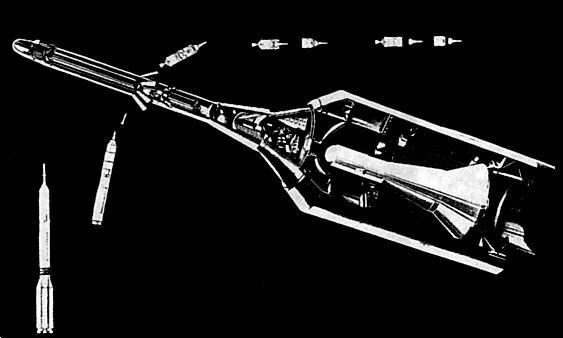 | TKS VA Test 20,057 bytes. 563 x 338 pixels. |