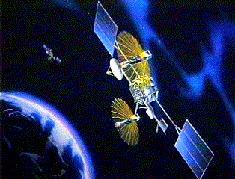
Credit: Lockheed-Martin. 12,114 bytes. 235 x 179 pixels.
| astronautix.com | TDRS |
|
| TDRS - Credit: Lockheed-Martin. 12,114 bytes. 235 x 179 pixels. |
Satellite communications network, for use by Shuttle and US military satellites. When first launched, the TDRS satellites were the largest, most sophisticated communications satellites ever built. The seventh vehicle in the series was ordered as a replacement when TDRS-2 was lost in the Challenger accident.
Spacecraft: Hexagonal spacecraft and payload modules.3-Axis stabilised, zero momentum biased control system uses reaction wheels and Earth sensors. Two solar arrays provide 2 kW BOL (1.7 kW EOL). These arrays have an area of ~ 29 sq. m and are articulated about one axis. Two 40 Ahr NiCd batteries provide power during eclipse. A hydrazine propulsion system with 24 4.45 N thrusters is used for orbit circularisation and orbit maintenance. Spacecraft telemetry and commanding performed via a Ku-band communications system, with emergency backup provided by an S-band system. Payload: Antennas : Two Single Access (SA) antennas - each antenna is a 4.9 m diameter molybdenum wire mesh antenna that can be used for Ku-band and S-band links. Each antenna is steerable in 2-axes and communicates with one target spacecraft at a time. One Multiple Access (MA) S-band antenna array - an electronically steerable phased array consisting of 30 fixed helix antennas. The MA array can receive data from up to 20 user satellites simultaneously, although it can transmit to only one satellite at a time. Twelve of the helices can transmit and receive, with the remainder only able to receive. One Space to Ground Link antenna (SGL) - a 2 meter parabolic antenna operating at Ku-band that provides the communications link between the satellite and the ground. All customer data is sent through this dish, as are all regular TDRS command and telemetry signals. The antenna is gimballed on two axes. One S-band omni antenna - a conical log spiral antenna used during the satellite's deployment phase and as a backup the event of a spacecraft emergency. This antenna does not support customer links. One small Ku-band and one small C-band antenna are also carried, designed to support communications with Westar satellites, but are no longer used. Transponders Four (plus 2 spare) 25W Ku-band TWTAs for LP (linearly polarised) zone coverage. Two (plus 2 spare) 1.5W Ku-band TWTAs for CP (circularly polarised) spot coverage. Two (plus 4 spare) 25W Ku-band TWTAs for LP zone coverage. Two (plus 2 spare) 1.5W Ku-band TWTAs for CP spot coverage12 5W TWTAs for LP C-Band up/downtown (plus 2 spare) 26W S-band SSPAs (used for intersatellite links)Eight (plus 4 spare) 3.5W S-band SSPAs (used for intersatellite links)
Financial/Operational:
Hughes contract on February 23 1995 for TDRS replacement - $ 481.6 million for 3 HS-601 spacecraft with added Ka band. Last launch set for 2002. Program cost to 1997 $ 3.3 billion over 10 years.
 | STS-6 - Deployment of the TDRS by STS-6 Challenger Credit: NASA. 33,018 bytes. 420 x 437 pixels. |
Design Life: 10 years. Maximum Diameter: 3.0 m. Total Mass: 2,240 kg.
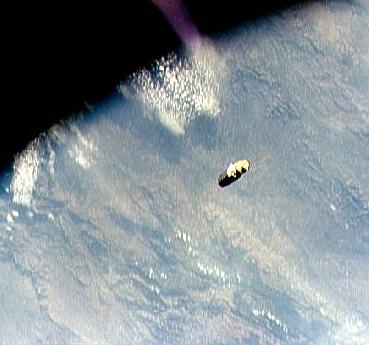 | STS-6 - TDRS satellite over African Rift Valley, Kenya, Africa Credit: NASA. 22,221 bytes. 369 x 345 pixels. |
 | STS-26 - STS-26 Discovery, Orbiter Vehicle (OV) 103, IUS / TDRS-C deployment Credit: NASA. 52,498 bytes. 476 x 474 pixels. |
 | STS-26 - STS-26 Discovery, Orbiter Vehicle (OV) 103, IUS / TDRS-C deployment Credit: NASA. 46,762 bytes. 472 x 470 pixels. |
 | STS-26 - STS-26 Discovery, Orbiter Vehicle (OV) 103, IUS / TDRS-C deployment Credit: NASA. 52,238 bytes. 477 x 474 pixels. |
 | STS-26 - STS-26 Discovery, Orbiter Vehicle (OV) 103, IUS / TDRS-C deployment Credit: NASA. 35,352 bytes. 467 x 462 pixels. |
 | STS-26 - STS-26 Discovery, Orbiter Vehicle (OV) 103, IUS / TDRS-C deployment Credit: NASA. 15,354 bytes. 473 x 373 pixels. |
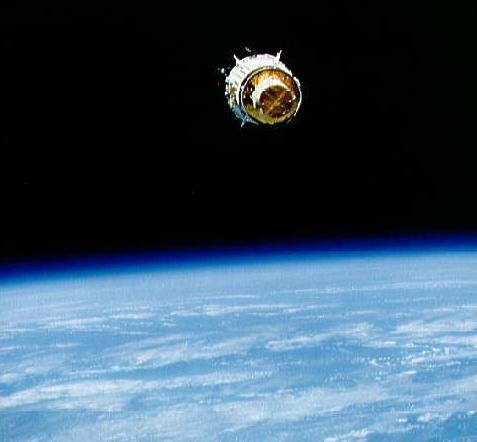 | STS-29 - STS-29 IUS with TDRS-D drifts above Earth's surface during post deployment Credit: NASA. 17,477 bytes. 477 x 442 pixels. |
 | STS-29 - STS-29 IUS with TDRS-D after deployment from Discovery, OV-103 Credit: NASA. 2,940 bytes. 187 x 160 pixels. |