 |
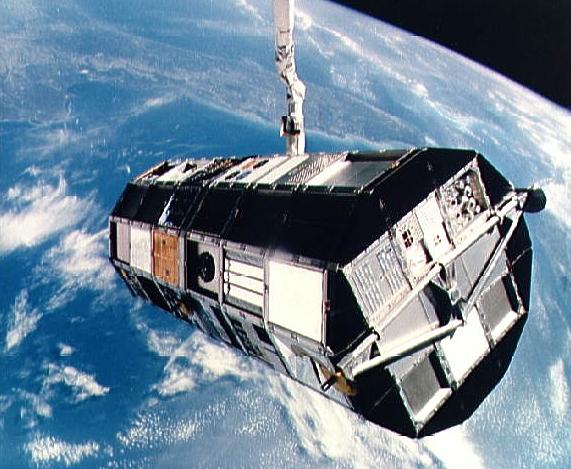
| STS-41-C Florida Peninsula, LDEF Deploy-RMS Credit: NASA. 57,989 bytes. 571 x 469 pixels. |
| astronautix.com | LDEF |
|
| STS-41-C Florida Peninsula, LDEF Deploy-RMS Credit: NASA. 57,989 bytes. 571 x 469 pixels. |
NASA's Long Duration Exposure Facility (LDEF) was designed to provide long-term data on the space environment, including micrometeoroids, and its effects on materials degradation and satellite systems (including power, propulsion, and optics). The mission's 57 experiments included participation of more than 200 principal investigators from 33 private companies, 21 universities, seven NASA centres, nine Department of Defense laboratories and eight foreign countries. LDEF was released from STS 41-C in April 1984 for a planned one year mission before retrieval by another Shuttle mission. Its planned retrieval was temporarily postponed in March 1985, and then indefinitely postponed by the loss of the Challenger in 1986. It was finally retrieved by STS-32 in January 1990 and returned to Earth. At the time of its retrieval LDEF was about one month away from re-entering the Earth's atmosphere. Many of the experiments were enhanced by the extended stay in space. After landing, the experiments were returned to the investigators' institutions for analysis. Spacecraft: Twelve-sided aluminum, steel, and titanium cylinder. Gravity gradient stabilised. Viscous magnetic damper to damp out initial oscillations. No telemetry, power, or propulsion systems. No attitude sensors. Payload: 57 materials, electronics, and micrometeoroid experiments mounted in 86 trays on the outside of the vehicle.
 | STS-32 - LDEF Retrieval over the Namib Desert, Namibia, Africa Credit: NASA. 47,031 bytes. 527 x 475 pixels. |
Design Life: 1 year. Total Length: 9.1 m. Maximum Diameter: 4.3 m. Total Mass: 3,625 kg.
Long Duration Exposure Facility; deployed from STS 41C 4/7/84; retrieved by STS-32 1/20/90. Spacecraft engaged in research and exploration of the upper atmosphere or outer space (US Cat B).
 | STS-32 - LDEF positioned by RMS over OV-102's payload during STS-32 retrieval Credit: NASA. 63,004 bytes. 624 x 429 pixels. |
NASA's Long Duration Exposure Facility (LDEF) was designed to provide long-term data on the space environment. LDEF was released from STS 41-C in April 1984 for a planned one year mission before retrieval by another Shuttle mission. Its planned retrieval was postponed by the loss of the Challenger in 1986. It was finally retrieved by STS-32 in January 1990 and returned to Earth. At the time of its retrieval LDEF was about one month away from re-entering the Earth's atmosphere. Many of the experiments were enhanced by the extended stay in space.
 | STS-32 - LDEF grappled by remote manipulator system (RMS) during STS-32 retrieval Credit: NASA. 36,352 bytes. 550 x 448 pixels. |