5,163 bytes. 207 x 280 pixels.
| astronautix.com | IMAGE |
|
| IMAGE - 5,163 bytes. 207 x 280 pixels. |
IMAGE was the first of its kind, designed to actually "see" most of the major charged particle systems in the space surrounding Earth. Previous spacecraft explored the magnetosphere by detecting particles and fields they encountered as they passed through them. This technique limited their "vision" to small portions of this vast and dynamic field, which extends about 40,000 miles on Earth�s day side and about 110,000 miles on Earth�s night side. It would be similar to attempt understanding the nature of the world�s oceans from a single buoy.
Just as taking a photograph of the night sky allows astronomers to count and study millions of stars at once, images returned by the IMAGE spacecraft were to provide simultaneous measurements of the densities, energies and masses of charged particles throughout the inner magnetosphere using three-dimensional imaging techniques.
During its two-year mission, the half-ton IMAGE spacecraft was to image remote particle populations in the magnetosphere. These "photographs" would then be linked together to make movies in real time. Their rapid two-minute cadence was to allow detailed study of the interaction of the solar wind with the magnetosphere and the magnetosphere�s response during a magnetic storm, which typically lasted a few days. IMAGE also used a real-time down link to the National Oceanic and Atmospheric Administration for space weather forecasting
IMAGE employed six instruments along with a data processor:
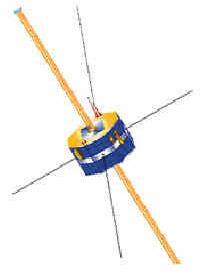
Lockheed Martin Missiles and Space of Sunnyvale, Calif. built the IMAGE spacecraft under contract with SwRI. On orbit, the RPI antennas aboard IMAGE extended 10 m parallel to the spin axis and 250 m in four directions perpendicular to the spin axis, making IMAGE the longest spacecraft then in orbit.
Total Length: 1.5 m. Maximum Diameter: 2.3 m. Total Mass: 494 kg. Electric system: 0.29 total average kW.
Imager for Magnetopause to Aurora Global Exploration was a MIDEX (mid-sized Explorer mission) developed by NASA-Goddard and the SWRI (Southwest Research Institute) of San Antonio, Texas. The spin-stabilised spacecraft carried a set of neutral atom and ultraviolet imagers, and antennae to study radio wavelength emissions from the magnetosphere plasma. The RPI radio plasma imager has four long wire antennae which will be deployed to a span of half a kilometre.