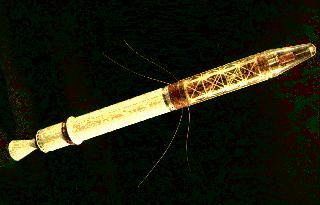
Credit: NASA. 11,241 bytes. 320 x 205 pixels.
| astronautix.com | Explorer A |
|
| Explorer 1 - Explorer 1 / Explorer A Credit: NASA. 11,241 bytes. 320 x 205 pixels. |
Discovered Van Allen radiation belts. Spacecraft engaged in research and exploration of the upper atmosphere or outer space.
Total Mass: 5 kg.
In a meeting, Dr. Wernher von Braun, Frederick C. Durant III, Alexander Satin, David Young, Dr. Fred L. Whipple, Dr. S. Fred Singer, and Commander George W. Hoover agreed that a Redstone rocket with a Loki cluster as the second stage could launch a satellite into a 200-mile orbit without major new developments. This became a joint Army-Navy study project after meeting at Redstone Arsenal on August 3. Project Orbiter was a later outgrowth of this proposal and resulted in the launching of Explorer I on January 31, 1958.
Von Braun report 'A Minimum Satellite Vehicle Based on Components Available from Developments of the Army Ordnance Corps' in response to June Pentagon meeting proposes $ 100,000 to launch satellite by Redstone.
Research and development Policy Council (DOD) unanimously recommended that the time-risk factor in the scientific satellite program be brought to the attention of the Secretary of the Defense for determination as to whether a Redstone backup program was indicated.
Von Braun briefs Secretary of Defence McElroy on Jupiter-C/Redstone for immediate US satellite launch. Promises launch in 60 days. Medaris says 90.
Explorer I, the first U.S. earth satellite, was launched by a modified Army Ballistic Missile Agency Jupiter-C. Explorer I, developed by the Jet Propulsion Laboratory, carried the U.S.-IGY (International Geophysical Year) experiment of James A. Van Allen and resulted in the discovery of the radiation belt around the earth.
Radiation, micrometeoroid data.