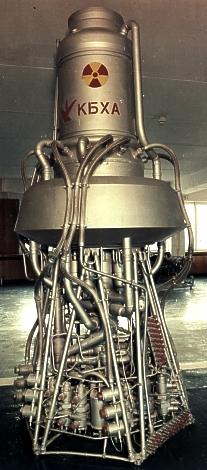
Credit: © Dietrich Haeseler. 25,183 bytes. 159 x 327 pixels.
| astronautix.com | Nuclear/LH2 |
|
| RD-0410 NTP Engine - RD-0410 Nuclear Thermal Engine Credit: © Dietrich Haeseler. 25,183 bytes. 159 x 327 pixels. |
Nuclear thermal engines use the heat of a nuclear reactor to heat a propellant. Although early Russian designs used ammonia or alcohol as propellant, the ideal working fluid is the liquid form of the lightest element, hydrogen. Nuclear engines would have twice the performance of conventional chemical rocket engines. Although successfully tested in both Russia and America, they have never been flown due primarily to environmental and safety concerns.
Liquid hydrogen was identified by all the leading rocket visionaries as the theoretically ideal rocket fuel. It had big drawbacks, however - it was highly cryogenic, and it had a very low density, making for large tanks. The United States mastered hydrogen technology for the highly classified Lockheed CL-400 Suntan reconnaissance aircraft in the mid-1950's. The technology was transferred to the Centaur rocket stage program, and by the mid-1960's the United States was flying the Centaur and Saturn upper stages using the fuel. It was adopted for the core of the space shuttle, and Centaur stages still fly today.
In Russia hydrogen fuelled upper stages were designed and developed by the mid-1970's, but the Russians never seem to have found the extra performance to be worth the extra cost. Europe and China developed liquid oxygen/liquid hydrogen engines for upper stages of the Ariane and Long March launch vehicles.
The equilibrium composition of liquid hydrogen is 99.79 per cent parahydrogen and 0.21 per cent orthohydrogen. The boiling point of this composition is -253 deg C. Liquid hydrogen is transparent and without a characteristic odour. Gaseous hydrogen is colourless. Hydrogen is not toxic but is an extremely flammable material. The flammable limits of gaseous hydrogen in air are 4.0 to 75 volume percent.
Hydrogen is produced from by-product hydrogen from petroleum refining and the partial oxidation of fuel oil. The gaseous hydrogen is purified to 99.999+ per cent, and then liquefied in the presence of paramagnetic metallic oxides. The metallic oxides catalyse the ortho-para transformation of freshly liquefied hydrogen. Freshly liquefied hydrogen which has not been catalysed consists of a 3:1 ortho-para mixture and cannot be stored for any length of time because of the exothermic heat of conversion. The delivered cost of liquid hydrogen in 1960 was approximately $ 2.60 per kg. Large-scale production was expected to reduce the cost to $ 1.00 per kg. In the 1980's NASA was actually paying $ 3.60 per kg.
| Eng-engineslink | Thrust(vac)-kgf | Thrust(vac)-kN | Isp-sec | Isp (sea level)-sec | Designed for | Status | RD-0410 | 3,600 | 35.30 | 910 | Upper Stages | Developed 1965-94 | RD-410 | 7,000 | 68.00 | Upper Stages | Developed 1960s | YaERD-2200 | 8,300 | 81.00 | Upper Stages | Developed 1962-69 | YaRD Type A | 18,000 | 177.00 | 900 | Upper Stages | Study 1963 | YaRD Type AF | 20,000 | 196.00 | 950 | Upper Stages | Study 1963 | Nerva | 27,206 | 266.00 | 800 | Upper Stages | Developed 1960's | Nerva NTR | 34,000 | 333.40 | 925 | Upper Stages | Design concept 1980's | YaRD Type V | 40,000 | 392.00 | 900 | Upper Stages | Study 1963 | YaRD Type V-B | 40,000 | 392.00 | 900 | Upper Stages | Study 1963 | RD-0411 | 40,000 | 392.00 | 900 | Upper Stages | Design concept 1965-94 | Timberwind 45 | 45,000 | 441.30 | 1,000 | 890 | Upper Stages | Developed -1990 | Timberwind 75 | 75,000 | 735.50 | 1,000 | 890 | Upper Stages | Developed -1990 | Nerva 2 | 88,451 | 867.40 | 825 | 380 | Upper Stages | Developed 1950-74 | RD-600 | 200,000 | 1,960.00 | 2,000 | Upper Stages | Developed 1962-70 | Timberwind 250 | 250,000 | 2,451.60 | 1,000 | 780 | Upper Stages | Developed -1990 | Nuclear 12 Gw | 295,000 | 2,892.00 | 830 | Upper Stages | Study, Ehricke, 1960 | Nuclear 14 Gw | 340,000 | 3,334.00 | 830 | Upper Stages | Study, Ehricke, 1960 | NERVA 1mlbf | 914,000 | 8,963.00 | 850 | Upper Stages | Study 1963 |