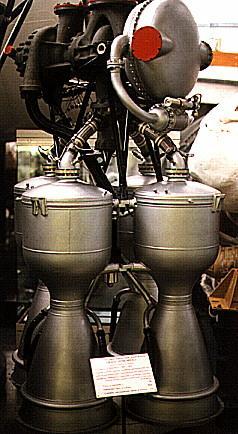
Credit: © Mark Wade. 28,354 bytes. 238 x 434 pixels.
| astronautix.com | Nitric Acid/Kerosene |
|
| RD-214 - Credit: © Mark Wade. 28,354 bytes. 238 x 434 pixels. |
Drawing on the German World War II Wasserfall rocket, nitric acid (HNO3) became the early storable oxidiser of choice for missiles and upper stages of the 1950's. To overcome various problems with its use, it was necessary to combine the nitric acid with N2O4 and passivation compounds. These formulae were considered extremely secret at the time. The propellant combinations WFNA/ JP-4 and later IRFNA/JP-4 were the first storable systems given serious consideration in the United States. Problems which caused the abandoning of these propellants were the absence of reliable hypergolic ignition and unstable combustion. IRFNA/UDMH and IRFNA/JP-X finally did prove satisfactory.
By the late 1950's it was apparent that N2O4 by itself was a better oxidiser. Therefore nitric acid was almost entirely replaced by pure N2O4 in storable liquid fuel rocket engines developed after 1960. The composition of propellant-grade nitric acids is covered by Military Specification MIL-N-7254. The nitric acids are fuming liquids which vary from colorless to brown, depending on the amount of dissolved N2O4. The vapours from these acids have a characteristic pungent odour. They are highly corrosive, toxic, oxidising agents and attack most metals. They react with most organic materials violently enough to cause fire. The acids are soluble in water in all proportions, with an accompanying evolution of heat. They cannot be made to explode. Approximately 90 per cent of the nitric acid is made by the catalytic oxidation of ammonia with air or oxygen to yield nitric oxide (NO). The latter is oxidised to N2O4 which, when treated with water, yields nitric acid (HNO3) and may be concentrated by distillation with sulphuric acid. Red fuming nitric acids may be produced by passing gaseous N2O4 into nitric acid, a slight modification of the above process. Production of nitric acid was estimated at 3 million tonnes in 1959. The price of RFNA was $ 0.20 per kg in drum lots; IRFNA was slightly higher. The varieties of nitric acid propellants include:
In January 1953 Rocketdyne commenced the REAP program to develop a number of improvements to the engines being developed for the Navaho and Atlas missiles. Among these was development of a special grade of kerosene suitable for rocket engines. Prior to that any number of rocket propellants derived from petroleum had been used. Goddard had begun with gasoline, and there were experimental engines powered by kerosene, diesel oil, paint thinner, or jet fuel kerosene JP-4 or JP-5. The wide variance in physical properties among fuels of the same class led to the identification of narrow-range petroleum fractions, embodied in 1954 in the standard US kerosene rocket fuel RP-1, covered by Military Specification MIL-R-25576. In Russia, similar specifications were developed for kerosene under the specifications T-1 and RG-1. The Russians also developed a compound of unknown formulation in the 1980's known as 'Sintin', or synthetic kerosene. Rocket propellant RP-1 is a straight-run kerosene fraction, which is subjected to further treatment, i.e., acid washing, sulphur dioxide extraction. Thus, unsaturated substances which polymerise in storage are removed, as are sulphur-containing hydrocarbons. Furthermore, in order to meet specification requirements of density, heat of combustion, and aromatic content, the kerosene must be obtained from crudes with a high naphthene content. RP-1 is an excellent solvent for many organic materials. The flash point is above 43 deg C. Above that temperature RP-1 will form explosive mixtures with air. The temperature range for explosive mixtures (rich limit) is 79 to 85 deg C. RP-1 is not so toxic as the JP series of fuels because of its lower aromatic content. In the United States, suitable kerosene fractions in 1960 were limited almost exclusively to the West Coast. The estimated 1956 United States production was 7700 tonnes, and the price was $0.05 per kg. By the 1980's it was typically $ 0.20 per kg. Russian formulations have typical densities of 0.82 to 0.85 g/cc, and even higher densities were achieved in the N1 and Soyuz 11A511U rockets by superchilling the fuel prior to loading.
| Eng-engineslink | Thrust(vac)-kgf | Thrust(vac)-kN | Isp-sec | Isp (sea level)-sec | Designed for | Status | RD-1KhZ | 300 | 2.94 | 200 | First Stages | Developed 1941-46 | RD-1 | 300 | 2.94 | 200 | First Stages | Developed 1941-45 | RD-2 | 612 | 6.00 | 200 | First Stages | Developed 1945-47 | RD-3 | 918 | 9.00 | 190 | First Stages | Developed 1950's | RD-2MZV | 1,400 | 13.70 | First Stages | Developed 1944-47 | RD-2MZV-F | 2,000 | 19.60 | First Stages | Developed 1946 | RD-210 | 3,044 | 29.85 | 241 | 214 | First Stages | Developed -1954 | Otrag | 5,985 | 58.70 | 250 | 240 | First Stages | Out of Production | S2.253A | 9,500 | 93.00 | 218 | First Stages | Out of Production | S2.253 | 9,514 | 93.30 | 251 | 219 | First Stages | In Production | RD-200 | 10,045 | 98.51 | 234 | 210 | First Stages | Developed -1951 | Isayev R-17 | 13,379 | 131.20 | First Stages | Out of Production | RD-212 | 63,500 | 623.00 | 253 | 227 | First Stages | Developed 1952-56 | RD-211 | 65,500 | 642.30 | 262 | 224 | First Stages | Developed 1952-55 | RD-214 | 74,350 | 730.00 | 264 | 230 | First Stages | Out of Production | RD-213 | 77,000 | 755.00 | 254 | 231 | First Stages | Developed 1956-57 | R-56 Blok B | 80,000 | 784.00 | 330 | Upper Stages | Design concept 1961 | R-56 Blok A | 450,000 | 4,412.00 | 320 | 300 | First Stages | Design concept 1961 |