Credit: NASA. 33,508 bytes. 386 x 305 pixels.
| astronautix.com | LOX/Hydyne |
|
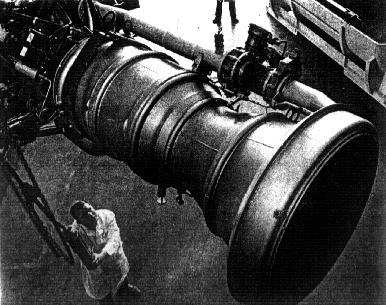
| Redstone engine - Credit: NASA. 33,508 bytes. 386 x 305 pixels. |
Liquid oxygen was the earliest, cheapest, safest, and eventually the preferred oxidiser for large space launchers. Its main drawback is that it is moderately cryogenic, and therefore not suitable for military uses where storage of the fuelled missile and quick launch are required. Liquid oxygen, as normally supplied, is of 99.5 percent purity and is covered in the United States by Military Specification MIL-P-25508. High purity liquid oxygen has a light blue colour and is transparent. It has no characteristic odour. Liquid oxygen does not burn, but will support combustion vigorously. The liquid is stable; however, mixtures of fuel and liquid oxygen are shock-sensitive. Gaseous oxygen can form mixtures with fuel vapours that can be exploded by static electricity, electric spark, or flame. Liquid oxygen is obtained from air by fractional distillation. The 1959 United. States production of high-purity oxygen was estimated at nearly 2 million tonnes. The cost of liquid oxygen, at that time, ex-works, was $ 0.04 per kg. By the 1980's NASA was paying $ 0.08 per kg.
Hydyne was a propellant blend pushed rather vigorously by the Redstone arsenal in the late 1950's, but it found little application. Hydyne, which is also known as MAF-4, is a 60 per cent, by weight, mixture of UDMH and 40 weight percent diethyltrianine (DETA). The normally occurring impurities are dimethylamine, beta-aminoethyl-N-piperazine, and water. Hydyne is a clear, colourless liquid which may become discoloured on exposure to air during storage. Both UDMH and DETA have an ammoniacal odour; the odour is not so sharp or fishy as that of UDMH. Hydyne is a hygroscopic liquid which will absorb carbon dioxide and oxygen from air. It is completely miscible with water and ethanol; the solubility of gasoline and JP-4 in Hydyne are somewhat limited. It forms flammable explosive mixtures with air. Amines generally yellow during storage due to oxidation followed by polymerisation induced by air (O2)� reaction is believed to form an intermediate amine oxide which undergoes polymerisation. The cost of Hydyne in 1959 was $ 0.80 per kg.
| Eng-engineslink | Thrust(vac)-kgf | Thrust(vac)-kN | Isp-sec | Isp (sea level)-sec | Designed for | Status | A-7 | 42,439 | 416.20 | 265 | 235 | First Stages | Out of Production |