31,000 bytes. 206 x 452 pixels.
| astronautix.com | SLS BC-2720 |
|
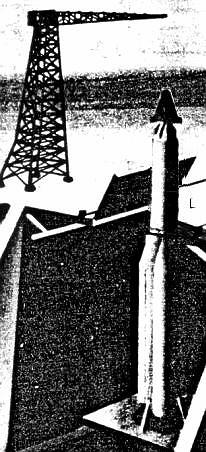
| Lunex BC-2720 LV - Lunex BC-2720 launch vehicle installed on the pad. 31,000 bytes. 206 x 452 pixels. |
In 1961 the Air Force completed several years of studies for a family of advanced heavy-lift launch vehicles for use in the late 1960's and on. Development of solid and liquid rocket engines was already begun to support this effort. One member of this family, selected to boost the Air Force Lunex lunar lander on a direct lunar trajectory, was the BC-2720. This would have used four 180 inch solid rocket boosters strapped around an the 'C' Lox/LH2 core vehicle. The core would have required either 12 J-2 engines or 2 M-1 engines. The translunar injection third stage was the 'B', with a single J-2 engine.
NASA, not the Air Force, received the task of going to the moon and building large boosters. But the Saturn series was abandoned, while the BC-2720 resembles very much the Shuttle configuration. Perhaps if things had been different...
LEO Payload: 158,800 kg. to: 560 km Orbit. at: 28.0 degrees. Payload: 60,800 kg. to a: translunar trajectory. Liftoff Thrust: 3,000,000 kgf. Total Mass: 2,600,000 kg. Core Diameter: 7.6 m. Total Length: 93.0 m.
The launchers used solid rocket boosters together with Lox/LH2 upper stages. The modular stages could be combined in various ways to achieve a range of launch vehicles (as for the USAF Lunex lunar base project). These studies would provide the basis for the later Titan derivatives and, eventually, the final space shuttle design.
 | Lunex Launch Pad - Lunex Launch Pad with BC-2720 vehicle in assembly. The Lunex upper stage package has been integrated with the 'B' stage and will be installed by crane on the C-2720 booster and core stage assembly already installed in the cliff-side pad. 51,000 bytes. 382 x 470 pixels. |
 | Lunex BC-2720 LV - Lunex BC-2720 launch vehicle. 8,000 bytes. 87 x 480 pixels. |