Credit: © Mark Wade. 8,253 bytes. 99 x 442 pixels.
| astronautix.com | R-36 |
|
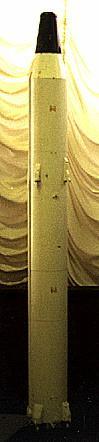
| 8K67 Model - Credit: © Mark Wade. 8,253 bytes. 99 x 442 pixels. |
The Global Rocket 1 (GR-1) requirement was to provide the Soviet Union with a single launch vehicle for several unmanned space combat vehicles. The primary ICBM mission was to send a large thermonuclear warhead over a range of 12,000 km. Chelomei proposed his UR-200 for the requirement, while Yangel offered the R-36, and Korolev the 8K713. Korolev's GR-1 experienced delays due to engine development and was cancelled before flight tests could begin. The UR-200 entered flight test; but the Yangel R-36 was found to be superior and selected after the downfall of Chelomei's patron, Khrushchev. 318 were deployed in five versions from 1966. This missile tilted the strategic balance and became known to the West as the awesome SS-9 Scarp 'city buster'.
Payload: 5,400 kg. to a: 12,000 km trajectory. Liftoff Thrust: 241,300 kgf. Total Mass: 185,000 kg. Core Diameter: 3.0 m. Total Length: 32.5 m.
Decree 'On Important Development of Intercontinental Ballistic and Global Missiles and Carriers-Rockets for Space Objects--work on the N1, R-36, R-36-O, and R-56' was issued.
State Committee for Defence Technology (GKOT) Decree 'On Detailed Work on Ampulized R-36 and R-36-O Missiles--design work on the R-36 and R-36-O missiles' was issued.
Decree 'On approval of the R-36 ICBM variant with countermeasures to overcome anti-ballistic missiles and on adoption of the R-36 ICBM into armaments' was issued.