 |
| Pegasus XL 10,746 bytes. 449 x 108 pixels. |
| astronautix.com | Pegasus XL |
|
| Pegasus XL 10,746 bytes. 449 x 108 pixels. |
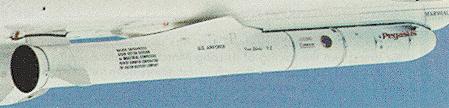
Uprated version of Pegasus air-launched winged light satellite launcher.
Launches: 20. Failures: 3. Success Rate: 85.00% pct. First Launch Date: 27 June 1994. Last Launch Date: 07 June 2000. LEO Payload: 443 kg. to: 185 km Orbit. at: 28.5 degrees. Payload: 190 kg. to a: Sun synchronous, 800 km, 98.5 deg orbital trajectory. Liftoff Thrust: 49,623 kgf. Total Mass: 24,000 kg. Core Diameter: 1.3 m. Total Length: 17.6 m. Launch Price $: 12.00 million. in 1994 price dollars.
Destroyed on launch
Space Test Experiment Platform.
LEO
LEO. Total Ozone Mapping Spectrometer-Earth Probe; atmospheric ozone mapping.
Second Small Explorer mission.
The High Energy Transient Experiment (HETE) is an international mission led by The Massachusetts Institute of Technology (MIT). Its prime objective is to carry out the first multiwavelength study of gamma ray bursts (GRBs) with UV, X-ray, and gamma ray instruments. A unique feature of the mission is its capability to localise bursts with several arcsecond accuracy, in near real-time aboard the spacecraft. These positions are transmitted to the ground, and picked up by a global network of primary and secondary ground stations (SGS), enabling sensitive follow-up studies.
Minisat-01 carried the EURD extreme ultraviolet spectrograph to study interstellar gas, the LEGRI gamma ray burst detector, and the CPLM microacceleration in liquids experiment.
FORTE - 'Fast On-orbit Recording of Transient Events' - was a US Los Alamos National Laboratory satellite designed to study natural and artificial radio emissions from the ionosphere. This data was needed to develop technology for monitoring nuclear test ban treaties.
Plane A. Ascending node 300.5 degrees.
Plane A. Ascending node 301 degrees.
Plane A. Ascending node 301.2 degrees.
Plane A. Ascending node 301.2 degrees.
Plane A. Ascending node 297.7 degrees.
Plane A. Ascending node 301 degrees.
Plane A. Ascending node 301.2 degrees.
Plane A. Ascending node 300.7 degrees.
SNOE, the Student Nitric Oxide Explorer. Small satellite built by the University of Colorado to measure the Nitric Oxide density as a function of altitude. First satellite in the STEDI (Student Explorer Demonstration Initiative) program.
NASA's third Small Explorer, the Transition Region and Coronal Explorer (TRACE), was successfully launched by an Orbital Pegasus XL. The L-1011 carrier aircraft took off from Vandenberg and dropped the Pegasus over the Pacific Ocean. TRACE, a project led by Lockheed's solar physics group, carried a 30-cm extreme ultraviolet imaging telescope which will study the Sun. The telescope mirrors were made by the Smithsonian Astrophysical Observatory. TRACE had an 8.5 arcmin field of view and 1 arcsecond resolution.
Plane B. Ascending node 60.4 degrees.
Plane B. Ascending node 60.4 degrees.
Plane B. Ascending node 61 degrees.
Plane B. Ascending node 59.7 degrees.
Plane B. Ascending node 61.1 degrees.
Plane B. Ascending node 61.2 degrees.
Plane B. Ascending node 59.9 degrees.
Plane B. Ascending node 60 degrees.
Plane C. Ascending node 178 degrees.
Plane C. Ascending node 181.6 degrees.
Plane C. Ascending node 181.8 degrees.
Plane C. Ascending node 181.7 degrees.
Plane C. Ascending node 181.5 degrees.
Plane C. Ascending node 181.5 degrees.
Plane C. Ascending node 181.6 degrees.
Plane C. Ascending node 181.7 degrees.
On December 3 the Orbital Sciences L-1011 Stargazer took off from Vandenberg AFB Runway 30/12 carrying a Pegasus XL launch vehicle with the SWAS satellite aboard. It reached the drop box at 36.0N 123.0W over the Pacific, but due to a software-related problem the range ordered the launch scrubbed and the L-1011 returned to base. After a further delay due to weather, the L-1011 took off at 23:58 GMT on December 5 and SWAS reached orbit and separated from the third stage at 01:09 GMT. SWAS, the Sub-millimetre Wave Astronomy Satellite, had a 0.6m telescope with a 490 to 550 GHz sub-millimetre receiver and an acousto-optical spectrometer. SWAS was used to study the cooling of molecular cloud cores, the sites of star formation in our galaxy, by measuring lines from molecular oxygen and water.
NASA's long-delayed WIRE (Wide Field Infrared Explorer) astronomy satellite was the fifth Small Explorer (SMEX) mission managed by NASA-Goddard. The L-1011 Stargazer launch aircraft took off from Vandenberg's runway 30/12 at 01:55 GMT on March 2 for the first launch attempt. The planned 02:56 GMT launch was cancelled at T-46 seconds due to a problem with the tail fin release mechanism of the Pegasus XL launch vehicle. The second attempt was successful, with the Pegaus XL being dropped at 36 degrees N x 123 degrees W over the Pacific Ocean at 02:56 GMT. However the WIRE ran into serious trouble shortly after orbit injection. The cover of the solid hydrogen telescope ejected prematurely, and the cryogenic coolant evaporated and vented, spinning the satellite out of control. WIRE was going to make an infrared photometry survey, generating a large catalog of galaxies and quasars.
TERRIERS was part of NASA's Student Explorer Demonstration Initiative (STEDI), which was a precursor program to the UNEX (University Explorer) series. STEDI was managed by USRA (the Universities Space Research Association) for NASA, while UNEX was to be more directly managed by NASA-GSFC. TERRIERS was to be operated by the space physics group at Boston University for ionosphere studies, and carried TESS, a set of extreme ultraviolet (EUV) spectrographs to get electron density and thermosphere emission profiles. The GISSMO instrument measured the solar EUV flux. The spacecraft was built by AeroAstro and based on HETE. TERRIERS was placed in the correct orbit, but it failed to orient its solar panel to the Sun and ran out of battery power by May 20. Controllers were optimistic that when its orbit processes to a better sun angle the satellite could be revived. Additional Details: TERRIERS.
After deploying the TERRIERS satellite, the conical Payload Adapter Fitting (1998-26E) was jettisoned at 05:21 GMT, leaving the disk-shaped MUBLCOM satellite attached to the Pegasus XL PRIMEX HAPS-Lite stage. The second HAPS burn at 05:22 GMT raised apogee to 775 km, followed by a third, apogee burn at 06:10 GMT which circularised the orbit. MUBLCOM was deployed to a 769 km x 776 km x 97.7 degree orbit. The final HAPS burn then placed the depleted HAPS stage in a lower 388 km x 722 km x 97.1 degree disposal orbit. MUBLCOM (Multiple beam Beyond Line-of-sight Communications) was an experimental satellite funded by DARPA and managed by the US Army's Communications-Electronics Command (CECOM) at Ft Monmouth, New Jersey. It was built by Orbital Sciences using the Microstar (Orbcomm type) bus and carries a payload testing hand-held radio satellite communications for the armed forces.
Seven Orbcomms launched, rather than eight as on previous flights.
Fifth STEP (Space Test Experiments Program) satellite. The satellite's main section was the STRV-2 experiment module, sponsored by the Ballistic Missile Defense Organization and the UK Ministry of Defense. This was to take infrared images of UK military aircraft at perigee, and then downlink data via laser. STRV-2 also carried vibration isolation and debris impact sensors. A secondary payload was the S97-1 CEASE (Compact Environmental Anomaly Sensor). This was an AFRL prototype sensor package to provide warning of spacecraft charging and radiation events.