 |
| Pegasus 26,740 bytes. 530 x 189 pixels. |
| astronautix.com | Pegasus |
|
| Pegasus 26,740 bytes. 530 x 189 pixels. |
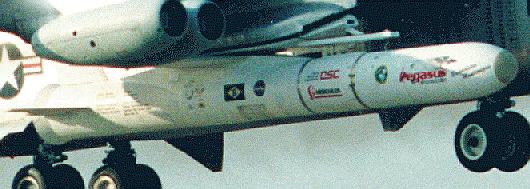
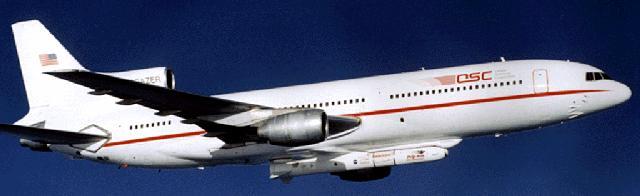
Privately-funded, air-launched winged light satellite launcher.
Launches: 10. Failures: 1. Success Rate: 90.00% pct. First Launch Date: 05 April 1990. Last Launch Date: 09 October 2000. LEO Payload: 375 kg. to: 200 km Orbit. Liftoff Thrust: 49,623 kgf. Total Mass: 19,000 kg. Core Diameter: 1.3 m. Total Length: 15.5 m. Development Cost $: 55.00 million. in 1999 average dollars. Launch Price $: 11.00 million. in 1994 price dollars.
 | Pegasus Credit: Orbital Sciences Corporation. 18,349 bytes. 640 x 196 pixels. |
Chemical release experiment. Spacecraft engaged in research and exploration of the upper atmosphere or outer space (US Cat B).
Store and forward.
Test of LEO network for global communications.
Test of LEO network for global communications.
Test of LEO network for global communications.
Test of LEO network for global communications.
 | Pegasus Credit: © Mark Wade. 693 bytes. 73 x 166 pixels. |
Test of LEO network for global communications.
Test of LEO network for global communications.
Experimental spacecraft. Spacecraft engaged in research and exploration of the upper atmosphere or outer space (US Cat B).
Environmental data relay. The SCD-1 (Data Collection Satellite 1) was a Brazilian satellite designed for the collection of meteorological data relayed by data collection platforms spread throughout the Brazilian territory.
Test of X-ray imaging sensors; solar array deployment malfunction. Spacecraft engaged in research and exploration of the upper atmosphere or outer space (US Cat B).
Did not achieve planned orbit, though still useful. Space craft engaged in investigation of spaceflight techniques and technology (US Cat A).
Advanced Photovoltaic and Electronic Experiments; studied radiation and plasma effects on solar power systems.
Commercial communications testbed. Plane F. Ascending node 199.1 degrees.
Lightning mapper; GPS radio occultation.
Commercial communications testbed. Plane F. Ascending node 198.5 degrees.
LEO. Sensor technology tests
Brazil's SCD-2 satellite was aboard Orbital Science's L-1011 Stargazer aircraft when it took off from the Cape Canaveral Air Station's Skid Strip (Runway 02/20, 28.2N 80.6W) at 23:05 GMT on Oct 22 and flew to the drop zone near Cape Canaveral (in the Mayport, Florida, Warning Area) at 29.0N 78.3W. The Pegasus ignited 5 seconds after drop. The first stage carried a NASA experiment attached to its right wing, to study hypersonic boundary layer separation. The 115 kg Satelite de Coleta de Dados (Data Collection Satellite) relays data from environmental monitoring stations.
Second High Energy Transient Explorer; built by MIT using leftover parts from the first HETE. This failed to operate because of a Pegasus adapter failure during launch in November 1996. MIT operates the satellite, while the program is managed by NASA GSFC as an Explorer mission of opportunity. HETE's main instrument is FREGATE, the French Gamma Telescope, a hard X-ray spectrometer operating in the 6 to 400 keV energy range. This gamma ray burst detector, together with a Wide Field X-ray Monitor hard X-ray coded mask telescope, is used to trigger searches with the two Soft X-ray Imagers which have 33-arcsecond spatial resolution. This will let astronomers get precise locations for gamma-ray bursts, allowing detailed follow-up with optical instruments. The satellite is in a 595 x 636 km x 2.0 deg equatorial orbit, and sends data to a network of small ground terminals spaced around the equator.