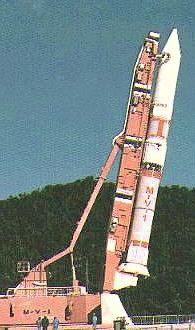
Credit: NASDA. 16,821 bytes. 195 x 330 pixels.
| astronautix.com | M-V |
|
| MV-1B - Credit: NASDA. 16,821 bytes. 195 x 330 pixels. |
All-solid satellite launch vehicle.
Launches: 3. Failures: 1. Success Rate: 66.67% pct. First Launch Date: 12 February 1997. Last Launch Date: 10 February 2000. LEO Payload: 1,800 kg. to: 200 km Orbit. at: 30.0 degrees. Payload: 1,300 kg. to a: 200 km, 90 deg inclination orbital trajectory. Liftoff Thrust: 430,000 kgf. Total Mass: 137,500 kg. Core Diameter: 2.5 m. Total Length: 30.8 m. Development Cost $: 220.00 million. in 1997 average dollars. Launch Price $: 60.00 million. in 1999 price dollars.
Originally known as Planet-B; renamed Nozomi ('Hope') after launch. The third stage and payload entered a 146 x 417 km x 31.1 deg parking orbit. The KM-V1 kick (fourth) stage then fired to place the spacecraft into a circumlunar 359 x 401491 km x 28.6 deg orbit. Nozomi made multiple lunar and Earth gravity assist passes to increase its energy for solar orbit insertion and the cruise to Mars.. The spacecraft used a lunar swingby on 24 September and another on 18 December 1998 to increase the apogee of its orbit. It swung by Earth on 20 December at a perigee of about 1000 km. The gravitational assist from the swingby coupled with a 7 minute burn of the bipropellant engine put Nozomi into an escape trajectory towards Mars. It was scheduled to arrive at Mars on 11 October 1999 at 7:45:14 UT, but the Earth swingby left the spacecraft with insufficient acceleration and two course correction burns on 21 December used more propellant than planned, leaving the spacecraft short of fuel. The new plan is for Nozomi to remain in heliocentric orbit for an additional four years and encounter Mars at a slower relative velocity in December 2003.
X-ray astronomy satellite. Stage 1 lost control, and separated with the rocket off-course at 75 seconds in the flight. Stage 2 burned correctly and separated at 218 seconds, followed by the third stage burn at 621 seconds. Last signals were received at 20 minutes after launch. ASTRO-E was to have separated from the third stage at 23 minutes, but ended in an orbit with a perigee of only 80 km and an apogee of 410 km. It probably reentered on the first orbit at around 0230 - 0300 GMT somewhere between East Africa and western China.