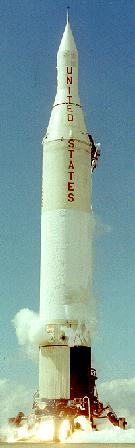
10,250 bytes. 135 x 448 pixels.
| astronautix.com | Juno II |
|
| Juno 2 - Juno 2 - COSPAR 1959-Iota 10,250 bytes. 135 x 448 pixels. |
Satellite launcher derived from Jupiter IRBM.
Launches: 10. Failures: 6. Success Rate: 40.00% pct. First Launch Date: 06 December 1958. Last Launch Date: 24 May 1961. LEO Payload: 41 kg. to: 200 km Orbit. Payload: 6 kg. to a: Translunar trajectory. Liftoff Thrust: 68,040 kgf. Total Mass: 55,110 kg. Core Diameter: 2.7 m. Total Length: 24.0 m. Development Cost $: 84.50 million. in 1958 average dollars. Launch Price $: 10.83 million. in 1985 price dollars. Total Development Built: 30. Total Production Built: 68. Flyaway Unit Cost $: 0.73 million. in 1960 unit dollars. Cost comments: Development cost, flyaway cost is for Jupiter IRBM.
Huntsville proposes Jupiter 1500 miles range/2500 lb payload. AF proposes Thor. Both authorized. Jupiter also ship-launch capable.
Secretary of Defense approved Jupiter and Thor IRBM programs, the first based on experience gained by Redstone Arsenal team from V-2 and Redstone, the latter on experience gained from Atlas program.
Largest U.S. test stand for rocket motors was completed at Redstone Arsenal, slated for Jupiter IRBM.
Following Navy withdrawal from the Jupiter IRBM program, separate Army and Navy Ballistic Missile Committees were established under chairmanship of respective service secretaries. Navy withdrawal based on interest in solid-propellant Polaris as ship-based IRBM.
Secretary of Defence Wilson rules that Army could not develop missiles over 200 mile range. Jupiter assigned to AF.
4751st Air Defense Missile Wing to develop and conduct training program for Bomarc units, and the 864th Strategic Missile Squadron to be equipped with Jupiter IRBM, were both activated.
Failed to reach moon; provided radiation data. Pioneer III, the third U.S.-IGY intended lunar probe under the direction of NASA with the Army acting as executive agent, was launched from the Atlantic Missile Range by a Juno II rocket. The primary objective, to place the 12.95 pound scientific payload in the vicinity of the moon, failed. Pioneer III reached an altitude of approximately 70,000 miles and revealed that the earth's radiation belt comprised at least two distinct bands.
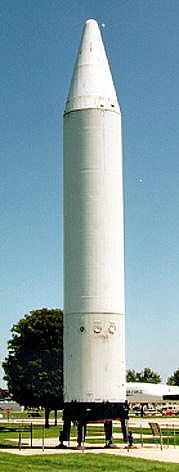 | Jupiter missile Credit: © Mark Wade. 12,374 bytes. 179 x 472 pixels. |
The fourth U.S.-IGY lunar probe effort, Pioneer IV, a joint project of the Army Ballistic Missile Agency and Jet Propulsion Laboratory under the direction of NASA, was launched by a Juno II rocket from the Atlantic Missile Range. Intended to impact on the lunar surface, Pioneer IV achieved earth-moon trajectory, passing within 60,200 km of the moon before going into permanent orbit around the sun.
Army announced that sea urchin eggs fertilized before Jupiter nose cone flight continued to grow normally.
As developmental planning for Project Mercury evolved, NASA notified the Army that to reduce the variety of launching vehicles to Jupiter missile would not be used for Project Mercury tests.
 | Juno 2 Credit: © Mark Wade. 517 bytes. 32 x 263 pixels. |
Ionospheric research. Spacecraft engaged in research and exploration of the upper atmosphere or outer space (US Cat B).
Gamma ray data. Spacecraft engaged in research and exploration of the upper atmosphere or outer space (US Cat B).