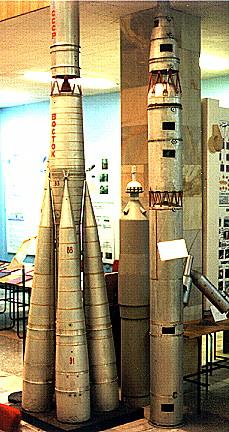
Credit: © Mark Wade. 30,995 bytes. 229 x 432 pixels.
| astronautix.com | GR-1 |
|
| Soyuz and GR-1 ICBM - Dynamic test models of Soyuz and GR-1 ICBM Credit: © Mark Wade. 30,995 bytes. 229 x 432 pixels. |
The Global Rocket 1 (GR-1) requirement of 1961 called for a system to place a large 1,500 kg nuclear warhead equipped with a deorbit rocket stage into a low earth orbit of 150 km altitude. The warhead could approach the United States from any direction, below missile tracking radar, so little warning was available. Not only could such a missile hit any point on earth, but the enemy would also be uncertain when it would be deorbited onto target. The main disadvantage was lower accuracy of the warhead in comparison to an ICBM.
Chelomei proposed his UR-200 for the requirement, while Yangel offered the R-36, and Korolev the 8K713. Korolev insisted on sticking to the liquid oxygen/kerosene propellants of his R-9 ICBM, despite the military's preference for the more toxic but storable propellants used by Yangel and Chelomei. Korolev considered the 8K713 a low risk project, using rocket elements already in development or production by his bureau:
Cancellation of the 8K713 had a significant and perhaps fatal impact on the project for Korolev�s N1 moon rocket: it was hoped that the GR-1 could be used to prove N1 engines and guidance systems. In a final bit of disinformation, the 8K713 mock-up was paraded in Red Square, and identified by NATO as an operational 'Scrag' ICBM. This confused Western defence analysts for many years to come.
LEO Payload: 1,500 kg. to: 150 km Orbit. at: 52.0 degrees. Payload: 4,000 kg. to a: 14,000 km trajectory. Liftoff Thrust: 155,000 kgf. Total Mass: 113,500 kg. Core Diameter: 2.7 m. Total Length: 39.0 m.
Central Committee of the Communist Party and Council of Soviet Ministers Decree 1021-436 'On start of work on the N1 and GR-1' was issued. Following a review of the N1 project by an Academy of Sciences expert commission headed by Keldysh in July, this decree provided a detailed plan leading to a first launch by the end of 1965. Planning and drawing release for the GR-1 were completed by this date and the decree ordered test flights to begin in the third quarter of 1963. However development problems with the NK-9 engine resulted in continual delays. Finally in 1964 Korolev's GR-1 was cancelled and Yangel�s R-36 was selected for the mission. This would deprive Korolev of a vital test-bed for flight test of the N1 engines.
 | GR-1 missile Credit: © Mark Wade. 1,491 bytes. 42 x 462 pixels. |
State Committee for Defence Technology (GKOT) Decree 640/06 'On start of work on the GR-1' was issued.