
13,911 bytes. 345 x 224 pixels.
| astronautix.com | FLTP |
|
| FLTP landing - FLTP orbiter lands 13,911 bytes. 345 x 224 pixels. |
The FLTP (Future Launcher Technology Program) was an ESA (European Space Agency) program, with responsibility assigned to CNES (Centre National d'Etudes Spatiales), the same center that developed Diamant and Ariane. The objective of FLTP was to identify and develop technologies necessary for the successor to Ariane 5. The planned configuration was a two-stage fully recoverable winged launch vehicle. The winged booster would deliver the orbiter to a given altitude, the two separate, and the booster flies back to its launch base. The second stage orbiter continues to orbit, delivers its payload and then returns to the original launch site on Earth. Launch and landing were to be from the CSG (Centre Spatial Guyanais) at Kourou. The first flight was planned for 2020. The spacecraft was designated to be unmanned. But its configuration could include human cargo at a later point.
The FLTP program was launched at the interministerial conference of ESA in May 1999, with funding of $ 48 million for 1999 to 2001. This was to be followed by an 18 month period during which a technology demonstration program would be defined for approval at the ESA interministerial council in mid-2001. This demonstration program would run from 2002 to 2007, at which time a decision on Ariane 5's successor could be made. Two flying demonstrators were envisioned for the technology phase:
 | FLTP Launch - FLTP Reusable Launch Vehicle Launch 18,463 bytes. 352 x 316 pixels. |
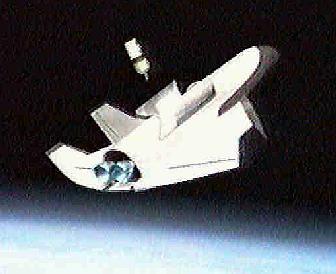 | FLTP Separation - Separation of Booster and Orbiter stages of European FLTP 15,862 bytes. 336 x 274 pixels. |
Thanks to Nicolas Pillet for providing images and information for this entry.
 | FLTP orbiter - FLTP orbiter releases payload 9,251 bytes. 323 x 272 pixels. |