
6,425 bytes. 84 x 480 pixels.
| astronautix.com | EKR |
|
| EKR Cutaway - 6,425 bytes. 84 x 480 pixels. |
B Chertok of NII-8 took the preliminary German R-15 cruise missile design and elaborated it, including consideration of the key problem of long-range automatic astronavigation. By 1951 to 1953 Korolev's design bureau had prepared an experimental design, the EKR. I Lisovich had developed a prototype astronavigation system that met the necessary specifications, and solution of basic problems in use of steel and titanium hot airframe technology had been solved at VIAM (All-Union Institute of Aviation Materials) and MVTU Bauman Institute. An expert commission in 1953 examined the EKR design and felt that there were still many technical problems to be solved, most of which were better handled by an aircraft designer rather than Korolev.
Further, Korolev had to place the highest priority on development of the R-7 ICBM. Therefore a final government decree on 20 May 1954 authorised the Lavochkin and Myasishchev aircraft design bureaux to proceed in parallel with full-scale development of trisonic intercontinental cruise missiles. The Eksperimentalniy krilatiy raket (experimental winged rocket) as designed by Korolev would have been a Mach 3 ramjet, accelerated to supersonic cruise speed by an R-11 booster. Smaller than the operational vehicle proposed by the Germans, it would have a range of 730 km with flight time of 927 seconds, a lift to drag ratio of 2.51, and a wing area 3.31 square meters.
Payload: 200 kg. to a: 730 km trajectory. Liftoff Thrust: 9,500 kgf. Total Mass: 7,874 kg. Core Diameter: 0.9 m. Total Length: 21.0 m.
German aerodynamicist Albring designed the G-3 missile for the Russians. This would use a rocket-powered Groettrup-designed G-1 as the first stage. The cruise stage would have an aerodynamic layout like that of the Saenger-Bredt rocket-powered antipodal bomber of World War II. Cruising at 13 km altitude, the supersonic missile would carry a 3000 kg warhead to a range of 2900 km. This was an alternate approach to Ustinov's 3000 kg over 3000 km range missile requirement of April 1949. This design would be elaborated at Korolev's bureau into the EKR ramjet design of 1953.
In 1951 to 1953 Korolev's design bureau had prepared an experimental trisonic ramjet design, the EKR.The expert commission ifelt that there were still many technical problems to be solved, most of which were better handled by an aircraft designer rather than Korolev. Further, Korolev had to place the highest priority on development of the R-7 ICBM. Therefore a final government decree on 20 May 1954 authorised the Lavochkin and Myasishchev aircraft design bureaux to proceed in parallel with full-scale development of trisonic intercontinental cruise missiles.
Council of Soviet Ministers (SM) Decree 'On approval of work on themes T1 and T2, on approval of work on the R-5, R-11, and EKR missiles, and on transferring draft project work for the R-12 from NII-88 to SKB-586' was issued. The decree set forth three phases of state trials tests for the R-5 missile.
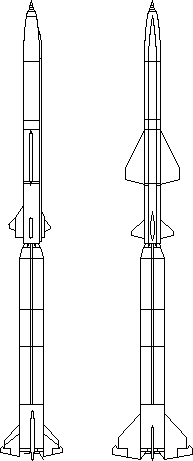 | EKR ramjet 2 view Credit: © Mark Wade. 3,441 bytes. 193 x 461 pixels. |
 | EKR ramjet 160 pixel Credit: © Mark Wade. 1,829 bytes. 81 x 461 pixels. |