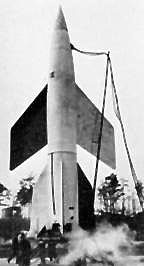
Credit: Gary Webster. 6,157 bytes. 144 x 266 pixels.
| astronautix.com | A4b |
|
| A4b Flight 1 - Credit: Gary Webster. 6,157 bytes. 144 x 266 pixels. |
Winged version of V-2 missile. A-4b designation used to disguise work on A-9 program. Two flown; manned version planned. The A4b had an empty mass 1350 kg greater than the basic V-2, with wings of 52 degree sweep. Another variation was conceived and under construction at the end of the war - a boosted version. This would use a ring of 10 solid propellant rockets to achieve Mach 6 cruise at 20,000 m altitude, extending the range by a further 400 km.
The A-4b was a winged V-2. This resurrected work on the A-9, abandoned in 1943 to concentrate on V-2 production. The A9 was to be the second stage of an ICBM designed to reach North America. By this time in the war the intent was to extend the range of the V-2 once Allied forces pushed the German lines so far back that Britain could no longer be targeted.
10 solid propellant rockets were delivered from the Wehrmacht to Pruefstand XII. Work was to be completed by the end of March to begin flight test of an extended-range using solid rocket boost. However Peenemuende was evacuated before the first flight test could be undertaken.
Germans successfully launched the A-4b, a prototype of the A-9 second stage of the first ICBM (the A-10) designed to reach North America. Although a wingtip sheared off in flight, the A4b reached a peak altitude of nearly 80 km and a maximum speed of 3960 m/s before entering a stable glide and achieving a range of 750 km. This concluded work on the A4b/A9; the increasingly chaotic situation in Germany prevented further flight tests.
 | A4b 3 view Credit: Gary Webster. 31,360 bytes. 536 x 414 pixels. |
 | A4b Flight 3 Credit: Gary Webster. 9,567 bytes. 153 x 302 pixels. |
 | A4b Cutaway Credit: Gary Webster. 9,675 bytes. 432 x 129 pixels. |
 | A-4b in Meilerwagen Credit: Gary Webster. 12,976 bytes. 274 x 179 pixels. |
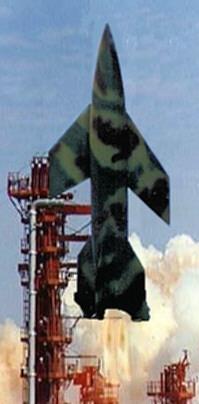 | Launch of A-9 Credit: © Mark Wade. 13,167 bytes. 199 x 404 pixels. |