
Credit: © Mark Wade. 10,913 bytes. 139 x 200 pixels.
| astronautix.com | RD-701 |
|
| RD-701 - Credit: © Mark Wade. 10,913 bytes. 139 x 200 pixels. |
The RD-701 was developed for the 22 tonne MAKS spaceplane, which was to have been launched at an altitude of 8 kilometres from the back of a behemoth An-225 Mriya transport. It was planned for 15 re-uses and featured both first and second stage engine characteristics in one reusable package. The tripropellant engine used dense kerosene and liquid oxygen for initial operations, then switched modes to a more modest thrust and higher specific impulse using low density liquid hydrogen and liquid oxygen. This reduced the huge hydrogen tank otherwise required. The state pulled out of the venture in cutbacks following perestroika but it was an extremely effective engine. A 9,000 kgf experimental engine with 19 injectors was tested. There were 50 test burns proving the separate modes and a smooth switch between them. Energomash states that if additional investment could be found use of the engine would lead to a 10 x cut in payload launch costs and make the development of a SSTO vehicle possible (VTOVL). Mass: 3990 kg assembly, 1840 kg each dry. Length: 5.4 m extension down, 3.8 m extension up. Diameter: 2.4 m. Engine Cycle: closed staged combustion. Oxidizer: LOX. Fuel: mode 1: hydrogen and kerosene. mode 2: hydrogen. Mixture Ratio: (O/F. mass) mode 1: 5.27:1 kerosene and 13.2:1 hydrogen. mode 2: 6.1:1. Flow Rate (each chamber, kg/s) mode 1: 388.4 LOX, 29.5 LH2, and 73.7 kerosene. mode 2: 148.5 LOX and 24.7 LH2. Thrust (each chamber, vac): 1960 kN mode 1 and 785 kN mode 2 (throttle 40-100%). Isp: mode 1: 415 sec and 330 sea level. mode 2: 460 sec. Chamber Pressure: mode 1: 290 atm. mode 2: 122 atm. Expansion Ratio: 170 extension down and 70 extension up. Developed 1986-on. Two identical engines with common booster pump set. Chamber pressure 294 / 124 bar. Specific impulse 415 / 460 sec.
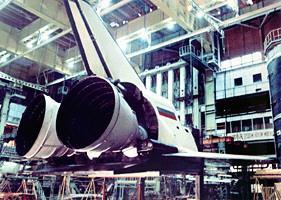 | MAKS mockup - aft - MAKS mockup - aft view of RD-701 engines Credit: Dr.Vadim P.Lukashevich. 19,249 bytes. 281 x 200 pixels. |