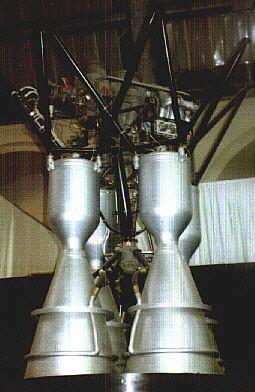
Credit: © Mark Wade. 46,098 bytes. 255 x 392 pixels.
| astronautix.com | RD-107-8D74 |
|
| RD-107 - Credit: © Mark Wade. 46,098 bytes. 255 x 392 pixels. |
Glushko decided that an ICBM using German ideas was impossible. He had developed the RD-110 with a cylindrical burner but it suffered combustion instabilities, the engine equivalent of flutter when breaking the sound barrier. Glushko returned to his experiments from the 30's with cylindrical burners - combining his ideas with German ones. He used slots for cooling the nozzle for example. The RD-106 was the result and it made the R-7 possible. The R-7 rocket had an RD-107 on the first stage strap-ons and an RD-108 on the second stage core. After 120 seconds the strap-on rockets fell off into the desert and 2.5 minutes later the second stage separated. The RD-108 had one turbo-pump but 4 combustion chambers. It made it possible to quickly prove the design of a single engine and then move to four. A single gas generator used the decomposition of H2O2. The hot gas spun up the turbine and was vented. The turbines turned the kerosene and oxygen turbo-pumps. Kerosene was used to cool the engine nozzles and then passed to the mixing head. Igniters were used because the propellants weren�t hypergolic. Vernier rockets were used for flight control. It took one week and 300 people to prepare a Soyuz rocket for launch. A unique feature you wouldn�t find today was a rotating handle on the engine where a soldier and a supervisor would prevent the pump seals freezing during the start of fuelling. It was automatically closed later. There were 9 modifications to the rocket for Progress, Soyuz, etc. The R-7 became the the mass production record holder with more than 1,700 flights of its family. This means 1,700 x 5 engines x 4 chambers per engine, plus ground test models. OKB Glushko. Used on 8K71 R-7 Stage 0. Developed in 1954-1955. Propellants kerosene (RG-1) / Lox. Diameter is per chamber.
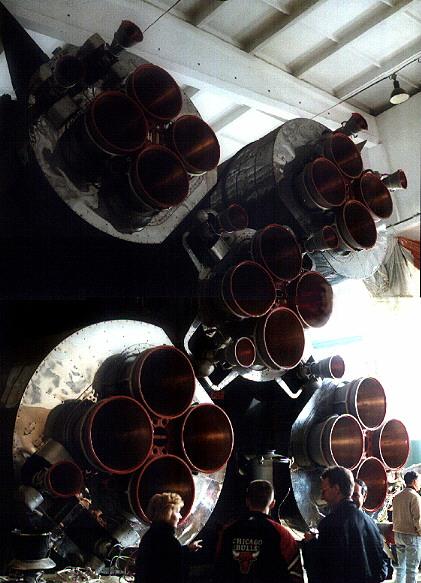 | R-7 aft end Credit: © Mark Wade. 47,694 bytes. 421 x 583 pixels. |