| astronautix.com | 1MV |
| Spacecraft: Mars 1M. Mars probe intended to photograph Mars on a flyby trajectory. The Mars probe had a mass of about 640 kg and carried a magnetometer, cosmic ray counter, plasma-ion trap, and micrometeorite detector. |
![]() | Spacecraft: Venera 1VA. The 1VA probe, the first spacecraft sent towards Venus, consisted of a cylindrical body topped by a dome, totaling 2 meters in height. Two solar panels extended radially from the cylinder. A large (over 2 meter diameter) high-gain net antenna was used to receive signals from the ground. This antenna was attached to the cylinder. A long antenna arm was used to transmit signals to Earth. The probe was equipped with scientific instruments including a magnetometer attached to the end of a 2 meter boom, ion traps, micrometeorite detectors, and cosmic radiation counters. The dome contained a pressurized sphere which carried a Soviet pennant and was designed to float on the putative Venus oceans after the intended Venus impact. Venera 1 had no on-board propulsion systems. Temperature control was achieved with thermal shutters. |
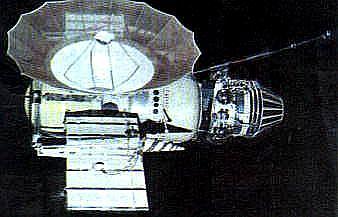
![]() | Spacecraft: Venera 1V (V-67). Venus probe with the announced mission of direct atmospheric studies. The descent vehicle carried two thermometers, a barometer, a radio altimeter, an atmospheric density gauge, 11 gas analyzers, and two radio transmitters operating in the DM waveband. The main bus, which carried the capsule to Venus, had a magnetometer, cosmic ray detectors, hydrogen and oxygen indicators, and charged particle traps. Signals were returned by the spacecraft, which braked and then deployed a parachute system after entering the Venusian atmosphere, until it reached an altitude of 24.96 km. |