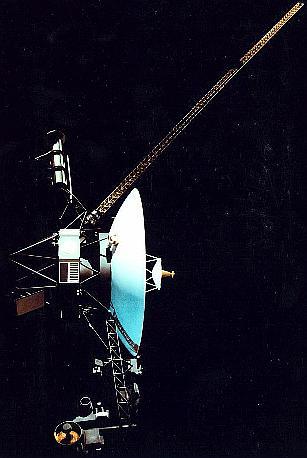
Credit: NASA. 22,031 bytes. 307 x 458 pixels.
| astronautix.com | Voyager |
|
| Voyager - Credit: NASA. 22,031 bytes. 307 x 458 pixels. |
The twin Voyager spacecraft were designed to perform close-up observations of the atmospheres, magnetospheres, rings, and satellites of Jupiter and Saturn. The mission was originally designed to make a "Grand Tour" of all five outer planets, but was descoped due to funding limitations. However, following its planned encounter with Saturn, Voyager 2's planetary mission was extended, and it was placed on a trajectory to allow flybys of Uranus and Neptune. Additional planetary flybys for Voyager 1 were sacrificed to permit better science observations at Saturn. Between them, Voyager 1 and 2 made numerous discoveries, including the discovery of new moons about several of the planets, Uranus' unique magnetic field, and the presence of volcanic activity on Io. Following their final planetary encounters, the vehicles began the Voyager Interstellar Mission (VIM), which will measure interstellar fields, particles, and waves to the outer limits of the Sun's sphere of influence, and possibly beyond. Both spacecraft will eventually depart our solar system and will travel towards other star systems. Each vehicle carries a gold phonograph record called "Sounds of Earth", bearing messages, sounds, and pictures from our planet as greetings to any species who recovers the spacecraft. The cost of the Voyager 1 and 2 missions, including the spacecraft development, launch, and mission operations through the Neptune encounter, is $865 million. An additional $30 million was provided to fund the VIM for two years following the Neptune encounter. Jupiter flyby 7/9/79, Saturn flyby 8/26/81, Uranus flyby 1/24/86, Neptune flyby 8/25/89. Solar system escape trajectory.
Spacecraft: 3-axis stabilised to within 0.1 deg. using hydrazine thrusters, star tracker, sun sensors, IRU.10-sided bus mounted beneath 3.7 m high gain antenna houses most electronics.3 RTGs produced 475 W at launch. X-band (4.8 to 21.6 kbps), S-band (40 bps) downlink to Deep Space Network. LGA for use during emergencies. Digital tape recorder stores 500 Mbits.13 m magnetometer boom. Remote sensing instruments mounted on 2 DOF pointing platform. Payload: Imaging Science Subsystem (ISS) - two cameras for visible wavelength imaging. "Wide angle camera" has 200 mm focal length, 60 mm aperture; "Narrow angle camera" has 1500 mm focal length with 176 mm aperture. Both cameras equipped with 8 filters. Photopolarimeter Subsystem (PPS) - used to measure surface textures and compositions by detecting how light changes when reflected off of a surface. Infrared Interferometer Spectrometer and Radiometer (IRIS) - used to measure surface temperatures, elemental composition of atmospheres and solid bodies, and the IR, visible, and UV energy reflected from solid bodies. Ultraviolet Spectrometer (UVS) - used to measure atmospheric elemental compositions and identify the presence of certain physical processes. Radio Science Subsystem (RSS) - uses the spacecraft telemetry system to measure atmospheric densities, temperatures, and pressures, as well as to estimate the width, shape, and thickness of planetary rings. Planetary Radio Astronomy (PRA) - measures RF signals emitted by the Sun and planetary systems. Plasma Wave Subsystem (PWS) - similar to the PRA, but works at different frequencies. Magnetometer (MAG) - measures solar and planetary magnetic fields. Plasma Subsystem (PLS), Low Energy Charged Particle (LECP), Cosmic Ray Subsystem (CRS) (PPS) - three independent instruments that are used to detect charged particles in different energy ranges.
Maximum Diameter: 3.7 m. Total Mass: 800 kg.
Jupiter flyby 7/9/79, Saturn flyby 8/26/81, Uranus flyby 1/24/86, Neptune flyby 8/25/89. Solar system escape trajectory. Spacecraft engaged in research and exploration of the upper atmosphere or outer space (US Cat B).
Jupiter flyby 3/5/79, Saturn flyby 11/12/80. Solar system escape trajectory. Spacecraft engaged in research and exploration of the upper atmosphere or outer space (US Cat B).