Credit: NASA. 21,219 bytes. 208 x 375 pixels.
| astronautix.com | Tiros N |
|
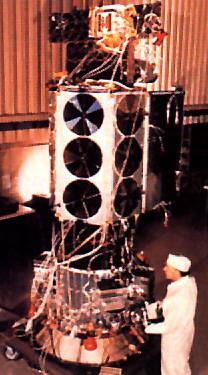
| Tiros-N - Credit: NASA. 21,219 bytes. 208 x 375 pixels. |
NOAA is part of the ongoing US series of polar-orbiting weather satellites. These were preceded by the TIROS series and the ITOS (Improved TIROS) series. These satellites make measurements of atmospheric temperature and humidity, surface temperature, cloud cover, water-ice-moisture boundaries, and space proton and electron fluxes. They can receive, process, and retransmit data from free-floating balloons, buoys, and remote automatic stations around the globe. These satellites are managed by NOAA (National Oceanic and Atmospheric Administration) and NASA is responsible for developing and launching the spacecraft. The NOAA spacecraft use a letter designator (NOAA G) before launch, when it receives a numeric designator. TIROS-N through NOAA-D are called the TIROS-N series. NOAA-E through NOAA-N are called the TIROS ATN series (Advanced TIROS N). NOAA-D was launched out of sequence and later became NOAA 12. (NOAA 11 shown in photo)Spacecraft: TIROS-N Spacecraft: 3-axis stabilised, nadir pointing with control to 0.1 deg using reaction wheels. The TIROS-N series incorporated significant design heritage from DMSP. Hydrazine propulsion system for orbit maintenance. Single solar panel generates over 1 kW (EOL). NiCd batteries provide power during eclipse. Structure is an elongated 5-sided box constructed of aluminum and titanium. S-Band communications. NOAA/NESDIS ground stations are located in Redwood City, CA, Wallops, VA, and Fairbanks, AK. Payload: AVCS (Advanced Vidicon Camera System). APT (Automatic Picture Transmission system). FPR (Flat Plate Radiometer). SPM (Solar Proton Monitor). VTPR (Vertical Temperature Profile Radiometer). VHRR (Very High Resolution Radiometer). AVHRR (Advanced Very High Resolution Radiometer). ASS (Atmospheric Sounding System). SEM (Space Environment Monitor). TOVS (TIROS Operational Vertical Sounder). TIP (TIROS Information Processor). MIR (Manipulated Information Rate processor). CSU (Cross-Strap Unit).
Design Life: 2 years. Total Length: 3.7 m. Maximum Diameter: 1.9 m. Total Mass: 1,416 kg.
Spacecraft engaged in practical applications and uses of space technology such as weather or communication (US Cat C).
Spacecraft engaged in practical applications and uses of space technology such as weather or communication (US Cat C).
Unusable orbit; would have been NOAA 7. Spacecraft engaged in practical applications and uses of space technology such as weather or communication (US Cat C).
Spacecraft engaged in practical applications and uses of space technology such as weather or communication (US Cat C).
Spacecraft engaged in research and exploration of the upper atmosphere or outer space (US Cat B).