 |
| STS-31 STS-31 Mission Specialist (MS) Sullivan dons EMU in OV-103's airlock Credit: NASA. 48,221 bytes. 608 x 442 pixels. |
| astronautix.com | Shuttle EMU |
|
| STS-31 STS-31 Mission Specialist (MS) Sullivan dons EMU in OV-103's airlock Credit: NASA. 48,221 bytes. 608 x 442 pixels. |
The Space Shuttle Extravehicular Mobility Unit (EMU) was a reusable space suit. For a particular crew member and mission it would be tailored from a stock of standard-size parts. Many variants were fabricated over the years. The suit was certified for eight EVA's, and its modular design allowed it to fit 90% of the male/female population. It featured an integrated hard torso with a portable life support system, RF sealed bladder, fabric mobility joint elements, waist bearing, and improved pressure gloves.
The EMU was designed only for the zero-G EVA function and utilized the upper body for mobility. It was not designed to provide a backup in case of loss of cabin pressure or protection on bailout. It was also not appropriate for surface operations on the Moon or Mars. The bulky Shuttle EMU consisted of 14 layers. The first was a liner of Nylon tricot over which was a layer of spandex fabric laced with plastic tubing. These made up a liquid-cooling-and-ventilation garment. Next was a bladder and restraint layer with a pressure bladder of urethane-coated nylon and fabric layer of pressure-restraining Dacron. Above this was a liner of Neoprene coated Nylon Ripstop. This was followed by a seven-layer thermal micrometeoroid garment of aluminized Mylar, laminated with Dacron scrim. The outer layer of the suit was made of Ortho-Fabric which consisted of a blend of Gortex, Kevlar, and Nomex. The Shuttle EMU suit weighed 50 kg and its PLSS Portable Life Support System, 15 kg. It provided life support for up to nine hours.
The Shuttle Space Suit Assembly
0n July 20, 1969, as the world watched in awe when Neil Armstrong made his "One Small Step For A Man" onto the lunar surface, a small engineering company located in Dover, Delaware was beaming with pride. That company was ILC Dover, and the pride felt at ILC was surely justified; they designed and manufactured the space suit astronaut Armstrong wore while making American history on the moon. That same pride was sustained throughout all fifteen Skylab and Apollo/Soyuz Test Project (ASTP) mission, during which ILC produced space suits performed flawlessly. It is of little wonder then, that in 1977 ILC Dover, as part of the Hamilton Standard team, was selected by NASA as Space Suit Assembly (SSA) contractor for the Space Shuttle program.
The MC Shuttle space suit is a pressure retention structure that, together with a life support system provides a life-sustaining environment, which protects the astronaut against the hazards of space. Such hazards include a vacuum environment, temperature extremes of -180 to +277 degrees Fahrenheit, and the impact of micrometeoroids and orbital debris. Unlike the space suits used in the Apollo or Skylab Programs, where the entire suit was custom manufactured for a specific astronaut, the Shuttle suit is comprised of separate components which can be assembled to make space suits to fit almost anyone (male & female). Several sizes of each component are manufactured and placed on the shelf for future use. When needed, the components are selected from the shelf (depending on the astronaut's size) and assembled into a complete space suit. The SSA and the Life Support System (LSS), when combined, become the Extravehicular Mobility Unit, or EMU. The EMU is used for all Shuttle program extravehicular space activities. The SSA is designed and has been tested for an eight-year operational life. The design permits low torque body movements required for performance of tasks in space.
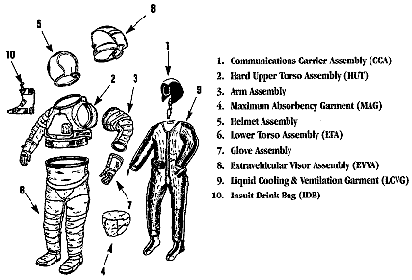 | Diagram of Shuttle E Credit: ILC Dover. 8,860 bytes. 412 x 280 pixels. |
The tube becomes very stiff and is difficult to twist or bend. Without these joints it would be virtually impossible for the astronaut to do useful work. These special joints are located at the knees, wrists, shoulders, elbows, ankles, thighs and waist of the SSA. Normal body movements by the astronaut cause the suit joints to bend. This flexibility permits the astronaut to conserve energy, reduce fatigue and to work for long periods of time.
A typical cross-section of the SSA is 11 layers deep, consisting of the liquid Cooling & Ventilation Garment (LCVG) (2 layers); pressure garment (2 layers); and the Thermal Micrometeoroid Garment (TMG) (7 layers). Simply stated, the LCVG maintains astronaut comfort, the pressure garment provides containment of the breathing air, and the TMG protects against the micrometeoroids which hit the suit, and insulates the astronaut from the extreme temperatures of space.
Communications Carrier Assembly (CCA)
The Communications Carrier is a skull cap that interfaces with the Electrical Harness Assembly. It contains a microphone and earphones for voice communications. The skull cap is made of teflon and nylon/lycra fabrics.
Hard Upper Torso Assembly (HIT)
The Hard Upper Torso is a vest-like rigid fiberglass shell which incorporates provisions for Arm, LTA and Helmet attachment. A Water Line and Vent Tube Assembly is fastened to the shell interior and interfaces with he LCVG and the Life Support System (LSS). The main portion of the LSS, containing water and oxygen storage and circulation provisions, mounts on the back of the HUT, while the LSS controls mount on the front within easy reach of the astronaut.
Arm Assembly
The Arm interfaces with the HUT by a ring that retains the Arm Scye Bearing in the HUT opening. The upper and lower arm joints are separated by an arm bearing, which allows lower arm rotation, the lower arm also provides for sizing adjustments and for quick connect/disconnect of the glove via a wrist disconnect. Maximum Absorbency Garment (MAG) . The Maximum Absorbency Garment is worn under the LCVG and provides for hygienic collection, storage, and eventual transfer of astronaut urine and feces discharged during extravehicular activities.
Helmet Assembly
The Helmet Assembly consists of a transparent Shell, Neck Ring, Vent Pad, Purge Valve, and an adjustable Valsalva device. The Helmet is secured to the HUT and provides an unobstructed field of vision. Optical clarity of the transparent shell is made possible by the use of rugged, impact resistant polycarbonate material. A vent assembly, bonded to the inside rear of the polycarbonate shell, serves to diffuse the incoming gas over the astronaut's face.
Lower Torso Assembly
The Lower Torso Assembly consists of an integrated Body Seal Closure, Waist, Waist Bearing, Leg, Thigh, Knee and Ankle joints, plus Boots. The LTA encloses the lower body and interfaces with the HUT via the body seal closure. The flexible waist section and waist bearing afford the astronaut a large degree of movement about the waist, e.g. bending and hip rotation.
Glove Assembly
The Glove is made up of a restraint and bladder encased in a TMG. The gloves protect the astronaut's wrists and hands and are attached to the arms at the wrist disconnects. The gloves incorporate a rotary bearing to allow wrist rotation, a wrist joint to provide flexion/extension, fabric joints for thumbs and fingers, plus a hot pad for protection of the hand from extreme hot and cold extravehicular conditions. The glove includes fingertip heaters that are controlled by the astronaut.
 | STS-31 - STS-31 MS Sullivan wearing EMU prepares for contingency EVA in OV-103 airlock Credit: NASA. 52,576 bytes. 624 x 439 pixels. |
The Extravehicular Visor Assembly is a light-and-heat-attenuating shell which fits over the Helmet Assembly. It is designed to provide protection against micrometeoroid activity and accidental impact damage, plus protect the crewmember from solar radiation. A special coating gives the sun visor optical characteristics similar to those of a two-way mirror; it reflects solar heat and light, yet permits the astronaut to see. Adjustable eyeshades may be pulled down over the visor to provide further protection against sunlight and glare.
Liquid Cooling & Ventilation Garment (LCVG)
The liquid Cooling & Ventilation Garment is a close-fitting undergarment covering the body torso and limbs. It incorporates a network of fine tubing that is maintained in close contact with the astronaut's skin by an outer layer of stretchable open fabric. The space suit is so well insulated that normal body heat maintains warmth, except for occasional cold hands, even on the cold, dark side of the spacecraft. However, cooling is required, therefore, water is circulated through the LCVG tubing to remove excess body heat. Water flows through the various inlet and return tubes and must be uninterrupted in order for the garment to be effective. The LCVG also uses ventilation ducting to return vent flow from the body extremities to the EMU Life Support System (LSS).
Insuit Drink Bag (IDB)
The IDB is a sealed bag that comes in two sizes, holding 21 oz. and 32 oz. of potable (drinking) water. The bag is secured by velcro to the inside front of the HUT. Water is readily accessible to the astronaut through a mouthpiece located at the top of the bag.
Since 1947, ILC has been active in the development of products for both government and industry. Then as today, most A C products are comprised of softgoods materials - our primary area of expertise. Today, ILC's products fall into six primary groups:
Astronauts of the space shuttle era have more than one wardrobe for space flight and what they wear depends on the job they are doing. During ascent and entry, each crewmember wears special equipment consisting of a partial pressure suit, a parachute harness assembly, and a parachute pack. The suit, consisting of helmet, communication assembly, torso, gloves and boots, provides counter-pressure and anti-exposure functions in an emergency situation in which the crew must parachute from the orbiter, The suit has inflatable bladders that fill it with oxygen from the orbiter. These bladders inflate automatically at reduced cabin pressure. They also can be manually inflated during entry to prevent the crewmember from blacking out. Without the suit pressing on the abdomen and the legs, the blood would pool in the lower part of the body and cause a person to black out as the spacecraft returns from microgravity to Earth's gravity. The partial-pressure suit and equipment will support a crewmember for a 24-hour period in a life raft in case of an egress over water.
Working Inside the Space Shuttle
During orbit, astronauts work inside the space shuttle in shirtsleeve comfort. Prior to a mission, crew members are outfitted from a selection of clothing including flight suits, trousers, lined zipper jackets, knit shirts, sleep shorts, soft slippers, and underwear. The materials of every component of the clothing are flame retardant. Covering the exterior of the garments are closable pockets for storing such items as pens, pencils, data books, sunglasses, a multipurpose Swiss army pocket-knife, and scissors.
Working Outside the Space Shuttle
To work in the open cargo bay of the space shuttle or in space, astronauts wear the shuttle extravehicular mobility unit (EMU) spacesuit, which was developed to be More durable and more flexible than previous spacesuits were. The suit is modular in design, with many interchangeable parts. The upper torso, lower torso, arms, and gloves are manufactured in different sizes and can be assembled for each mission in combinations needed to fit men and women astronauts. This design is cost-effective because the suits are reusable and not custom fitted as were spacesuits used in previous NASA manned space flight programs.
Suiting up
The EMU comprises the spacesuit assembly, the primary life support system (PLSS), the display and control module, and several other crew items designed for spacewalks and emergency life support. The EMU accommodates a variety of interchangeable systems that interconnect easily and securely in single-handed operation for either normal or emergency use. When preparing to work in space, the astronaut goes into the airlock of the space shuttle orbiter and puts on the following parts of the EMU:
All fabric-to- hardware connections are made with either mechanical joints or adhesive bonding. Materials used in the construction of the suit are selected to prevent fungus or bacteria growth; however, the suit Must be cleaned and dried after flight use. The entire suit assembly is rated with a minimum 8-year life expectancy. The nominal operating atmospheric pressure in the suit is 4.3 psid. The suit comprises several layers including a polyurethane-coated nylon pressure bladder, a polyester structural restraint layer with folded and pleated joints (for mobility), and a woven Kevlar, Teflon, and Dacron anti-abrasion outer layer.
The maximum total weight of the largest size spacesuit assembly, including the liquid cooling and ventilation garment, urine collection device, helmet and visor assembly, communications carrier assembly, in-suit drink bag, and biomedical instrumentation subsystem, is 107 pounds,
The astronaut is ready to go to work in space and secures the necessary tools to the mini-workstation of the suit. The EMU lights are mounted on the helmet and are a necessity because during orbital operations approximately every other 45 minutes are spent in darkness.
Communications
An electrical harness inside the suit connects the communications carrier assembly and the biomedical instrumentation equipment to the hard upper torso where internal connections are routed to the extravehicular communicator by means of a pass-through.
The extravehicular communicator attaches to the upper portion of the life support system at the back of the hard upper torso, The controls are located on the display and control module mounted on the chest at the front of the upper torso. The extravehicular communicator provides radio communication between the suited crewmember and the orbiter. In addition, electrocardiographic (EKG) information is telemetered through the extravehicular communicator to the orbiter and to flight surgeons in the Mission Control Center at Houston, Texas.
The radios for spacewalk communications have two single UHF channel transmitters, three single channel receivers, and a switching mechanism. These backpack radios have a "low profile" antenna - a foot-long rectangular block fitted to the top of the PLSS. The radios weigh 8.7 pounds and are 12 inches long, 4.3 inches high, and 3.5 inches wide.
Primary life support system The PLSS consists of a backpack unit permanently mounted to the hard upper torso of the suit and a Control-and-display unit mounted on the suit chest. The backpack unit supplies oxygen for breathing, suit pressurization, and ventilation. The unit also cools and circulates water used in the liquid cooling ventilation garment, controls ventilation gas temperature, absorbs carbon dioxide, and removes odors from the suit atmosphere. The secondary oxygen pack attaches to the bottom of the PLSS and supplies oxygen if the primary oxygen fails. The control-and-display unit allows the crewmember to control and monitor the PLSS, the secondary oxygen pack, and, when attached, the manned maneuvering unit.
Total Mass: 65 kg.