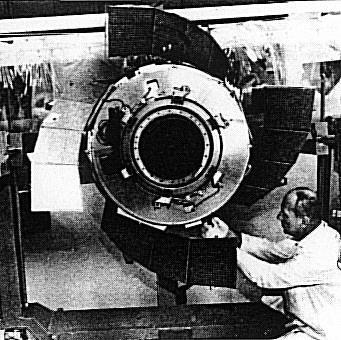
Credit: NASA. 36,207 bytes. 341 x 340 pixels.
| astronautix.com | RAE |
|
| RAE - Credit: NASA. 36,207 bytes. 341 x 340 pixels. |
The Radio Astronomy Explorer investigated low frequency (long wave-length) radio emissions from the sun and its planets as well as galactic and extragalactic sources. The spacecraft had a mass of about 190 kg. It was equipped with a dipole antenna (36 m from tip to tip) and two V-shaped antennas. These antennas consist of four 230 m long elements which form a large "X" with the spacecraft in the centre. The V-shaped antennas provided gravity gradient stabilisation. The RAE program, as planned, called for a series of four spacecraft with the first scheduled for launch in early 1968. Two missions (RAE-A and B) were approved and payloads for them were selected. Missions RAE-C, and D were not approved. RAE-A and B were intended for a circular orbit with an altitude of 5800 km. Inclination of the orbit to the equator was 58 degrees retrograde and the orbital period was 3.83 hours.
Total Mass: 190 kg.
Radio Astronomy Explorer; Earth, solar, cosmic radio emission data. Spacecraft engaged in research and exploration of the upper atmosphere or outer space (US Cat B).
Radio Astronomy Explorer; measured galactic, stellar radio noise. Lunar Orbit (Selenocentric). Spacecraft engaged in research and exploration of the upper atmosphere or outer space (US Cat B).