|
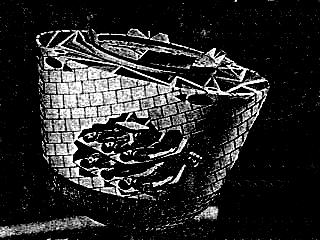
| NASA ACRV - NASA Assured Crew Return Vehicle. Credit: NASA via Marcus Lindroos. 27,847 bytes. 320 x 256 pixels. |
|
Nation: USA. Agency: NASA. The early Space Station proposals assumed the facility would be equipped with a 'safe haven' where the crew would wait for a rescue Shuttle in case of emergency. After the 1986 Space Shuttle Challenger accident, it became obvious that some sort of 'lifeboat' would have to be added....
NASA's Johnson Space Center began examining the alternatives, including refurbishing old unused Apollo lunar capsules from the 1960s! The cheapest options examined included:
- The $600-million 'Station Crew Return Alternative Module' (SCRAM) would have consisted of a heat shield from the Viking Mars probe and a cylindrical 6-man capsule. It would however have produced high G-loads on the crew.
- An alternate configuration would have been derived from the old US Air Force 'Discoverer' recovery capsule. The crew return vehicle version would have been scaled up to accommodate a full Space Station crew of eight astronauts. In 1986 General Electric and NIS Space Ltd. proposed a commercially developed series of such capsules, for unmanned microgravity research as well as Space Station crew rescue.
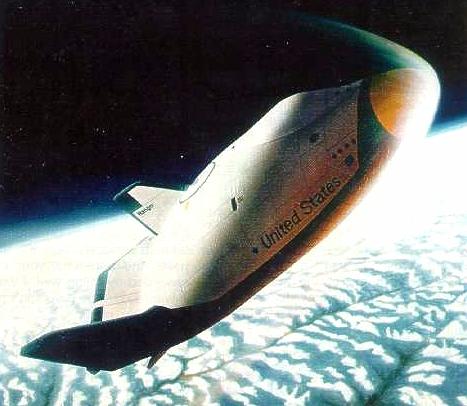
- The HL-20 Crew Rescue Vehicle was the 'luxury' crew rescue vehicle option. Langley Research Center's $2-billion HL-20 was loosely based on a Soviet spaceplane design. It could carry a crew of eight and might even double as a 'Personnel Launch System' mini-shuttle if launched on a Titan IV rocket. Its lifting body design would have provided superior manoeuvrability for safe return from orbit. However, Congress balked at the price and cancelled all funding in 1990.
- The X-38 Crew Rescue Vehicle was the solution selected after Congress effectively cancelled the HL-20. NASA had briefly examined using the French 'Herm�s' mini-shuttle and off-the-shelf Russian Soyuz capsules as the Space Station's lifeboat before finally settling for the in-house 'cheaperfasterbetter' X-38 design. This vehicle is based on the old X-23/X-24A lifting body which was extensively tested in the 1960s. The total cost was estimated to be approximately $1 billion. The X-38 was designed to return all six International Space Station astronauts to Earth in an emergency. NASA was also hoping that the European Space Agency would develop an X-38 Crew Transfer Vehicle version that could be launched on the Ariane-5 rocket. In March 1998, the total expected program cost to the first re-entry test from orbit was $280 million, plus $150 million for a Shuttle launch. Production of four operational CRVs plus a fifth for ground training would cost $500 million. The 8.7m long vehicle was to weigh 9,072 kg and have an in-orbit lifetime of five years. Perhaps the biggest challenge was the giant landing parafoil which was to provide a pinpoint vertical landing capability. The first landing tests were carried out in 1998-99 and the vehicle was to be fully operational in 2003..