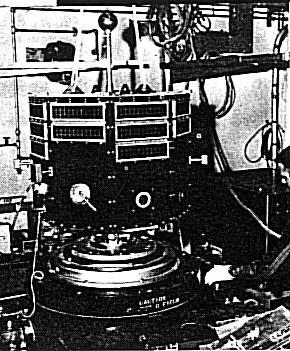
Credit: NASA. 37,510 bytes. 290 x 351 pixels.
| astronautix.com | DME |
|
| DME - Credit: NASA. 37,510 bytes. 290 x 351 pixels. |
The Explorer 31, Direct Measurement Explorer, was launched with a Canadian Alouette II on November 28, 1965, on a Thor-Agena rocket from Vandenberg Air Force Base, California. The double-launch project, known as ISIS-X was the first in a new co-operative NASA-Canadian Defense Research Board program for International Satellites for Ionospheric Studies. Explorer 31 was in orbit with an apogee just over a kilometre more than Alouette's and with a perigee of just more than a kilometre lower. The orbits were some 3000 km at apogee and 500 km at perigee. Explorer 31 was built for the NASA Goddard Space Flight Center, Greenbelt, Maryland, by the Applied Physics Laboratory of The Johns Hopkins University. Eight ionospheric measurement experiments sampled the environment both forward and after the satellite's path. Explorer 31 was 0.76 m across the top and was 25 inches high. A spherical mass spectrometer protruded 0.58 m above the top surface, making the total height 0.64 m. The satellite was powered by solar cells which covered about 15 percent of the spacecraft's surface.
Total Mass: 99 kg.
Ionospheric research; data correlated with Alouette 2. The Explorer 31, Direct Measurement Explorer, was launched with a Canadian Alouette II on November 28, 1965, on a Thor-Agena rocket from Vandenberg Air Force Base, California. The double-launch project, known as ISIS-X was the first in a new co-operative NASA-Canadian Defense Research Board program for International Satellites for Ionospheric Studies. Explorer 31 was in orbit with an apogee just over a kilometre more than Alouette's and with a perigee of just more than a kilometre lower. The orbits were some 3000 km at apogee and 500 km at perigee. Eight ionospheric measurement experiments sampled the environment both forward and after the satellite's path.