 |
| DLB Module Deployed View of the DLB Soviet lunar base modules as they would appear deployed on the lunar surface. 11,895 bytes. 619 x 135 pixels. |
| astronautix.com | DLB Module |
|
| DLB Module Deployed View of the DLB Soviet lunar base modules as they would appear deployed on the lunar surface. 11,895 bytes. 619 x 135 pixels. |
The N1 draft project of 1962 spoke of 'establishment of a lunar base and regular traffic between the earth and the moon'. Korolev raised the matter informally at tea with Chief Designer of rocket complexes Vladimir Pavlovich Barmin, head of GSKB SpetsMash (State Union Design Bureau of Special Machine-Building). Barmin was interested in pursuing the subject, but how could such a base be placed on the moon. 'You just design the base', Korolev assured him, 'and I'll figure out how to get it there'. The project was known to SpetsMash as the 'Long-term Lunar Base' (DLB) and to OKB-1 as 'Zvezda'. Consideration was given to using the same elements in expeditions to other planets. Under the DLB studies SpetsMash defined purposes of the base, the principles of its construction, phases of its deployment and composition of its scientific and support equipment. The enthusiasts that worked on the project at Zvezda were naturally known as 'lunatics'.
 | DLB Stow/Unstowed - View of DLB Soviet lunar base modules as they would appear in short transport configuration and in inflated, telescoped deployed configuration. 14,830 bytes. 597 x 157 pixels. |
Ambitious articulated mobile nuclear-powered Lunokhod laboratories would take the cosmonauts from the landing sites on long-duration traverses of the lunar surface. The Lunokhods were equipped with core samplers and manipulators so that the crew could conduct collection of surface samples from within the pressurised cab without the need to always exit the ship and conduct surface operations in space suits. One of the main objectives of the base would be the location and mining of Helium-3 for use in nuclear fusion reactors on earth. Rare on the earth, Helium-3 was abundant on the moon, having collected in the regolith from the solar wind.
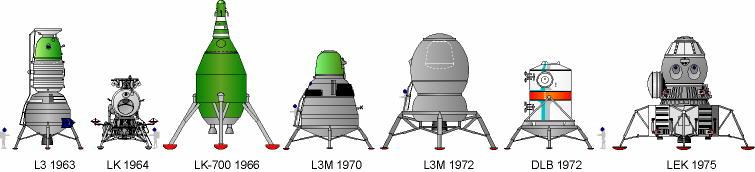 | Soviet Lunar Landers - Comparison of Soviet lunar lander designs. Only the LK reached the hardware stage. 23,098 bytes. 755 x 172 pixels. |
The nine modules would be pre-equipped in the factory for specialised functions: command module, laboratory/warehouse module, workshop module, midpoint module, medical/gymnasium module, galley module with dining room, and three living modules. A prototype of one of these modules was used in 1967 for a one-year closed-cycle living experiment at the IBMP (Institute for Bio-Medical Problems). Based on the results of this experiment it was planned that the units on the moon would have a false window, showing scenes of the Earth countryside that would change to correspond with the season back in Moscow. The exercise bicycle was equipped with a synchronised film projector, that allowed the cosmonaut to take a 'ride' out of Moscow with return. These psychological measures were felt important to maintain the crew's mental health.
 | Zvezda / DLB base - Zvezda / DLB long-tern lunar base Credit: Spetsmash. 14,792 bytes. 320 x 218 pixels. |
By 1971 the lunar city project was practically complete and Chief Designer Barmin arranged a meeting with Secretary Ustinov, head of all military and space rocketry. He brought along two of this 'lunatics', Aleksandr Yegorov and Vladimir Yeliseyev. The project was defended in a marathon meeting - nine presentations over six hours. At the conclusion, Ustinov agreed that the project should go ahead - but he couldn't decide, at the pace of a walk or the speed of a freight train. In the event, the point was moot. The N1 never successfully flew, and the rocket, and its associated projects, were cancelled in May 1974. In any case, the Soviet economy very likely could never have sustained the cost of the project - 80 billion dollars in 1997 prices.
 | Zvezda / DLB module - Basic module for Zvezda / DLB long-tern lunar base 10,212 bytes. 279 x 140 pixels. |
 | DLB Lunar Base - Models of Elements of Zvezda Lunar Base Credit: © Mark Wade. 59,585 bytes. 640 x 262 pixels. |
Craft.Crew Size: 9. Design Life: One year. Total Length: 8.6 m. Maximum Diameter: 3.3 m. Total Mass: 18,000 kg. Electrical System: Nuclear reactor.
The N1 draft project of 1962 spoke of 'establishment of a lunar base and regular traffic between the earth and the moon'. Korolev raised the matter informally at tea with Chief Designer of rocket complexes Vladimir Pavlovich Barmin, head of GSKB SpetsMash (State Union Design Bureau of Special Machine-Building). 'You just design the base', Korolev assured him, 'and I'll figure out how to get it there'. Under the DLB studies SpetsMash defined purposes of the base, the principles of its construction, phases of its deployment and composition of its scientific and support equipment. The enthusiasts that worked on the project at Zvezda were naturally known as 'lunatics'.
 | DLB Lunar Base - Models of Elements of Zvezda Lunar Base Credit: © Mark Wade. 24,363 bytes. 605 x 191 pixels. |