This page no longer updated from 31 October 2001. Latest version can be found at www.astronautix.com
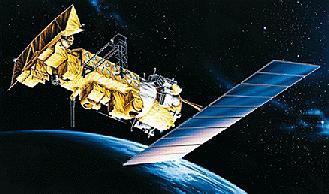 |
| Advanced Tiros N - Credit: Lockheed-Martin. 17,577 bytes. 329 x 194 pixels. |
|
Class: Earth. Type: Weather. Nation: USA. Agency: NOAA. Carried search and rescue package.
SpecificationTotal Mass: 3,775 kg.
Advanced Tiros N Chronology
28 March 1983
NOAA 8 Program: Tiros. Launch Site: Vandenberg . Launch Vehicle: Atlas E. Mass: 3,775 kg. Perigee: 793 km. Apogee: 817 km. Inclination: 98.6 deg. Carried search and rescue package. Spacecraft engaged in practical applications and uses of space technology such as weather or communication (US Cat C).
12 December 1984
NOAA 9 Program: Tiros. Launch Site: Vandenberg . Launch Vehicle: Atlas E. Mass: 1,712 kg. Perigee: 833 km. Apogee: 855 km. Inclination: 99.1 deg. Spacecraft engaged in practical applications and uses of space technology such as weather or communication (US Cat C).
17 September 1986
NOAA 10 Program: Tiros. Launch Site: Vandenberg . Launch Vehicle: Atlas E. Mass: 1,700 kg. Perigee: 795 km. Apogee: 816 km. Inclination: 98.5 deg. Spacecraft engaged in practical applications and uses of space technology such as weather or communication (US Cat C).
24 September 1988
NOAA 11 Program: Tiros. Launch Site: Vandenberg . Launch Vehicle: Atlas E. Mass: 1,712 kg. Perigee: 838 km. Apogee: 854 km. Inclination: 99.2 deg. Carried search & rescue package. Spacecraft engaged in practical applications and uses of space technology such as weather or communication (US Cat C).
09 August 1993
NOAA 13 Program: Tiros. Launch Site: Vandenberg . Launch Vehicle: Atlas E. Mass: 1,712 kg. Perigee: 845 km. Apogee: 861 km. Inclination: 98.9 deg.
Spacecraft engaged in practical applications and uses of space technology such as weather or communication (US Cat C).
30 December 1994
NOAA 14 Program: Tiros. Launch Site: Vandenberg . Launch Vehicle: Atlas E. Mass: 1,712 kg. Perigee: 847 km. Apogee: 861 km. Inclination: 98.9 deg.
13 May 1998
NOAA 15 Program: Tiros. Launch Site: Vandenberg . Launch Vehicle: Titan 2. Perigee: 807 km. Apogee: 824 km. Inclination: 98.7 deg. NOAA K carried a new microwave sensor in addition to the standard optical/near-infrared radiometers and imagers and the SARSAT search and rescue package. It was the first NOAA launch to use the Titan 23G launch vehicle, a refurbished ICBM. Titan 23G-12 placed NOAA K into a suborbital trajectory 6 minutes after launch. A Star 37XFP solid motor on the satellite fired at apogee to put NOAA K in orbit.
21 September 2000
NOAA 16 Launch Site: Vandenberg . Launch Vehicle: Titan 2. Mass: 1,476 kg. Perigee: 853 km. Apogee: 867 km. Inclination: 98.8 deg. The NOAA polar orbit weather satellite, an Advanced Tiros N with a suite of imaging and sounding instruments. The two-stage Titan II launch vehicle, serial 23G-13, put NOAA-L into a suborbital -2500 x 800 km x 98.0 deg trajectory. The spacecraft's Thiokol Star 37XFP solid motor fired at apogee to circularize the sun-synchronous orbit at 800 km.
Bibliography:- 2 - McDowell, Jonathan, The United Nations Registry of Space Objects, Harvard University, 1997. HTML when accessed: http://hea-www.harvard.edu/QEDT/jcm/space/un/un.html
- 6 - JPL Mission and Spacecraft Library, Jet Propulsion Laboratory, 1997. HTML when accessed: http://msl.jpl.nasa.gov/home.html
Back to Index
Last update 12 March 2001.
Contact Mark Wade with any corrections or comments.
Conditions for use of drawings, pictures, or other materials from this site..
© Mark Wade, 2001 .