| astronautix.com | Thomas |
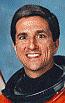
He is a private pilot with over 250 hours in single engine land aircraft and gliders, and over 600 hours flying as mission specialist in NASA T-38 jet aircraft.
Selected by NASA in January 1990, Dr. Thomas became an astronaut in July 1991. He has worked in the Safety and Operations Development Branches of the Astronaut Office working on issues relating to Shuttle Orbiter systems, and was also a spacecraft communicator (CAPCOM) for Shuttle missions STS-47, 52 and 53. A veteran of three space flights, he has logged 663 hours and 27 minutes in space. He was a mission specialist on STS-65 (July 8-23, 1994), STS-70 (July 13-22, 1995) and STS-83 (April 4-8, 1997). He is scheduled to fly aboard Columbia on STS-94 in the Summer of 1997.
STS-65 flew the second International Microgravity Laboratory (IML-2) Spacelab module. The seven-member crew aboard Space Shuttle Columbia launched from Kennedy Space Center in Florida on July 8, 1994, and returned there on July 23, 1994 setting a new flight duration record for the Space Shuttle program. During the 15-day flight the crew conducted more than 80 experiments focusing on materials and life sciences research in microgravity. The mission was accomplished in 236 orbits of the Earth, traveling 6.1 million miles.
On STS-70, Dr. Thomas was responsible for the deployment of the sixth and final Tracking and Data Relay Satellite from the Space Shuttle. The five-member crew aboard Space Shuttle Discovery launched from the Kennedy Space Center July 13, 1995, and returned there July 22, 1995. During the 8 day 22 hour mission, the crew completed 142 orbits of the Earth, traveling 3.7 million miles.
STS-83, the Microgravity Science Laboratory (MSL-1) Spacelab mission, was cut short because of problems with one of the Shuttle's three fuel cell power generation units. Mission duration was 95 hours and 12 minutes, traveling 1.5 million miles in 63 orbits of the Earth.
Carried IML-2; microgravity, biology experiments. Payloads: International Microgravity Laboratory (IML) 2, Orbital Acceleration Research Experiment (OARE), Commercial Protein Crystal Growth (CPCG), Air Force Maui Optical Site (AMOS), Military Applications of Ship Tracks (MAST), Shuttle Amateur Radio Experiment (SAREX).
Deployed TDRS 7. Payloads: Tracking and Data Relay Satellite (TDRS) G/ Inertial Upper Stage (IUS); Bioreactor Demon-stration System (BDS) B; Biological Research in Canisters (BRIC); Commercial Protein Crystal Growth (CPCG); Hand-Held, Earth-Oriented, Real-Time, Cooperative, User-Friendly, Location-Targeting and Environmental System (HER-CULES); Microcapsules in Space (MIS) B; Physiological and Anatomical Rodent Experiment (PARE)/National Institutes of Health (NIH) Rodents (R); Radiation Monitoring Experiment (RME) III; Shuttle Amateur Radio Experiment (SAREX) II; Space Tissue Loss (STL)/National Institutes of Health (NIH) Cells (C); Military Applications of Ship Tracks (MAST); Visual Function Tester (VFT) 4; Window Experiment (WINDEX).
The launch of STS-83, the first Microgravity Science Laboratory (MSL-1) mission, was postponed for a day to replace some insulation around a water coolant line in Columbia's payload bay. Liftoff was further delayed 20 minutes due to anomalous oxygen readings in the orbiter's payload bay. STS-83 was cut short due to a problem with one of the three fuel cells that provide electricity and water to Columbia (flight rules required that all three must be operating). At 14:30 GMT on April 6 the crew were ordered to begin a Minimum Duration Flight (MDF). On April 8 the OMS engines ignited at 17:30 GMT for the deorbit burn, and Columbia landed on Runway 33 at Kennedy Space Center at 18:33 GMT.
With delays in International Space Station construction leaving ample room in the shuttle schedule, NASA made the unique decision to leave the equipment installed in Columbia and refly this mission with the same crew later in 1997 as STS-94.
STS-94 was the reflight, with the same equipment and crew, of the curtailed STS-83 mission. Cargo Bay Payloads:
In-Cabin Payloads: SAREX, MSX
The mission this time went for its full two week duration and the crew completed the full list of experiments. The deorbit burn was on July 17, 1997 at 09:44 GMT and Columbia landed on KSC's Runway 33 at 10:46:34 GMT.